Category: Spirituality and philosophy


  • Hinduphobia: A sad attempt to tarnish a noble and universal doctrine.

    Hinduphobia: A sad attempt to tarnish a noble and universal doctrine.

    A few weeks ago, I was browsing the Darshana exhibit on Hinduism: https://hindudarshana.com. I was overwhelmed by the appreciation of the great humanistic view of the Hindu Dharma and the universally applicable philosophy it teaches to all humans regardless of their way of worship. I was glad that we were sharing this marvel with our fellow Americans through the avenue of the exhibition throughout the USA. Sadly, a few days after the exhibition, many of our esteemed public official guests who had graced the exhibition received letters from a group of miscreants spreading false information about Hindus, Hindu organizations, and Hinduism to besmirch the goodwill generated by the exhibition. I contemplated why somebody would engage in this behavior.

    I realized that the people who denigrate Hindus generally fall into five categories:

    1. The first category is the good-natured people who are misguided by the articles and news items in the mainstream media. Many respectable media houses selectively highlight unfortunate events in India. They rarely have stories of any positive stories about Hindus or India. These media sources will selectively splice stories to demonstrate how a Hindu group in India violently reacted to some provocation and will not talk about the inciting act itself. Historical wrongs like the destruction of the temple at Ayodhya (the birthplace of Lord Ram) will not be discussed. Instead, the reclamation of the ancient space will be addressed in a negative light (for review on this topic please read, https://pattekar.medium.com/the-epochal-beginning-of-the-restoration-of-one-of-the-holiest-sites-of-hindus-a-story-of-loss-3e2f19d70e5). Attacks on Hindus are never addressed in American news. Hindus are lumped as Indians or minorities described by their specific religions. The prime example of this phenomenon is the selective reporting about the riots in Gujarat in 2002. None of these stories mention that the riots were a reaction to the 58 Hindu pilgrims being burnt alive by a communal mob. Atrocities committed by minorities in India are never given airtime. No American media reported on the recent decapitation of a Hindu shopkeeper by a minority mob in India for expressing support for a Hindu politician. The only people interviewed for news items are those with a particular slant to support the media’s intentional preconceived bias. The Hindu genocide in Kashmir gets minimal airtime on media like NPR in contrast to the widespread negative coverage of the Indian government’s attempt to maintain the rule of law. The good-natured American people who read the articles believe them without understanding the background and the multifaceted premise.

    The onus for responding to these people falls entirely on the American Hindus. Hindus in their daily lives should interact with their neighbors and colleagues and take the initiative to explain any news about Hindus and India to friends and colleagues. Hindus should also be more represented in the media, a refrain voiced by many for a long time.

    2. The second category is the religious zealots who are frustrated by the resistance shown by Hindus to their attempt to convert them to their religion. These zealots spend millions of dollars and extensive effort to convert Hindus. They want to spread misinformation, disinformation, and mal information about Hinduism and Hindus to decrease the confidence their vulnerable Hindu targets have in their Hindu upbringing and philosophy. These missionaries also aim to increase the monetary donation collected from their supporters to “harvest the souls” of Hindus. Nice American people who will never hurt a fly in their own life will donate their hard-earned money to the missionaries with a misguided good intention of “pulling the Hindus out of the darkness of Hinduism”. When we hear our American friends or acquaintances say proudly that they’re going to India for missionary activities, please question them on why they want to practice the violence of breaking the Hindu society. To quote the great Hindu teacher Swami Dayanand Saraswati, “Conversion is an act of violence because it hurts deeply, not only the other members of the family of the converted but the entire community that comes to know of it”.

    I have seen extensive conversion activity targeted toward Hindu students in American Universities. These students are very emotionally vulnerable due to financial, psychological, and educational stress. The vulnerable young students are preyed upon by people to convert them to their religion. This psychospiritual genocide of Hindu University students can be counteracted by the Hindu American people living in University towns who should take an interest in the welfare of Hindu students. This can be done by socially engaging the existing students and new arrivals. The established Hindus should connect with Hindu student organizations at the universities, participate in cultural programs and invite student groups to their homes, temples, and social functions.

    3. The third category is people who themselves, their loved ones or their ancestors have been abused by the many bad people who have misinterpreted and misrepresented Hindu scriptures to discriminate and exploit their Hindu brethren for generations. These people have perverted the original ancient horizontal organizational system of classification of society. This system divided people into groups called varna based on an individual’s natural inclination as well into professional family guilds of jati. The system was corrupted into a vertically stratified caste system where the groups who were in power by their knowledge or physical/economic strength exploited and abused the people from the lower weaker strata. On one end of the spectrum, I have firsthand witnessed discrimination against people based on their caste during my student days in villages around my medical school. On the other end, I have also intimately experienced the noblest human beings of the ‘so-called upper castes’ who strived for uplifting people from the lowest social groups. I am a product of a mixed jati parentage myself. Discrimination based on jati and varna is illegal in India since the establishment of the Republic of India, in the year 1950, although in certain quarters of Hindus, this behavior unfortunately persists.

    Every Hindu especially those in the privileged groups should take it upon themselves to integrate the people of marginalized communities into their social circles. This has to be done on an individual basis. In terms of America, this means keeping your eyes open and figuring out who among your colleagues and neighbors are from the community which has been historically mistreated by the socially advantaged Hindus in India and taking it upon themselves to form friendships and includes them in the religious rituals and by just be a true Hindu.

    4. The fourth category is the academics who have made a career by calling themselves experts on Hinduism by selectively highlighting adverse societal phenomena and interpreting every possible Hindu principle to twist it into its worse possible interpretation. These are highly intelligent malevolent individuals who willfully ignore the true universally benevolent nature of Hindu Dharma. These people can only be counteracted by Hindus entering the liberal arts fields of study. Unfortunately, in America, most Hindus are in STEM careers. If more American Hindus including non-Hindu Americans, with a true understanding of Hinduism, enter the academic world and present the Hindu principles, these rabid wolves in sheep’s clothing will be exposed.

    5. Lastly, falling into the fifth category are those Hindus who believe that since they have achieved fame in one field like acting, modeling, or business, they have an acquired qualification to make ignorant baseless blanket statements about Hinduism. These people usually parrot whatever their friends want to hear and cause grave damage since many young Hindus value their opinion, which is circulated on popular social media. The only way to neutralize these people is to immediately repudiate their statements on the same media platform by a large number of true scholars.

    based on an individual’s natural inclination as well into professional family guilds of there may be many more categories in which I believe the readers would come up with their observations. I implore you my friends, to please not be a passive witness but be proactive and if needed, reactive to this onslaught on Hinduism. Please make sure that the beautiful treasure trove of universal principles is shared with humanity and not relegated to some musty corner of obscurity.
  • Basic Philosophy of Hindus

    Basic Philosophy of Hindus

    In our daily life, many of us interact with a Hindu in one way or another. Either your doctor, a coworker, a classmate, a close friend, a neighbor, a teacher, a business owner, or even a spouse. Some of us have witnessed a caricature of a Hindu in a TV serial or a cartoon. If you have ever wondered what the Hindu faith is, or you are curious to know more about your fellow Hindu Americans, there is a golden opportunity close to you.

    We all want to be happy. All our endeavors are in that direction. We seek material goods, pleasant experiences, power over others, suitable mates, and many other things which give us fleeting moments of happiness. But is it possible to have everlasting happiness? The ancient Hindu sages meditated on this question and came to this answer. Yes, it is possible. We can be permanently happy by discovering our true divine nature. How do we do that?

    Hindus believe that the entire creation is made of pure consciousness. Our true nature is pure consciousness. Unfortunately, we have forgotten our true nature. The entire purpose of Hinduism is to get back to our original selves and be permanently happy in our divine state.

    The first step is to base our life on an ethical foundation which is called Dharma. To live ethically, there are a few qualities that are described in the Hindu scriptures. The main ones are Ahimsa, which is non-injury, Satya which is truth, and Brahmacharya which is a disciplined life of nonindulgence. These are not commandments but are nuanced guidelines. The guidelines are context-based. Our Dharma depends on our social situation. Dharma for a policeman will be different than that of a teacher. In the same person, the Dharma today is not the same as the Dharma tomorrow. It is different depending on our role at that moment. Our Dharma as a child is different than our dharma as a husband or as a parent. Dharmic living is doing our duty at the present moment, thereby pouring our heart out every time we do something, all the time and without attachment. There are lots of Hindu scriptures that help us decide what is ethical in a given situation. Dharma is the true internal nature of everything. On a more profound scale Dharma is what sustains everything, including us individually, our family, our community, our country, our earth as well as the cosmos. Dharma has a much more nuanced definition which the actual exhibition will illustrate.

    The second step is Sewa which is selfless service. Also called karma yoga. For many of us, yoga equates to a contortion of body parts into postures. This aspect of yoga is just a small portion of the concept of yoga. The word yoga means union. It is the union of ourselves with our divine nature. Karma yoga is the action that unites us with our divine nature. We should do our duty because it is the right thing to do and not be result-oriented. Do everything as if it is an offering to the Divine. Hinduism understands that the path of connecting with divinity is difficult. It needs mastery over oneself. It takes a long time which can span this life but also may need multiple lifetimes. In each life, you reach a particular point. In the next life, you begin where you left, and move forward or backward based on your action (karma) in the past birth. Everyone will get there at the end. How long it takes will depend on your actions. What you do now affects the future either in this life or in the next life. There is accountability and consequence for everything you do. The flip side is that I accept what happens to me, hence I am able to accept sorrows and calamities. What I do and how I deal with my calamities affect my future. This way we accept what is happening to us and do our best to handle it.

    The third step is the choice of three spiritual paths. Hinduism recognizes that people are different. So there are different paths suited for different people based on their different temperaments.

    • The first path is called Raj yoga. In this path, there are eight steps of which the first two deal with practicing ethical restrains, and ethical observations. The next three are physical postures and breathing exercises as well as control of senses., The rest of the steps deal with meditation. This path requires consistent practice and great discipline.
    • The second part is Dnyana yoga which is the study of scriptures. Hindus have a massive library of scriptures describing the different paths. This path is intellectually strenuous, and a seeker needs a subtle mind to grasp the concepts.
    • The third path is Bhakti yoga, which is the path of Devotion. Essentially, we rest our minds and hearts in God. Anybody can do that as there are no prerequisites.

    This raises the question, Which or what God? In Hinduism, there are varieties of ways in which divinity or God is conceptualized.

    1. The first concept is pure consciousness which is described by the symbol pronounced as Om. Pure consciousness had no attribute and is infinite. This is a difficult concept to wrap their minds around for many people.
    2. The second concept is Ishwara which is divinity with attributes. The all-knowing, all-powerful all-controlling supreme being. This has no physical form, and our mind is open to the abstract.
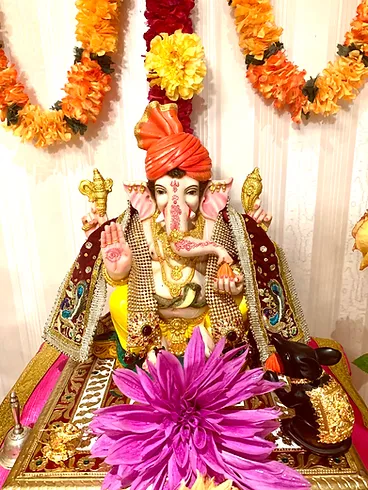
    3. The third concept is the Divine in a personal form. People can connect much more easily to a personal form. With forms comes a personality and a story. If you know a story you felt intimate with that form. You develop a close personal connection with that particular form of God. This tangible form is called a murti. This is represented by statues, photos, and physical symbols or objects. The mind stays easily focused on the physical form away from distractions. Although there are many physical forms of God, there is only one supreme being. Hindus worship one supreme being who can appear in many forms. We can use whichever form of divinity that the divinity chooses to manifest itself.

    Choose any of these paths. Take part of this and part of that. Mix and match. Let’s find the divinity within ourselves and recognize it in the whole creation. Let us be happy.

  • Elevator speech on Hinduism

    Elevator speech on Hinduism

    On many occasions, I have been asked by non-Hindus, about the essence of Hindu Dharma. Like many of us, I have struggled in the brief moments to try to achieve the balance between barely skimming the surface and diving too deep into the gold mine which is Hindu Dharma. A few years ago, I came across the remains of an old pamphlet in our temple bookshelf in Peoria IL, which was tattered, describing the 5 Ps of Hindu Dharma. On further ruminating, I added some more Ps and rephrased the original material. Unfortunately, I do not remember who had published the original booklet and cannot give due credit to the author who planted the seed in my mind.

    Please note that this is the outline of an elevator speech, so please forgive me if some key concepts are missing. Once the elevator interaction progresses to friendship and further discussion over lunch, dinner, or liquid imbibements, you are free to pontificate based on your knowledge.

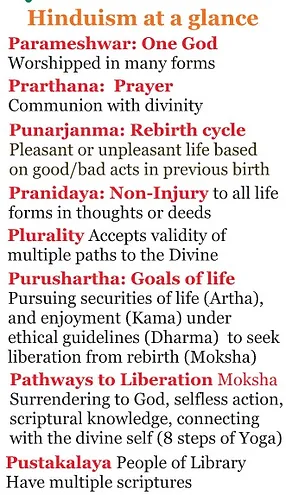
    Here are my 8Ps of Hinduism:

    ,P,arameshwar: One God. Hindus believe in one God who is worshipped in many forms. There is the freedom to choose a physical form (statue, object, drawing, plant, or animal), or no form based on your preference.

    ,P,rarthana: Prayer. Vocal or silent prayer which is the communion of Hindus with the Divinity.

    ,P,unarjanma: Rebirth cycle. Pleasant or unpleasant life experiences in the current life are based on the good/bad acts in the previous birth. This serves as an all-encompassing Divine justice system, with no ‘get out of jail Free- card’. This can be expounded with details on the karma concept, punishment mitigating actions, as and when time permits.

    ,P,ranidaya: Ahimsa – Non-injury to all life forms in thoughts or deeds.

    ,P,lurality: Acceptance of validity of multiple paths to the divine. Hindus have no issues with other religions and do not try to actively proselyte.

    ,P,urusharthas: Goals of life. Pursuing security of life (Artha – money, shelter, food, etc) and enjoyment (Kama– sensuous pleasure), but under ethical guidance (Dharma – righteous living) to seek liberation from the cycle of rebirth (Moksha).

    ,P,athways to liberation (Moksha): Surrendering to God (Bhakti Yoga), selfless action (Karma

    Yoga), gaining scriptural knowledge (Dnyana Yoga), connecting with the divine self (Raj Yoga- ashtanga yoga for some).

    ,P,ustakalaya: Hindus are people of the library and have multiple scriptures to guide us (some transcribed by seers and some authored by spiritually advanced humans). Many consider Bhagwad Gita as a convenient handbook for initial study.

    An additional P can be added which is ,P,rerana from Bharat, acknowledging India as the fountainhead of this profound philosophy.

    I hope these Ps act as pointers that will lead to an in-depth discussion and sharing thereby enabling greater understanding and friendship.

  • Forehead Dot

    Forehead Dot

    One of the major factors for a person’s satisfaction with life is the alignment between a person’s internal values and physical actions. Many times, people express their internal values verbally but due to external and internal constraints, their actions do not match their values. The conscious and subconscious awareness of this discrepancy results in a psychic imbalance and self-doubt. On an evolutionary basis, our brain is programmed to make decisions for performing actions that would increase the probability of our survival. Once the person’s survival is assured, further decisions are taken to obtain comforts and sensual pleasures. Early in evolution, our day-to-day decisions affected the possibility of surviving or dying on a near-constant basis. In most of the areas of the world, as civilization progressed most of our decisions are not that critical, except in areas of natural or man-made calamities. Our brain takes information from our surroundings through the five senses. This information is matched to patterns of previous experiences in form of self memories and shared knowledge (including learned prejudices) and the definitions of norms that have been established by the company we keep. Many times, the information conveyed by the sense organs is flawed. If we are driving on the interstate road on a hot humid summer day, we may see a large collection of water in the middle of the road. The eyes send that information to the brain. Fortunately, due to previous experiences and knowledge, wisdom takes over and the probability of a large body of water in the middle of the interstate is deemed to be not possible at that time. We ascribe this finding by the eyes to the phenomenon of mirage and continue to drive. Another more nuanced example is the thoughts that arise in our mind when a well-dressed good-looking person (based on the local standards) smiles at you in a public place versus an unattractive poorly dressed person of similar age, sex, and race doing the same action. On honest self-reflection, we will acknowledge that the thoughts are grossly different which I do not need to elaborate.

    The metaphorical third eye which when opened has the power to see clearly through the illusions seen by the physical two eyes. There is an incident in ancient history described in the epic Ramayan when Lakshman and Sita hear the demon Mareech who had transfigured into a golden deer, screaming in Lord Rama’s voice. Lakshman uses his third eye to see through this falsehood, which unfortunately Sita does not use, resulting in the subsequent unfortunate sequence of events for her. Many times our two physical eyes delude us into associating poverty, way of dressing, and physical stereotypes with negative characteristics. It is our third eye that helps us cross the abyss of otherness and recognize the shared divinity with other beings. When someone trips and falls on a pavement, the homeless panhandler to whom he gave a scornful eye a few minutes ago, maybe the first person to rush to help. The third eye of Shiva is described in Puranas (ancient allegorical Hindu scriptures) as having the power to burn anything it sees when it opens up. This burning is not the physical ignition, but the light cast by the faculty of wisdom on the illusion presented by the sensory organs. A popular story of how Shiva burns Kamadeva the deity of love, when Kamadeva disturbs Shiva’s meditation, in order to evoke the feelings of love in the ascetic Shiva for Parvati. Most of us who are involved in intense concentration activities like studying, artistic endeavors, or spiritual pursuit, can agree that sensory organs bring in information in the most inopportune moments which causes an interruption in our thought processes and drift our attention by disturbing thoughts. By using different meditation techniques such as observing breathing, counting numbers, and chanting a mantra, we try to override the input from the sensory organs. These techniques are our third eye in action. The process of applying a bindi by women and tilak by men is a daily reminder that we possess this third eye which we should use to master the input to our brain from

    the sensory organs. This can be as mundane as controlling the desire to walk to the kitchen when the aroma of food permeates our nose, if we are on a calorie-restricted regimen, ignoring the text messages from our friends when we are studying for our school work, or the desire we feel when an attractive person of opposite sex walks in our visual field. This also includes the thoughts which arise in our minds when external events cause happy or painful thoughts in our minds. The third eye will also help in achieving a state of equanimity. Achievement of this state is a constant struggle with a very steep upward slope.

    Next time you see somebody applying the forehead dot, realize that that person is on a quest to master his or her own senses. Based on our situation we may not be able to apply physical bindi or tilak. But the physical action of applying an invisible pressure to the point between your eyebrows would be a great reminder. I pray to the divine that our third eye is open as much as possible and burn the distractions that try to steer us away from our goal of realizing our true nature.

    Please note that I sincerely apologize to others who have other great explanations for the reason to apply been the bindi or tilak. These thoughts are my own, based on the teachings of various wise persons. I do not disagree or contravene with other valid explanations.

  • Hindu Dharma in Nutshell

    Hindu Dharma in Nutshell

    In our daily life, many of us interact with a Hindu in one way or another. Either your doctor, a coworker, a classmate, a close friend, a neighbor, a teacher, a business owner, or even a spouse. Some of us have witnessed a caricature of a Hindu in a TV serial or a cartoon. If you have ever wondered what the Hindu faith is, or you are curious to know more about your fellow Hindu Americans, Here is a subtle glimpse.

    Let me ask you a question. What do we all want? We all want to be happy. All our endeavors are in that direction. We seek material goods, pleasant experiences, power over others, suitable mates, and many other things which give us fleeting moments of happiness. But is it possible to have everlasting happiness? The ancient Hindu sages meditated on this question and came to this answer. Yes, it is possible. We can be permanently happy by discovering our true divine nature. How do we do that?

    Hindus believe that the entire creation is made of pure consciousness. Our true nature is pure consciousness. Unfortunately, we have forgotten our true nature. The entire purpose of Hinduism is to get back to our original selves and be permanently happy in our divine state.

    • The first step is to base our life on an ethical foundation which is called Dharma. To live ethically, there are a few qualities that are described in the Hindu scriptures. The main ones are Ahimsa, which is non-injury, Satya which is truth, and Brahmacharya which is a disciplined life of nonindulgence. These are not commandments but are nuanced guidelines. The guidelines are context-based. Our Dharma depends on our social situation. Dharma for a policeman will be different than that of a teacher. In the same person, the Dharma today is not the same as the Dharma tomorrow. It is different depending on our role at that moment. Our Dharma as a child is different than our dharma as a husband or as a parent. It is different when we are working at our job. Dharmic living is doing our duty at the present moment, thereby pouring our heart out every time we do something, all the time and without attachment. There are lots of Hindu scriptures that help us decide what is ethical in a given situation. Dharma is the internal nature of everything. On a more profound scale Dharma is what sustains everything, including us individually, our family, our community, our country, our earth as well as the cosmos. Dharma has a much more nuanced definition which the actual exhibition will illustrate.
    • The second step is Sewa which is selfless service. Also called karma yoga. For many of us, yoga equates to a contortion of body parts into postures. This aspect of yoga is just a small portion of the concept of yoga. The word yoga means union. It is the union of ourselves with our divine nature. Karma yoga is the action that unites us with our divine nature. We should do our duty because it is the right thing to do and not be result-oriented. Do everything as if it is an offering to the Divine. Hinduism understands that the path of connecting with divinity is difficult and has lots of steps. It needs mastery over oneself. It takes a long time which can span this life but also may need multiple lifetimes. In each life, you reach a particular point. In the next life, you begin where you left, and move forward or backward based on your action (karma) in the past birth. Everyone will get there at the end. How long it takes will depend on your actions. What you do now affects the future either in this life or in the next life. There is accountability and consequence for everything you do. The flip side is that I accept what happens to me, hence I am able to accept sorrows and calamities. What I do and how I deal with my calamities affect my future. This way we accept what is happening to us and do our best to handle it.
    • The third step is the choice of three spiritual paths. Hinduism is recognizing that all people are different so there are different paths suited for different people based on their different temperaments.

    · The first path is called Raj yoga. In this path, there are eight steps of which the first two deal with practicing ethical restrains, and ethical observations. The next three are physical postures and breathing exercises as well as control of senses., The rest of the steps deal with meditation. This path requires consistent practice and great discipline.

    · The second path is Dnyana yoga which is the study of scriptures. Hindus have a massive library of scriptures describing the different paths. This path is intellectually strenuous, and a seeker needs a subtle mind to grasp the concepts.

    · The third path is Bhakti yoga, which is the path of Devotion. Essentially, we rest our minds and hearts in God. Anybody can do that as there are no prerequisites.

    This raises the question, Which or what God? In Hinduism, there are varieties of ways in which divinity or God is conceptualized

    1) The first concept is pure consciousness which is described by the symbol pronounced as Om. Pure consciousness had no attribute and is infinite. For many people, this is a difficult concept to wrap their minds around it.

    2) The second concept is Ishwara which is divinity with attributes. The all-knowing, all-powerful all-controlling supreme being. This has no physical form, and our mind is open to the abstract.

    3) The third concept is the Divine in a personal form. People can connect much more easily to a personal form. With forms comes a personality and a story. If you know a story you felt intimate with that form. You develop a close personal connection with that particular form of God. This tangible form is called a murti. This is represented by statues, photos, and physical symbols or objects. The mind stays easily focused on the physical form away from distractions. Although there are many physical forms of God, there is only one supreme being. Hindus worship one supreme being who can appear in many forms. We can use whichever form of divinity that the divinity chooses to manifest itself.

    Choose any of these paths. Take part of this and part of that. Mix and match. Let’s find the divinity within ourselves and recognize it in the whole creation. Let us be happy.

  • A Yogathon for All

    A Yogathon for All

    My introduction to Surya Namaskar was at a very early age. Every morning I used to wake up hearing sounds of students reciting the thirteen names of the Sun on the primary school playground opposite my house, as they performed a series of yoga postures in a rhythmic fashion to the beats of a bass drum. My grandmother insisted that I learn to do the same sequence correctly and memorize the thirteen names of the Sun describing its various attributes. Over time, the simple sequence of yoga postures had become part of my regular morning routine. I was pleasantly surprised when in 2007, Hindu Swayamsevak Sangh (HSS) launched the Surya Namaskar Yagna (sun salutation offering yogathon) campaign to raise awareness of this effective but simple exercise sequence, for the benefit of the general masses, and correct the misperception of yoga in America being somewhat of an elitist activity.

    Every year, the period of fifteen days, starting from the auspicious day of Makar Sankranti (January 14th), when the sun enters the Sagittarius constellation, and ending on Ratha Saptami, the 7th day after the new moon, is selected for a concentrated effort to maximize the outreach and share the benefits of the regular practice of Surya Namaskar to the American masses. Community organizations, general places of gathering, places of employment, schools, and colleges have been involved in this activity. To make the promotion more interesting and participatory, the number of Surya Namaskar performed by individuals is maintained using a user-friendly SNY app. This year, 12,676 individuals logged a total of 728,795 Surya Namaskars into the SNY app. The project reached 34 schools with 3,004 students and teachers participating.

    A cursory search on the internet will unearth an extensive treasure trove of research on the benefit of Surya Namaskar for interested individuals, including benefits on the entire neuro glandular and neuromuscular systems of the body and the entire psychosomatic human constitution. An interesting perspective was given to me by a friend who said that given the paucity of time available for a busy individual like him, performing Surya Namaskar was an all-rounded efficient exercise that stretched and toned all the major muscle groups of the body, burned calories, and added a spiritual side to exercise. Performing Surya Namaskar daily in the morning, along with your spouse and children, also brings the entire family together at the start of the day, at least for a short duration of time.

    I was asked by a colleague whether Surya Namaskar was a religious activity. I explained that Surya Namaskar was a humanistic activity. Offering namaskar (which is more than just a simple salutation) to the sun was an expression of gratitude to the divine. In every religious tradition, the sense of Gratitude is looked upon as a very positive mental state. The term ‘Yagna’ in the name of the Surya Namaskar campaign also has a deep meaning. Yagna means sacrifice or offering. Instead of the exercise being a self-centered activity for our own betterment, performing Surya Namaskar with a mental state of offering it to the divine, in the form of the Sun, transforms it into a spiritual activity. The well-balanced movements, with an ordered breathing sequence facing the rising sun (whenever possible), contrast with my other exercise routines that are performed in the gym while staring at my own reflection or a television screen.

    Last few years, my wife taught Surya Namaskar at an underserved school in my hometown of Peoria before the interruption of the COVID epidemic. Every week different classes performed the yoga routine, followed by a spiritual breathing exercise called Pranayam. One beauty of Surya Namaskar was that it only requires small space of 3 feet by 6 feet, without the use of any equipment. The children at the school were greatly enthusiastic, and an anecdotal report suggested that many have continued the practice. This has been repeated over multiple years, which interestingly would be the first and possibly the only exposure of these children to the benefits of yoga. In the future, when the children grow up to be adults, they will have fond memories of Surya Namaskar and will continue to learn and practice it.

    My younger daughter’s high school JROTC (Junior Reserve Officer Training Corps) physical training team also performed Surya Namaskar as a warm-up routine at competitions, even after she graduated from the program. As the cadets stood in a long line, performing the series of movements and counting in unison, while other teams watched in curiosity, there was a sense of unity that energized the team and prepared them for the competition to come.

    This year, Health for Humanity Yogathon has been acknowledged by numerous elected representatives and has received 129 proclamations from American mayors, governors, US Congresspersons, and United States Senators. It was also recognized as a part of Congressional records in 2017. Acknowledging the benefit to the American community from this campaign, the ‘Let’s Move’ initiative of the then First Lady Michelle Obama declared HSS as a partner in 2012.

    Whether Surya Namaskar is used as a family activity, health initiative in underserved areas, or a warm-up for a sport, there are undoubtedly significant physical, mental, and spiritual benefits to the exercise, and we must share it for the benefit of society. The slogan yoga for health, health for humanity is aptly put in practice by the Surya Namaskar Yagna. I am sure Surya Namaskar will be a regular routine and one of the prime jewels offered as a gift by the ancient Hindu culture to the rest of humanity.

  • Debate

    Debate

    As our next Presidential election looms closer, we are all listening to the media, the sheer barbarism of the public arena vocalization filled me with great anguish as to how far we have fallen. On the current political debate stages, behavior like blatant lying, interrupting the opponents, childish insults have become a norm for the people vying to hold offices of public trust. In stark contrast is the ancient Hindu technique of debate called Purva (prior) paksha (side)and Uttar (later) paksha (side).

    The aim of any honest debate is to conclude what is the truth. Each debater brings his or her relative truth to the table. Based on their past experiences either intellectual or physical, each debater tries to prove that their relative truth is as close as possible to an absolute truth. For this to occur each debater must debate based on his perspective, and not based on personal ego or an undisclosed agenda. Further, each should be willing to embrace the resultant conclusion of the debate. Prior to the debate the opponents make a wager on the result. The usual wager in ancient India was that the defeated debater and his followers becomes the disciples of the winner. Purva paksha phase of the debate starts when each of the opposing debaters, states in greatest possible detail the perspective of his opponent. For this to occur each debater must have the deepest understanding of the stated position of his opponent. The rival then agrees that the opponent has indeed expressed his position correctly. Then the process is repeated by the other debater. This exercises also forces each debater to realize any weakness in his own perspective. Once the rivals agree that they have demonstrated the clear understanding of each other’s position, then comes the next phase of Uttara paksha.

    The first part of Uttara paksha is Khandana, where each debater presents the rebuttal of the antagonist’s position. Then comes Siddhanta, which is the perspective of the debater. Finally, as one of the debaters fails to provide rebuttals, the judge declares the winner, and the defeated party accepts the perspective of the winner. A classic example of this kind of debate occurred in 7th or 8th century (around middle of 600 CE) between the great philosopher Shankaracharya who was a proponent of Advaita (Monoism- which states unity of God, soul and world — ‘everything is God’) and Mandana Mishra who was proponent of Mimansa (a more ritualistic school of philosophy). Since Shankaracharya was a young monk in his mid-twenties, Mandana who was much older and a well-established scholar gave him the opportunity to choose the judge.

    Shankaracharya chose Mandana’s wife Ubhaya Bharati who was a great scholar in her own accord. The wager was that the losing scholar would become a renunciate (monk) and accept the winner’s school of philosophy. After intense and long debate Mandana was defeated. Just as he was going to take the vow of renunciation, his wife who did not want to lose her husband, challenged Shankara, saying that a wife is one half of the husband. Therefore, Shankara must debate her too, prior to proclaiming his victory. Ubhaya being a clever woman in addition to being a scholar, debated Shankara with questions involving marital issues.

    Shankara being a celibate has no marital knowledge. Being a fair contestant, she gave him a weeks’ time to get the knowledge. Incidentally, a King of a neighboring kingdom died at that time. Shankara using his yogic powers transmigrates his soul into the dead Kings body and the body becomes alive. By living as the King with his many wives and discussing in depth the intricacies of marriage with one of the wise queens, Shankara gains the requisite knowledge and by the end of the week departs the Kings body and returns to his own. Next day he soundly defeats Ubhaya based on his new found knowledge augmenting his profound knowledge and wisdom. Both the husband and wife then become Shankaras disciples and after his death at the age of 32 years, carry on his school of philosophy.

    Imaging our Presidential candidates debating using Purva paksha and Uttara paksha technique. Even if the defeated does not accept the perspective of the opponent, the fact that he/she learns about the opponents position and the basis for holding that position, will make politics very civilized and through it the government will truly be OF the civilized people, FOR all the people and BY the reasonable people.

  • Hindu MANDIR (temple): Its MEANING AND SIGNIFICANCE

    Hindu MANDIR (temple): Its MEANING AND SIGNIFICANCE

    Why do we go to the temple? This question sometimes comes to our mind, especially after we have not gone to the temple for some time or when there are other interesting things that conflict with temple events. Sometimes children ask us that question either due to genuine self-introspection, part of teenage angst and rebellion, or an excuse to pursue other more alluring events. This write-up is not a sermon, but an attempt to provoke more thinking. Just as each one of us has his/her own relationship with our parents; no one can or has the right to censure others on their relationship with the divine parent.

    According to Hindu Philosophy if Bhagavan (God) is present everywhere, why do I have to go to the temple?

    I have used this allegory to explain the significance of mootis (consecrated statues) in the temple. Radio waves (like Bhagavan) are everywhere, but you need a fine-tuned radio receiver to listen to music. The fine-tuning is done by ‘prana pratishstan’ ceremony performed at the time of the consecration of the temple when we invoke the divine to reside in the moortis. The temple is the concert hall which is best suited to appreciate the music.

    Another way of thinking is that the temple is a giant super magnet charged by the divine and each of us is a tiny magnetic material that becomes magnetized when we visit the temple and spend some time there. The magnetism persists for some time after we leave. Hence, we must return periodically to recharge.

    Visiting the temple is also like visiting our favorite grandparents with a beautiful house whose advice and help we seek, who grant us gifts, and where we can be children again by eating sweet prasad (blessed sweets distributed in the temple), sing and occasionally dance.

    None of these allegories are perfect but based on our own situation may be more or less applicable.

    It is true that Bhagavan is present everywhere, and the miracle of manifestation can be seen everywhere, but have we attained the mental state to experience the ultimate cause of everything? Visiting a temple, experiencing the auspicious ambiance, and doing devotional services are processes that are designed to calm our senses, to guide them inwards, thereby helping us to prepare for experiencing our divine nature.

    Most of us are not self-aware of our true quest to realize our divinity. Occasionally, in fleeting moments we become aware and then quickly get immersed in our daily routines just like card-players in a train who occasionally glance out of the window to realize where they are and where they are going, but again get too engrossed in the card game, sometimes ending up traveling to wrong places. After many cycles of reincarnations based on our karma, we get more and more in-tune with our ultimate aim of moksha (merging with divinity). The serene surroundings of the temple are very conducive to bringing self-awareness.

    The moortis or consecrated statues in the sanctum of the temple have forms that were revealed to ancient seers during their state of deep meditation, while some represent artists’ interpretation of historic descriptions from scriptures narrating ancient history. Both human male, female forms as well as forms featuring a fusion of both human and animal morphology are present. These various Deity forms are worshipped in multiple ways according to the scriptural injunctions and depending upon one’s inclination and devotional attitude. The beauty of Hindu Dharma is that one is free to choose and worship any of these manifestations. This great diversity in the approach corroborates with the infinite variety of human attitudes and experiences and is valid as long as the underlying unity is understood.

    The temple is a giant collection of symbolism as well as spiritual aids which is available to all devotees to use based on the individual stage of their personal spiritual journey. To aid us in fostering is the attitude of contemplation, there is a statue of a tortoise that pulls in its head and four legs, representing our five senses which we should turn inwards when we concentrate on Bhagwan. There is also a statue of Nandi the bull vehicle of Lord Shiva who teaches us to be patient, as he has sat in front of Shiva motionless for eons, calm but alertly waiting for Shiva’s next order.

    After a recent adverse health event, I was fortunate to have our local temple and fellow temple devotees to help get my body and mind back on road to recovery and experience the Divine bliss through rekindling the relationship with Bhagavan.

  • Diwali: More than a Hindu Festival of Lights

    Diwali: More than a Hindu Festival of Lights

    Diwali, the Hindu festival, is nowadays simplified as “the festival of lights.” Unfortunately, it is reduced to the display of electric string lights, shopping at ‘Diwali sales,’ and indulging in sweets. However, Diwali is actually a multifaceted celebration to teach and remind us of important principles of being a noble human.

    Hindus are ancient people, who are distributed over a large geographical area and have a long history, in addition to varied local resources. Hence, there is extensive diversity in the way Diwali is celebrated. Diwali is celebrated in October/November on the dark fortnight of this period. It is celebrated by Hindus, Sikhs, and Jains in India and around the globe. There are approximately 1.3 billion self-identified Hindus in the world. There are 3.3 million Hindus in the USA, according to the 2016 census, which is 1% of the American population. The reason I say self-identified is that there are many people who follow Hindu principles but do not actually identify themselves as Hindus.

    Diwali is derived from the Sanskrit word “Deepavali,” which means “row of lights.” Many historical events have occurred during Diwali, and these events are celebrated and remembered regionally or globally with varied stories and traditions. For example, Lord Ram, the 7th avatar (human manifestation of the divine), defeated the evil king Ravana who had abducted Ram’s wife Sita and was committing atrocities on people. Furthermore, the sixth Sikh Guru Hargobind, who was imprisoned by the mogul emperor Jehangir, was released on this day, along with 52 other kings. Mahavir, the last Jain Tirthankar, also attained Nirvana during Diwali.

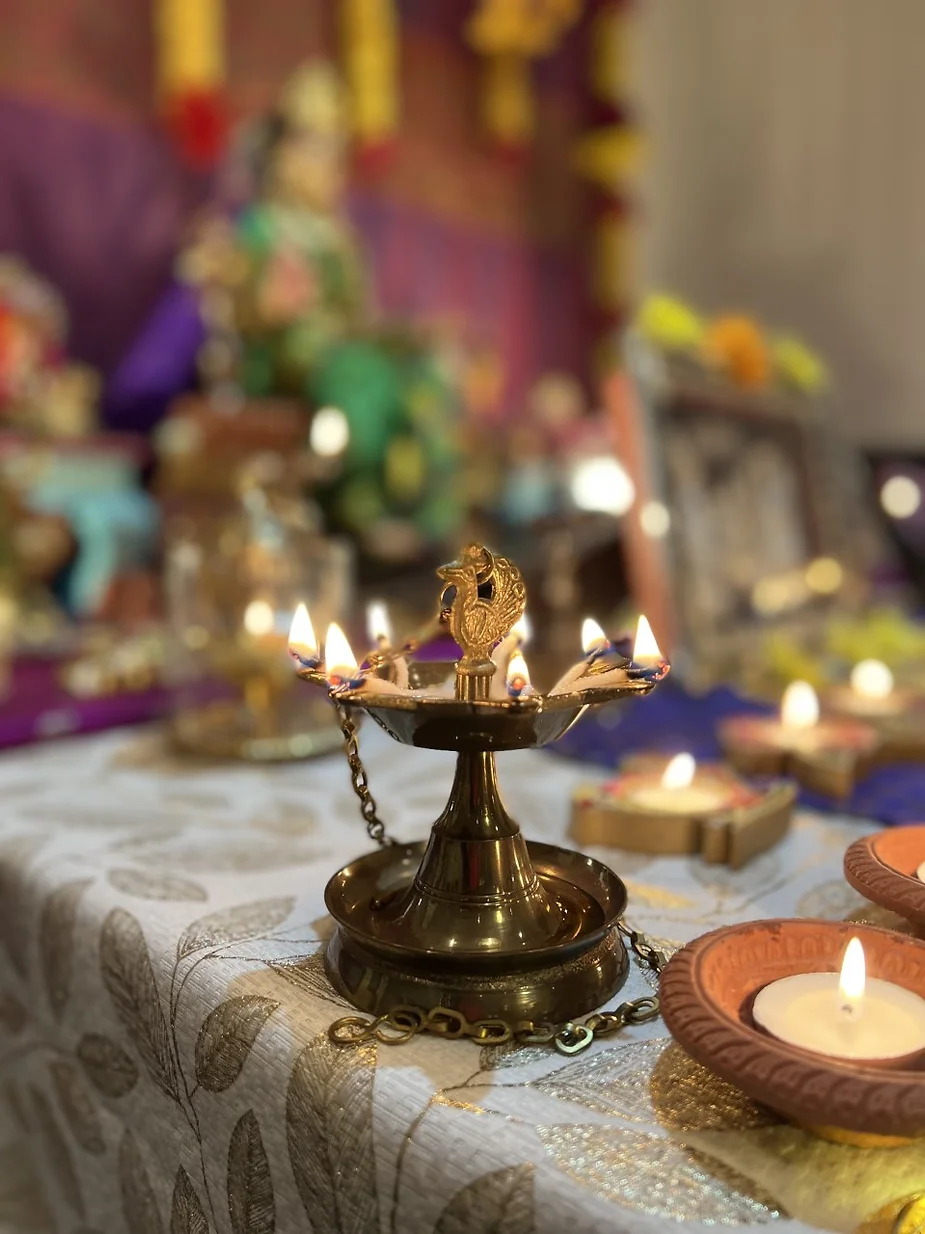
    So, how do we celebrate Diwali? Hindus clean and decorate their houses, draw Rangolis (floral designs on the ground made by colored powder or flowers), indulge in sweet and savory snacks, shop, exchange gifts and food with friends and neighbors, and light fireworks. We also visit the temple, make offerings to the deities of spiritual and material prosperity, donate to the needy, and light earthen oil lamps and other types of lights around the house. In fact, the lighting of the earthen lamp has great significance for Hindus. The earthen lamp represents the recyclable mortal body (dust to dust). The light symbolizes knowledge. The oil or ghee (clarified butter) in the lamp represents our negative tendencies, and the wick is our ego. When we light the lamp (body) with the flame (knowledge from our teacher), it slowly exhausts the oil (negative tendencies), and the wick (ego) perishes. The knowledge takes us to higher ideals, similar to how the flame burns upwards. One single person of knowledge can share knowledge with others without diminishing his own knowledge, just as a single lamp can light hundreds of lamps.

    Six days of Diwali

    Day 1: Vasu Baarus — 12th Day of Lunar Calendar

    Vasu means brilliance or wealth. Baarus means the 12th day. This day pays homage to the cow and calf, representing wealth, motherhood, fertility, and sustenance.

    Why is the cow considered sacred? Hindus see cows as particularly generous creatures. A cow gives lots to the human being but takes almost nothing from us, just like our biological mother and mother of all, the earth. Cow worship is acknowledgment and appreciation of these holy qualities. In every agrarian house, there is a cow whose milk is drunk from childhood and throughout life. The male cow plows the field and is a mode of transportation — the bullock cart. Thus, the cow is considered part of the human household family. Cows not only give milk and innumerable milk derivatives, which are used as food, but they also give cow urine with medicinal properties, and cow dung, which is used for its antimicrobial properties, as a fuel, and for bioremediation of environmental pollutants. Cows not only take care of us during their entire life but also after their death, through leather and making fertilizers from their bones. In addition, Hindus associate various animals with different gods and consider these animals sacred. These include monkeys-Lord Hanuman, elephants and mice-Lord Ganesha, and tigers-Goddess Durga, among others, but none is revered as much as the cow, who is associated with Lord Krishna.

    Day 2: Dhanteras — 13th Day of Lunar Calendar

    Dhan is the abbreviation for Lord Dhanvantari. the deity of health and medicine. Teras means the 13th day. This day is celebrated in India and around the world as National Ayurveda Day. Ayurveda is the world’s oldest holistic healing system developed in India and is now getting popular in America and around the world. Dhan also means wealth, representing both material and spiritual wealth, as well as health (health = wealth). Consequently, Dhanteras is a massive shopping day in India, in addition to other forms of celebrations.

    Day 3: Narak Chaturdashi — 14th Day of Lunar Calendar

    Narakasur was a tyrannical demon king who had a boon that he could not be killed by a man. Satyabhama, the wife of Lord Krishna — the 9th avatar, thus killed the demon and released the 16,000 women whom Narakasur had kidnapped. The lesson from this story is that women should not wait for a knight in shining armor. Women should don the armor themselves, pick up a weapon, and vanquish the offenders themselves, or use other legal ways as in modern society. The demon may be a politician, powerful celebrity, workplace colleague, a roadside ruffian, or even negative characteristics of oneself. For Hindus, the women are not damsels in distress or delicate flowers but goddesses of power and strength. The traditions of this day include special ritualistic baths and worship and lighting of lamps to eradicate the negative energies.

    Day 4 Laxmi Pujan — No Moon Day

    The worship of Laxmi, the deity of prosperity, is important because we should respect wealth and not misuse it for inappropriate and immoral purposes. During the dark winter months, you need material wealth to survive. Only the ‘haves’ can feed the ‘have nots.’ Wealth provides security for you and everyone else because Hindus believe that the entire creation is a family. The business community starts new account books on this day. In villages during olden times, grains were shared with the 12 guilds (balutedars) who served the village throughout the year as a part of a complex barter system. In the USA, Sewa Diwali (www.sewadiwali.org) is conducted, a collective initiative by a large number of Dharma-based organizations around the country, who hold food drives and other necessary drives to benefit underserved communities. Last year, more than 300,000 pounds of food were collected from 400 centers and distributed to 200 facilities.

    Day 5: Bali Pratipada/Padwa — 1st Day of Lunar Month

    This day commemorates the defeat of king Bali. He was originally a virtuous person who got corrupted by power and became too arrogant. The Supreme Being thus manifested as Vaman, a dwarf and the 5th Avatar of the divine, to carry out the task. This is a lesson for powerful people to behave righteously, since even an apparent weak person may cause their end. This day is also celebrated as a husband-wife festival in which the wife gives a ritualist bath to the husband with scented oils and perfumes stressing the romantic nature of the relationship, while the husband gives jewelry and gifts to the wife. These gifts belong only to the wife and are not family property.

    Day 6: Bhai Dooj — 2nd Day of Lunar Month

    This is the brother-sister festival. In ancient days and even now, many sisters are far away from brothers’ homes, and brothers do not get a chance to meet them throughout the year. However, on this day, it is the duty of the brother to visit the sister, regardless of how far she is located, or if impossible do so, at least make a virtual video call with her. The brother gives gifts to the sister, and the sister performs ceremonial rituals for the brother and feeds him. In my hometown of Peoria, IL, we conduct a food drive for The Center for Prevention of Abuse (https://www.centerforpreventionofabuse.org/), using the principle of brothers helping the local sisters in distress.

    To review in short:

    Day one — Animal protection and appreciation.

    Day two — Health awareness.

    Day three — Women empowerment.

    Day four — Well-being for all.

    Day five — Removal of arrogance and greed, and homage to the husband-wife relationship.

    Day six — Homage to the brother-sister relationship.

    Thus, Diwali is not just a festival for Hindus, but its principles are applicable to the entire humanity regardless of your mode of worship.

    Om Shanti Shanti Shanti. Om Peace Peace Peace.

  • Swabhawa – True nature of things

    Swabhawa – True nature of things

    During adversity, a person’s true nature (Swa- self, bhaava- essence) gets exposed. In normalcy, many of us take on covering to fool others and sometimes ourselves. We take on roles to fit into what we believe is expected from us to be accepted as a member of the society around us. The current pandemic is acting as a cleaver, slicing the outer false shell and exposing the inner true nature.

    Some of us are hoarding food and other essentials in quantities far beyond our wildest imagined needs. From toilet paper and canned meat to protective masks, vast quantities of materials have disappeared from stores as well as online retailers. Some people have hoarded medicines like hydroxychloroquine due to unsubstantiated statements of its ability to cure Covid-19 infections, at the cost of causing shortage to people who really need it for their immunological disorders. Some of these hoarders have become black marketeers. There are others who have built a virtual moat and stockage system around them, with stockpiles of essentials hoping to survive the pandemic by complete isolation, binging on streaming online entertainment, oblivious to the suffering around them.

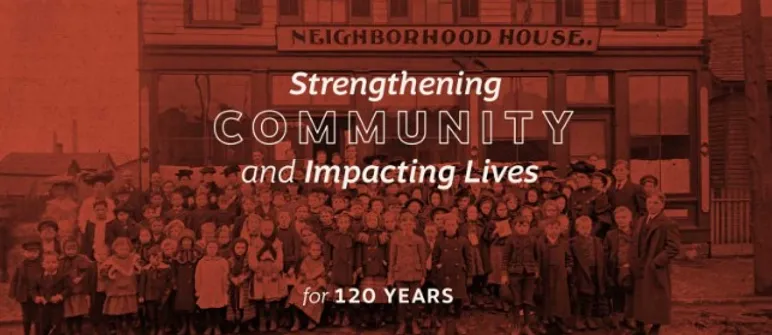
    At the same time, there are others who have seen the distress around them, and their true divinity gets manifest. These are the so called ‘ordinary’ people who become extraordinary. When disaster strikes, they blossom into true heroes. A few weeks ago, my youngest daughter and I had gone to Neighborhood House, a local charity in Peoria (nhpeoria.org), a life-line to many of Peoria’s most vulnerable population, to volunteer for making long shelf life food packages and delivering food to the elderly. On the delivery day, we arrived 5 minutes before the scheduled time. To our surprise, the whole parking lot was filled with volunteers, and in a few minutes all the deliveries were assigned. I was truly humbled by the spirit of service in Peoria.

    My first-hand knowledge is somewhat limited to my organization Hindu Swayamsevak Sangh, USA and its sister organization Sewa International (sewausa.org) who have established help lines covering all the time zones of the country. Requests ranging from home bound elders for grocery delivery, hospitals requesting cloth masks, stranded travelers, immigration help to spousal abuse and emotional/mental support are being handled by the help lines. Feeding the homeless and supporting food banks by conducting food drives are being done. At some places fundraising is being done to order food from local restaurants for the charity free food organizations, so that the local restaurant owners will earn money since their restaurants are closed to public, and the hungry will get food, thereby achieving two good activities in one stroke.

    The medical community starting from the front door greeters/security personnel to the EMT to the doctors and nurses are the brave hearts, holding back the Tsunami of the pandemic, and hopefully soon overturning it. Fortunately, for us in central Illinois, the rampage of the virus is limited compared to New York and Louisiana. Some local children are sending thank you posters to the hospitals. Drawing these pictures of gratitude will encourage our heroes and also ingrain into the children the examples of service before self.

    In Hindu Dharma, God manifests on earth (Avatar) when the balance of good and evil tilts too much in the favor of evil, and God rectifies the situation by annihilating the evil. One particular form of Avatar is called ‘Aveshavatar,’ where for a brief time God manifests special powers through an individual soul and acts through that person. I sincerely believe that each of the people who are helping others whether for an instant or by giving up their life while fighting for humanity are manifesting Aveshavatars channeling the divine force through their thoughts and acts. Lets all close our eyes for a few minutes and listen to our individual divine, manifesting through ourselves or through a prophet/philosopher, and do more than we are already doing.

  • Charity

    Charity

    There is a story of a famous poet Māgha in the 6th century, who was carefree with his wealth and lived in poverty towards the end of his life. One day, a poor man came to his door asking for some money so that he could get his daughter married. Māgha saw that his sleeping wife was wearing two gold bangles. He quietly slipped off one of them from her wrist and donated it to the visitor. When his wife woke up, he hesitatingly told her why he had taken her bangle. His wife admonished him, “How can a father get his daughter married with just one gold bangle. Please take off my other gold bangle and give it to him!”

    Hindu literature is filled with anecdotes of ordinary people performing extraordinary charitable acts without giving it much thought. This originates from the understanding of shared Divinity among all life forms resulting in a feeling of oneness, so that helping someone is like a person’s hand feeding his own mouth. For simple understanding of the process of charity, the Hindu scripture, Bhagawad Gita (17.20-22), states three categories of giving.

    1)A gift that is given without any expectation of benefit or reward is greatly beneficial to both the giver and recipient.

    (2) A gift that is given with the expectation of some advantage is of lower value.

    (3) A gift that is given at the wrong place and at the wrong time, causing embarrassment to the recipient, is harmful to both the giver and recipient.

    Charity essentially is a gift of useful time and resources. Nowadays, it is easier for many people to give under category 2, with the most common expectation being name recognition and advertisement of their economic success. Although we should all strive for the category 1, my personal opinion is that display of wealth is not always bad depending on how you do it. I have been a beneficiary of ‘display of wealth.’ I have received treatment at a hospital which carried the name of the famous Tata family in Mumbai. I used a library which was named after a benefactor who bestowed a large sum on the charitable trust. I have played in a park constructed on a piece of land donated and named after an industrialist. Having donated a large sum of money to a charitable cause indicates that you are wealthy. Of course, I do understand that the above gifts to the public by the generous benefactors were for the betterment of the masses, not just display of wealth. But is it not a great way to let everybody know that you have made it by donating to worthy causes? My suggestion to people who want to display their wealth is to donate more. A name on a plaque on a wall of charitable organization or emblazoned on a hospital or school lasts longer than a latest model expensive car. Further, more people can see it. This display is more glaring than a rare timepiece or jewelry. A hot meal consumed by a hungry person is nutritious regardless of the intention of the donor. Educational material donated to an underserved area organization gives the same quality of knowledge and career boost to children regardless of the selfish reasons of the donor.

    Sense of charity is like a skill. For some it comes naturally. For others, there is a steep learning curve. Small steps till we are comfortable, then one fine day we soar. Initially, perform charitable acts for prestige, self-aggrandization, or display of wealth. When you experience the joy of alleviating the misery of a fellow life form, slowly it transforms you. The hubris of self-importance starts getting washed away by the realization of oneness of giver and receiver, and ultimately oneness of the creation.

    ‘Giving without expectation’ is an epitome of perfection which we should all try to achieve. But just because a rooster cannot fly as majestically like an eagle, it does not stop trying. Some fortunate beings are born eagles, but for many of us, doing small acts of charity will be the building blocks which one day will result into our metamorphosis into a truly selfless charitable being.

    Featured image credit: Lalesh Aldarwish