Category: Spirituality and philosophy


  • Mahabharata, Bene Israel, and Ethics of War

    Mahabharata, Bene Israel, and Ethics of War

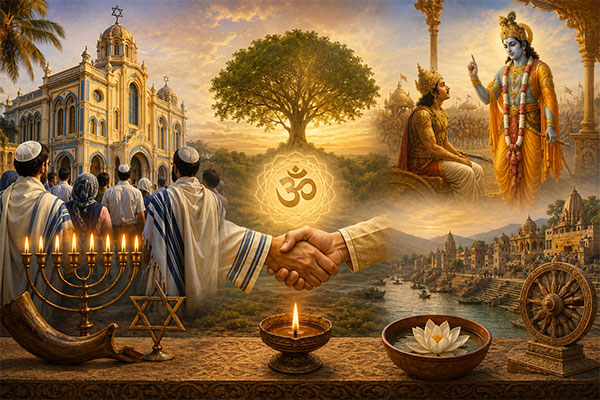
    As a close friend waited for his flight at Tel Aviv’s Ben Gurion Airport, he noticed several Bene Israel families among the travelers and immediately texted me. Years earlier, I had told him about my Jewish neighbors while growing up in Maharashtra, India. The Bene Israel are descendants of Jews who sought refuge in India as early as the second century BCE. Over many centuries they adopted Marathi, my mother tongue, while faithfully preserving Jewish traditions such as the Sabbath, circumcision, and kosher practices. They flourished without persecution, and their synagogues continue to stand as respected places of worship.

    For many Jews outside India, the Bene Israel remain little known. Yet their history offers one of the world’s most remarkable examples of religious coexistence. For nearly two millennia, Jews lived among a Hindu majority without experiencing the state-sponsored antisemitism, expulsions, or pogroms that scarred so much of Jewish history elsewhere. India did not merely tolerate its Jewish communities; it allowed them to preserve their faith while becoming an integral part of the nation’s cultural life.

    That history reflects something distinctive about India’s civilizational ethos. Hindu thought has long embraced the conviction that truth may be approached through multiple paths and that every human being possesses an inherent spiritual dignity. This worldview did not eliminate political conflict or social divisions, but it created a space for religious minorities, including Jews, to flourish without abandoning their identity.

    As I reflected on my friend’s message, I was reminded of another enduring gift of Indian civilization: the Mahabharata. Like the Hebrew Bible, it is far more than an ancient narrative. It is a sustained meditation on power, justice, leadership, loyalty, and the moral burdens that accompany the defense of a people. Its questions remain startlingly contemporary because they address dilemmas that every civilization eventually confronts.

    The Mahabharata should not be read as a political blueprint for modern conflicts, nor should its heroes be mapped onto contemporary nations. Its enduring value lies elsewhere. Like the Hebrew Bible, it explores what happens when a people committed to moral principles must also wield political power. The epic refuses easy answers. Victory never erases moral responsibility, and righteousness never guarantees freedom from tragedy.

    The epic’s central concept is ‘Dharma’, a term that encompasses justice, duty, moral order, and ethical responsibility. Throughout the story, even its noblest figures struggle to discern what dharma requires under impossible circumstances. The supposed moral paragon, elder brother Yudhishthira, makes painful mistakes. The greatest warrior, Arjuna, hesitates before battle, overwhelmed by the prospect of killing relatives and teachers. Krishna, the Divine incarnate himself, counsels actions that challenge conventional notions of morality when he believes the preservation of justice requires them.

    These struggles echo a recurring theme within Jewish tradition. The Hebrew Bible, the Talmud, and later Jewish thinkers likewise refuse to portray righteous leaders as morally flawless. Abraham argues with God for the sake of Sodom. Moses loses the privilege of entering the Promised Land. King David’s greatness coexists with profound moral failure. Jewish ethics, like the Mahabharata, recognizes that leadership often requires navigating competing obligations rather than choosing between obvious good and evil.

    Nowhere is this tension more evident than in the ethics of war. The Bhagavad Gita, set on the eve of the Mahabharata‘s climactic battle, does not celebrate violence. Arjuna’s reluctance to fight arises from compassion, not cowardice. Krishna does not dismiss those concerns. Instead, he teaches that the use of force may sometimes become a painful duty when all peaceful alternatives have failed. Yet he also insists that action must remain free of hatred, vengeance, and selfish ambition.

    Jewish thought has wrestled with similar questions for centuries. The tradition recognizes both the necessity of self-defense and the moral limits that accompany the use of power. The challenge is never merely how to prevail, but how to preserve one’s ethical character while confronting those who seek one’s destruction.

    These ancient insights resonate far beyond India. Israel’s modern history has required its citizens to confront many of the same enduring questions that have occupied moral thinkers across civilizations: How does a democratic society defend itself against existential threats? How does military necessity coexist with ethical restraint? How can security be pursued without losing sight of the humanity of those caught in conflict?

    The Mahabharata offers no simple political answers. Indeed, one of its deepest lessons is that even a just victory carries immense human cost. After the devastating war at Kurukshetra, the victorious Pandavas inherit not triumph but a shattered civilization. Their kingdom survives, yet countless families mourn their dead. The epic reminds readers that war may sometimes be unavoidable, but it is never something to celebrate.

    This perspective feels particularly relevant today. Israelis continue to confront terrorism and genuine threats to their security, while Palestinians have endured decades of displacement, suffering, and uncertainty. Durable peace cannot emerge from military strength alone, even when that strength is indispensable. Nor can it emerge from denying a nation’s legitimate right to defend itself. The moral challenge lies in holding both truths simultaneously.

    Underlying the Mahabharata is another profound principle of Hindu philosophy: Universal Oneness. The Upanishads teach that the same divine reality dwells within every human being. The Bhagavad Gita describes the truly wise as those who perceive the same spiritual essence in every person, regardless of status or circumstance. This vision does not abolish conflict or erase the necessity of justice. Rather, it insists that even an adversary must never be stripped of human dignity.

    That insight finds a striking parallel in Judaism’s teaching that every person is created b’tzelem Elohim-in the image of God. Although the two traditions emerge from very different theological foundations, they converge on a shared moral intuition: genuine strength is inseparable from reverence for human life.

    The history of India’s Jewish communities demonstrates that these principles need not remain abstract philosophy. For nearly two thousand years, the Bene Israel, Cochin Jews, and Baghdadi Jews maintained their distinct religious identities while living peacefully among a Hindu majority. Their experience does not suggest that India was a utopia, nor does it erase the complexities of its history. But it stands as a remarkable example of a civilization confident enough in its own traditions to allow another ancient faith to flourish.

    In an age increasingly defined by polarization and civilizational distrust, that history deserves renewed attention. The story of India’s Jews reminds us that coexistence is not merely an aspiration but a lived historical reality. And the Mahabharata reminds us that the measure of a civilization lies not only in its capacity to defend itself but also in the wisdom and restraint with which it exercises power.

    Perhaps that is the deepest lesson shared by Hindu and Jewish civilizations. Both understand that strength and compassion are not opposing virtues. Both insist that justice requires courage as well as humility. And both remind us that the ultimate purpose of power is not domination, but the preservation of a moral order in which human dignity can endure, even amid the tragedies that history sometimes makes unavoidable.
  • Yamas & Niyamas: Hindu Ten Commandments?

    Yamas & Niyamas: Hindu Ten Commandments?

    The recent passage of the law by the state of Louisiana requiring all state-funded schools and universities to display the biblical Ten Commandments in classrooms has sparked extensive controversy. The Ten Commandments, central to Judeo-Christian ethics, are seen by supporters as timeless moral principles essential for a just society. They argue these commandments promote values like honesty, respect, and responsibility, fostering social cohesion and personal integrity.

    However, critics contend that this law can be problematic in diverse societies. They argue that the commandments are rooted in a specific historical and cultural context and imposing them may infringe on individual freedoms and the principle of the separation of church and state. They suggest that if you need students to be reminded of moral principles at educational institutions, other sources of such guidelines are available. I would suggest that a more universal set of guidelines for a just and moral society can be found in the first two elements (angas) of the eight elements (Ashtanga) described in Sage Patanjali’s Yogasutra. The Yogasutra is the compilation of ancient wisdom, stated in 196 aphorisms composed before the 5th century CE. Although, the aphorisms are intended as guidelines for individuals seeking complete spiritual freedom (moksha), choosing to follow the guidelines will benefit the people regardless of their beliefs. The keyword is ‘choosing’. An individual can opt to follow the guidelines to better themselves and the society as a whole.

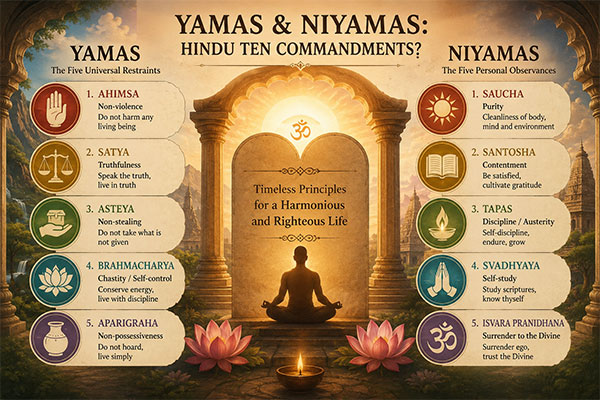
    The first set of five guidelines is called Yamas (Restraints). These guide our interaction with the external world.

    1. Ahimsa (Non-injury): Non-injury in thoughts and actions. Ahimsa should be practiced by living our life maintaining a conscious intention of causing the least possible injury to other living beings. A self-directed injury should also be curtailed by forgiving our own perceived transgressions from personal expectations.

    2. Satya (Truth): Truthfulness in conduct and speech. Fundamental to the practice of Satya is the ability and willingness to distinguish between truth and point of view.

    3. Asteya (Non-stealing): Taking only what is freely given. This guideline superficially seems to pertain to material things but can include stealing somebody’s happiness or wasting the limited shared universal resources like fresh water, food, etc.

    4. Brahmacharya (Abstinence): Personal energy conservation by avoiding overstimulation of senses. Sensual tempering can range from complete asceticism to gradual moderation.

    5. Aparigraha (Non-hoarding): Freedom from wanting more. Accumulating more than needed can be avoided by realizing what you already have, and a feeling of gratefulness towards it.

    The second set of five guidelines is called Niyamas (Observances). These guide an individual’s self-care:

    Saucha (Cleanliness): Cleaning is an act of separating two entities, one of which is undesired at that moment. The separation is done by daily or very regularly consciously selecting the desired entity. The undesired entity can be physical like spilled food or grim on the body; emotional like distressing memories associated with a person or place, and mental like immoral desires arising towards an object or person.

    Santosh (Satisfaction): Santosh is accepting life as it is. It does not mean abandoning efforts to better oneself. To practice Santosh is to be content at every moment, but continuously strive to better the overall situation.

    Tapas (fiery discipline): Tapas means the willingness to put effort by developing discipline, enthusiasm, and an intense desire to improve. Derived from the root word ‘tapa’, means to become hot. This results in the friction between your entrenched habits and the new self you want to be.

    Swadhyaya (self-study): One meaning of the niyama is the study of written works by enlightened people. But another meaning is the study of self. Being an honest, but compassionate observer of self. Having empathy and working on oneself leads to empathy towards the world.

    Ishwara pranidhana (Detachment from the result): The actual translation is completely offering yourself to the power that makes everything possible. For people with the belief or conclusion that there is such a higher power, the concept is easier. For people who do not believe in such an entity, it can be understood as letting go of the results of your actions after you have put in the best effort using the other nine guidelines.

    Whether the Yamas and Niyamas are better guidelines than the Ten Commandments depends on your personal beliefs, spiritual goals, and cultural context. Both sets of guidelines have their own merits and are suited to different paths of ethical and spiritual development. Some people might find that integrating aspects of both can provide a well-rounded approach to ethical living.

  • Festivals of prayerful lights

    Festivals of prayerful lights

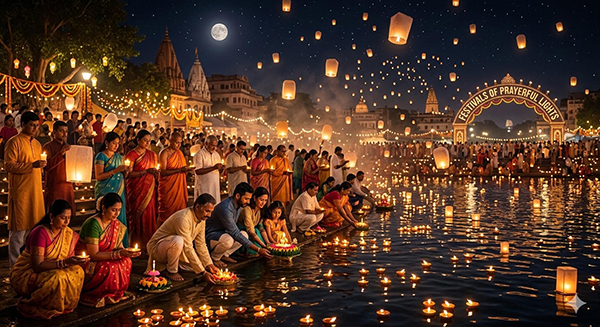
    There is a tradition in many Hindu households to light a lamp in the evening and pray. I remember my grandmother lighting up a small earthen oil lamp in front of our family altar and summoning me to recite the evening prayer. My primary motivation for showing up was getting to eat the sweet offerings (prasad) to the Deity after the worship. Once she explained to me the symbolism of an earthen lamp. The earthen lamp is like a human body. It is made of material that is temporarily borrowed from the earth. It lives its allotted span and then falls apart, returning to the mother earth. The oil in the lamp represents the person’s ego and worldly attachments. The Wick represents a single-pointed mind, which is lit by prayer and through gaining the knowledge of the Truth. The resultant flame of wisdom has to be protected from wayward gusts of desire. As the wick is lighted, the ego is consumed, and desires dissipate. At that age, I did not grasp the significance of this explanation, yet I remembered it because of the pleasant association with munching on the sweet treat of peanuts, jaggery, and rock sugar.

    Although the act of lighting a lamp or a candle is a universal act associated with praying, I feel that the act itself is akin to a prayer itself. The process of lighting a lamp or a candle requires concentration, even for a moment. For that fleeting instant, we are in true communion with the Divine as we watch the tip of the wick transform from an ordinary piece of cotton to a luminescent source. The light emanating from the lit lamp spreads all over, traveling within and towards the infinite space. Similarly, a pure prayer, untainted by the bartering of devotion for some earthly desires, sublimes to the infinite omnipresent Divine.

    Recently, the Deepavali festival (Deepavali- row of lamps) was celebrated all over the world by Hindus, Sikhs, Jains, and Buddhists, as well as many Indians of other faiths who realize that they are culturally Hindus. During Deepavali (also called Diwali), the Peoria Hindu community and their friends collected and donated 12,000 pounds equivalent of food to four local organizations, namely, the Center for Prevention of Abuse, Neighborhood House, Trewyn School, and Peoria Grown Market 360. This collective act of sharing was part of a massive national initiative called Sewa Diwali. In 2025, nearly a million pounds of food were collected and locally distributed throughout the USA.

    The act of sharing expresses the true meaning of lighting a lamp. Just as an unobstructed ray of light from a lamp travels infinitely, the act of sharing expresses the boundlessness of universal love and kindness. While a physical barrier stops the light, the bounty of love and kindness becomes limited when curtailed by the feeling of ‘otherness’ towards fellow human beings.

    As I thank our donors, calling them “generous” almost feels redundant. The word to describe the true nature of human beings is empathy (Karuna in the Sanskrit language). During this year’s Peoria food drive, the four hundred-plus donors were just revealing their true nature.

    As the less fortunate around the world are facing darkness and cold due to all kinds of “winters”, I pray to the Divine that the recent succession of festivals of various faiths may become a continuous row of lights exhorting us humans to manifest our true nature.

  • Prosylatism: A bane on humanity

    Prosylatism: A bane on humanity

    On March 11, 1689, on the eve of the auspicious Gudi Padwa, Sambhaji Maharaj, the second Chhatrapati of the Maratha Kingdom and eldest son of Chhatrapati Shivaji Maharaj, was brutally murdered under the orders of Mughal Emperor Aurangzeb.

    As we celebrate the Hindu New Year at our homes, places of worship, and with friends and colleagues of other faiths, we should solemnly remember those whose sacrifices have served as a lasting bulwark against forced conversion for the last millennia. Due to their sacrifices, we still retain our culture, way of worship, and freedom to practice or not practice them as we choose.

    After being captured through treachery, Aurangzeb presented Sambhaji with an ultimatum: convert to Islam or endure excruciating torture. Over forty agonizing days, Sambhaji endured unimaginable torment. Despite relentless pressure, he steadfastly clung to his Hindu faith. His tormentors peeled his skin, doused him in salt, sprinkled chili powder, inflicted lashes, pulled out nails, severed his tongue, blinded his eyes, crushed his hands and feet, and, in a final act of desperation, Aurangzeb ordered his beheading.

    Such barbarity was characteristic of Aurangzeb’s fanaticism. Earlier, in Delhi’s renowned Chandni Chowk, he executed the 9th Sikh Guru, Tegh Bahadur, on November 11, 1675, for refusing to renounce Sikhism. Before Tegh Bahadur’s decapitation, he was forced to watch his disciples suffer gruesome fates, including being sawn into pieces and being boiled alive. Countless Hindus and Sikhs met similar fates during Aurangzeb’s reign, enduring forced conversions or torture to death.

    Tragically, this culture of cruelty persists in modern times. During the 1971 Bangladesh independence war, the International Crimes Tribunal convicted several leaders of the Islamic Razakar militia, as well as the Bangladesh Muslim Awami League, of forced conversion of Bengali Hindus. The genocide of Kashmiri Pandits has stopped only recently, thanks to the iron-willed government in New Delhi.

    Every day, in Pakistan and Bangladesh, Hindus, Christians, and members of minority Islamic sects face harassment, rape, and forced conversion.

    It behooves those of us who are fortunate enough to be safe today to not only honor the memory of martyr heroes but also to alleviate the suffering of those still oppressed. In Bharat, the Citizenship Amendment Act (CAA) offers a glimmer of hope to refugees fleeing persecution in neighboring Islamic nations. In the USA, advocacy efforts should be intensified so that aid to these countries from the USA should be stringently tied to human rights records.

    Many in India uphold traditions to honor Sambhaji Maharaj’s sacrifice. Some forgo meals or cherished possessions for forty days, while others fast or practice various acts of penance. Despite often being overshadowed by his father’s legendary legacy, Sambhaji’s valor should occupy a prominent place in the minds of not only individuals of Indian descent but everyone in the world who is concerned about the evils of forced proselytization. If the forces of freedom work together, they will be victorious, just like the Marathas, who after Sambhaji’s death, kept on fighting such that even after trying for 27 years Aurangzeb could not capture Deccan and died there, a broken man.”

  • Who is Dnyaneshwar and why his buffalo?

    Who is Dnyaneshwar and why his buffalo?

    Dnyaneshwar was a thirteenth century saint and philosopher from India. He was a great proponent of Advaita, a very popular Hindu philosophy, which for in simple words professes that GOD is everything. Using a common metaphor, the GOD is the potter, the intelligence of making pots, the clay, the pottery wheel, the land on which the pottery making is occurring as well as the air inside and outside the pot.

    In his very short life of 21 years Dnyaneshwar enlightened ordinary mass, and left behind profound philosophical works in form that could be understood by the lay masses. One of his books is Dnyaneshwari, which was a poetic translation of Bhagwat Geeta from Sanskrit into the local language of Marathi.

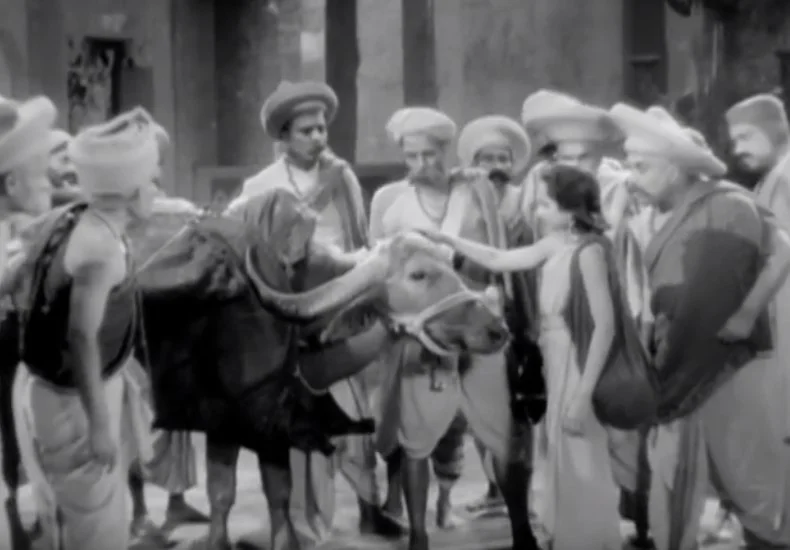
    One day young Dnyaneshwar got into a debate with a local scholar who ridiculed him on the Advaita philosophy. Incidentally, there was a man leading a male buffalo (called reda in Marathi) walking down the street. The scholar asked Dnyaneshwar whether he and the male buffalo shared the same divinity. Dnyaneshwar affirmed. The scholar laughed and said that then the male buffalo should be able to recite the scriptures. As the locals gather around, Dnyaneshwar lays his hand on the buffalo’s head. Miraculously, the buffalo starts reciting scriptural mantras.

    I have been associated with many such Dnyaneshwars in my life. Through their discourses, books, articles and informal talks they have laid their hands on my forehead, and whatever comes out of my keyboard (not pen any more) is through their grace. The metaphor of male buffalo is very apt that they are not very useful. The female gives milk. Sometimes the males are used to plow fields. Even this lowly animal shares the same divinity with all the creation. If we recognize the shared divinity, world peace will no longer be a fantasy only for idealists.

    The home page has a still from 1940 biopic Sant Dnyaneshwar.

  • Goals of life

    Goals of life

    In Sanskrit, the ancient language of the Hindus, there is a term called Simhavalokan – Lion’s gaze. When a lion is walking, after covering a distance, he will pause and turn back, as if contemplating where he came from, and then charting his future course. In short Simhavalokan is ‘in retrospect’.

    This year as I approach 50 years of my existence in this human body, I too am contemplating the goal of my life through the lens of the Hindu philosophy. In Hindu philosophy, there are four goals of human life: Artha, Kama, Dharma, and Moksha. Each life form is in the pursuit of happiness. Based on the degree of spiritual evolution, the perception of the pursued happiness evolves. In the most basic form, our happiness is related to the degree of our consumer abilities, which forms the basis of two of the four goals. The first goal of any life form is Artha, which can be translated as security or survival. This includes shelter, food, security from your enemies, and for humans, financial security. The second goal of all life forms is Kama, a desire for pleasure. The pleasure can be sexual or for humans it can be secondary to entertainment, gourmet food, desirable clothes, dance, music, etc.

    In pursuit of Artha and Kama, we need to be conscious that others have similar needs too. Our pursuit of happiness should not hamper the pursuit of happiness of others or deliberately cause someone else’s pain. To prevent the abuse of others during our pursuit of happiness, we need Dharma and Moksha. Dharma is derived from the root word Dhr-, one which supports. Dharma is the moral law that supports the existence and sustenance of the individual and society. Dharma encompasses the duties of an individual. When everyone performs their duties, everyone’s rights are automatically protected.

    A life of Dharma is lived when after our basic needs are satisfied, we graduate from being consumers to becoming contributors. A contributor seeks beyond his own needs for the benefit of society. The pleasure of contribution is more sustaining than the temporary pleasure of egotistic self-satisfaction. As a life of Dharma is lived, a human realizes that there is an ultimate goal, a limitless existence called Moksha. Moksha is to be one with the Divine after death, getting liberated from the cycle of reincarnation. Hindus believe in Divine justice through reincarnation. We are reborn to live as some life form, to suffer for or receive pleasure for our current & past actions. While we have to suffer for the bad action, the way to avoid being reborn is to be unattached to our good actions. We should avoid ‘my social work’, ‘my donation’, ‘my charity’. Performance of good actions without a sense of ownership of the effect leads to a soul with no attached baggage, clearing the way to attain Moksha. The best way to be unattached from your actions is to perform good deeds as an offering to the Divine.

    Moksha has nothing to do with the method of worship, religion, or belief system. It is attainable for all humans regardless whether you believe it or not. Every living entity in the entire creation is capable to the realization of Moksha, receiving complete freedom and oneness with the Divine, whether after this life or after multiple births. Just act with the mental state of Edam Namama- Nothing is mine. Every aspect of my life I surrender to the Divine.

    First published in thecommunityword.com

  • Debts of Humans

    Debts of Humans

    Yesterday, I was at a dinner hosted at a friend’s house when the person sitting opposite me introduced himself. In turn I introduced myself by just the name and expected to return to casual polite conversation with everyone. But he looked at me, and he repeated my name. He exclaimed, “You may not remember me, but you saved my life.” In my profession as a physician, I had apparently done something completely unaware, which was beyond the expected norms, and which greatly helped him. He was profusely thankful to me in front of everyone. On my way home, I was thankful to him in my mind for the opportunity he had provided me to decrease my human debt.

    All humans are born with certain debts which are called ‘Runa’ (roona). We have accumulated these runa in all our previous lives, and we continue to accumulate them in this life. The runa occur when someone else does something for us, and we owe them for that. The runa tie us to others. To achieve Moksha after we finish our human life, meaning we achieve liberation from the cycle of rebirth, we need to clear all our runa by performing actions to pay back these helpful deeds. At the same time it is paramount that we should not take ownership of the good acts we perform, so as to not create new bonds.

    The runa are of five kinds:

    1. Runa towards parents: This runa is cleared by taking care of your own parents as they age. In our lives, many people have stepped in the role of our parents. To pay back that runa, we need to help take care of all the elderly. Visiting elder homes to talk to residents who may yearn for company, getting children to send good-wishes cards to retirement homes, or volunteering in activities that benefit seniors all help decrease the runa.

    2. Runa towards teachers: The best way is to teach needy students. If you can, help teachers in underserved areas with school supplies. Volunteer at schools which need help. Attend and organize teacher appreciation events.

    3. Runa towards other humans: To thrive and prosper, to survive in this life, all of us need each other. This runa is cleared by helping others. The greater the difference between you and the helped person, the greater is the effect. Dedicating a small fixed time per week facilitates these activities.

    4. Runa towards nature: We are born at 5-15 pounds of weight. Our adult body is a collection of material from this mother earth, whether from plants or other animals. To sustain this body and mind, we need to sustain the environment. We clear our runa to nature by using only what we need. We milk the nature, instead of slaughtering it. We heal nature’s wounds by replanting, cleaning, and nurturing our environment.

    5. Runa towards divine: Surrendering our ego to the divine helps decrease the runa. Of course, this runa is never cleared, and it is not possible to be cleared. However, worshipping in your own manner, and allowing others to worship in their manner, thereby not imposing your beliefs on others, helps you mitigate this runa. I will end with a small prayer: May all be happy; May all be free from illness. May all see what is auspicious; May no one suffer. Aum, peace, peace, peace.

    First published in thecommunityword.com

  • Sewa – Selfless service

    Sewa – Selfless service

    Sewa is selfless service performed without expecting anything in return. It is an act performed by humans as a basic property of being a human, not guided by the expectation of joy dependent on desire fulfilment. As a human we feel compassion, which is a state in which one sees all life forms as part of one’s own self, and thus everyone’s suffering as one’s own suffering. The action which then takes place in response to this compassion is sewa. Thus, sewa is a physical manifestation of the realization of shared divinity in all life forms.

    Reasons for performing sewa:

    1. Sewa is worship. As Swami Vivekananda said, “Be grateful to the man you help, think of him as God. Is it not a great privilege to be allowed to worship God by helping our fellow men?” Even if you are atheist or agnostic, being skeptic about the existence of God, being a pragmatic humanist behooves you to feel the suffering of fellow humans and feel the urge to eradicate it.

    2. The world becomes yours. Every day we face the equation of ‘mine versus others.’ As we conduct sewa, the ‘mine’ side of the scale increases. You interact with people who are outside your usual comfort zone. You realize the commonality and emphasize on it. The differentiation becomes secondary, less glaring. Taken to the ultimate degree, it embodies the philosophy of ‘so ham asmi’ (I am what he is.).

    3. Sewa explores your fullest potential. Most of us are identified by our job or a corporate title. Sewa activities let you expand your repertoire of attributes. A computer engineer becomes a coach, a favorite math teacher, an environmentalist. You gain knowledge, overcome shyness, enhance leadership skills, and discover abilities you never knew you had. You realize that there are many more facets of your personality that get exposed, accentuated, and polished.

    4. Sewa lifts barriers. Sewa brings down the barriers between groups who have been separated by prejudice and stereotyping. It will alleviate the feeling of fear and hatred of people who are different. As you perform sewa, the served community gets curious about you in a positive manner. Once they come to know that you want nothing in return, they appreciate and accept you.

    5. Sewa mitigates mid-life crisis. As we age, many of us start pondering our mortality and the legacy we leave behind. The self-focused definition of joy starts to manifest limitations. Sewa helps us look outside. Instead of complaining and blaming, we start looking for solutions. Trash on the highway becomes an adopt-a-highway project. Our attention, intellect, and material strength becomes manifest in creating solutions, instead of getting trapped in quagmires on unhealthy excessive self-analysis and criticism.

    6. Sewa creates a better world for all. If the giver gives in such a way as to uphold the dignity of the receiver, over time the act of sewa empowers the receiver to be a self-respecting and self-reliant individual who can then perpetuate the cycle of serving others. Your act of sewa may have a butterfly effect of changing the life and destiny of a human or the entire humanity.

    On a final note, lots of acts of sewa are done unseen, unstated, un-recorded, and unpublished in small ways without even being understood by the doer that they are doing sewa. Don’t be awed by huge sums and organized efforts by large charities and be dejected by your relatively meager effort. A drowning man needs only one strong arm at the right time to save him, not an aircraft carrier.

    First published in thecommunityword.com 

  • Hindu perspective on discrimination

    Hindu perspective on discrimination

    A Hindu perspective on discrimination Recently, I was fortunate enough to be on a panel discussion on the topic of AntiSemitism at B’Nai B’Rith senior housing apartment. As I heard the speakers voice their opposition to Anti-Semitism and support the people of the Jewish faith, the words of one of the adages of Hinduism reverberated again and again in my mind … Aham Brahmasmi – I am Bramhan – I am the whole.

    The ancient wisdom proclaims that the true I in me is the same in you. The same divinity is in you and me, and in everything. Therefore, once I realize that we are composed of the same divinity, I cannot hate you based on you being yourself. A teacher once explained to me that according to Hindu philosophy if I was an earthen pot, then God or the divine force was the potter, the intellect of making the pottery, the clay used to make the pot, and also the content of the pot. The same God permeates me, you, and everything. Our separateness is an illusion, or Maya. In our human state, in our daily existence, we have to behave in a manner respecting this illusion, but if in our inner mind we constantly remind ourselves of our Universal oneness, then peace is the direct result.

    In our conversations we use similes like brave as a lion, beautiful as a rose, crafty as a fox. What is the simile for a human? I believe it is ‘kind as a human.’ Human beings by their primary nature are kind. However, due to external factors we get tarnished and our true self gets hidden. We try to identify the self by defining ourselves as distinct from others. This distinctness is supposed to be our selfness. The defining border first includes ourselves as an individual, then family, then relatives, and then some group of individuals. This concept then mandates that someone has to be the others. For one reason or another, the others then get vilified. To rise above hate, we should not just tolerate others, but we should accept and respect them. The highest level is when we do not feel that someone is other.

    A woman finds a lost child on the street outside her house. She cleans him, clothes him, and feeds him. After handing the child back to the authorities, she feels the satisfaction of service. Later in the day when she does the exact things to her own son, she does not give a second thought, and continues with her daily chores. Her kindness towards her own son was natural for her, and that kindness was so innate that it did not even register as something special she did for another human being. The rose will emanate its fragrance when worn in the hair of a beautiful woman, in a ditch by the side of the road, or in a pile of excrement. External factors will not alter its innate attribute. Each of us is like that rose. Our aroma is our kindness. Let us recognize the shared divinity within all the creation, express our true nature, and live in peace.

    First published in thecommunityword.com

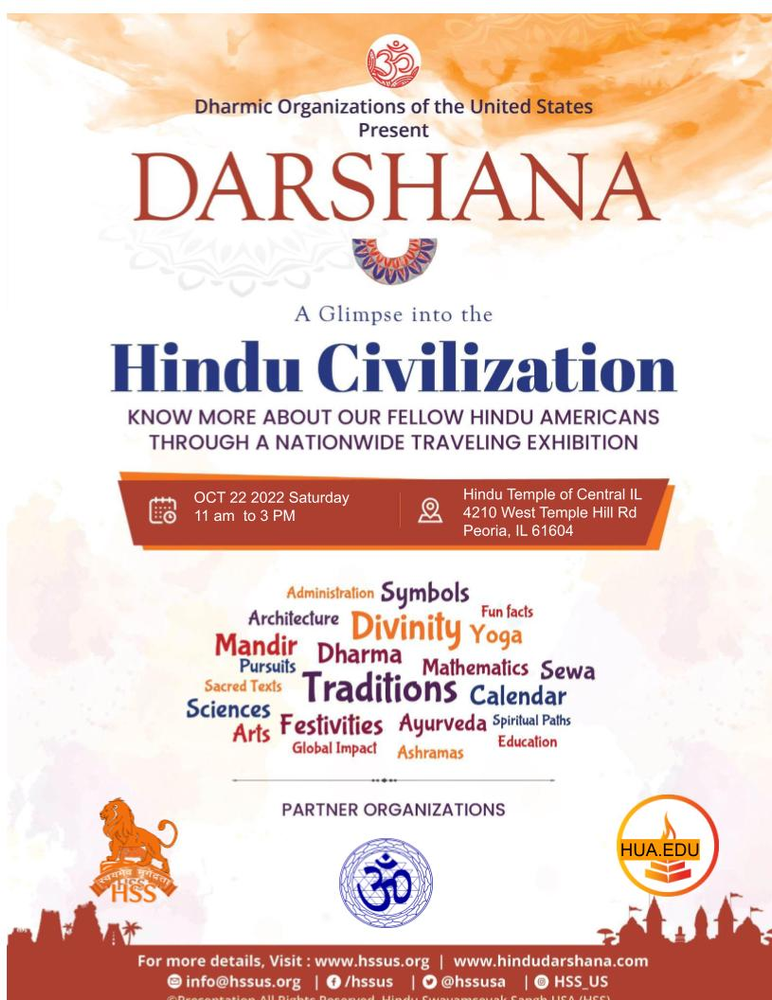
  • Darshana, a glimpse into the Hindu civilization

    Darshana, a glimpse into the Hindu civilization

    In our daily life, many of us interact with a Hindu in one way or another. Either your doctor, a coworker, a classmate, a close friend, a neighbor, a teacher, a business owner, or even a spouse. Some of us have witnessed a caricature of a Hindu in a TV serial or a cartoon. If you have ever wondered what the Hindu faith is or are curious to know more about your fellow Hindu Americans, this is a golden opportunity.

    Let me ask you a question. What do we all want? We all want to be happy. All our endeavors are in that direction. We seek material goods, pleasant experiences, power over others, suitable mates, and many other things which give us fleeting moments of happiness. But is it possible to have everlasting joy? The ancient Hindu sages meditated on this question and came to this answer. Yes, it is possible. We can be permanently happy by discovering our true divine nature. How do we do that?

    Hindus believe that the entire creation is made of pure consciousness. Our true nature is pure consciousness. Unfortunately, we have forgotten our true nature. Hinduism’s purpose is to return to our original selves and be permanently happy in our divine state.

    The first step is to base our life on an ethical foundation called Dharma. A few qualities of ethical living are described in the Hindu scriptures. The main ones are Ahimsa, non-injury; Satya, truth; and Brahmacharya, a disciplined life of nonindulgence. These are not commandments but are nuanced guidelines. The guidelines are context-based. Our Dharma depends on our social situation. Dharma for a policeman will be different than that of a teacher. In the same person, the Dharma today differs from the Dharma tomorrow. It is different depending on our role at that moment. Our Dharma as a child is different from our Dharma as a husband or parent. It is different when we are working at our job. Dharmic living is doing our duty at the present moment, thereby pouring our hearts out every time we do something, all the time and without attachment. There are lots of Hindu scriptures that help us decide what is ethical in a given situation. Dharma is the internal nature of everything. On a more profound scale, Dharma sustains everything, including us individually, our family, our community, our country, our earth, and the cosmos. Dharma has a much more nuanced definition which the actual exhibition will illustrate.

    The second step is Sewa which is selfless service. Also called karma yoga. For many of us, yoga is a contortion of body parts into postures. This aspect of yoga is just a small portion of the concept of yoga. The word yoga means union. It is the union of ourselves with our divine nature. Karma yoga is the action that unites us with our divine nature. We should do our duty because it is the right thing to do and not be result-oriented. Do everything as if it is an offering to the Divine. Hinduism understands that the path of connecting with divinity is difficult and has lots of steps. It needs mastery over oneself. It takes a long time which can span this life, but it also may need multiple lifetimes. In each life, you reach a particular point. In the next life, you begin where you left off and move forward or backward based on your action (karma) in the past birth. Everyone will get there at the end. How long it takes will depend on your actions. What you do now affects the future, either in this life or in the next life. There is accountability and consequence for everything you do. The flip side is that I accept what happens to me; hence I am able to accept sorrows and calamities. What I do and how I deal with my calamities affect my future. This way, we accept what is happening to us and do our best to handle it.

    The third step is the choice of three spiritual paths. Hinduism recognizes that all people are different, so there are different paths suited for people based on their different temperaments.

    • The first path is called Raj yoga. In this path, there are eight steps, of which the first two deal with practicing ethical restraints and ethical observations. The next three are physical postures and breathing exercises, as well as control of senses., The rest of the steps deal with meditation. This path requires consistent practice and great discipline.

    • The second part is Dnyana yoga which is the study of scriptures. Hindus have a massive library of scriptures describing the different paths. This path is intellectually strenuous, and a seeker needs a subtle mind to grasp the concepts.

    • The third path is Bhakti yoga, which is the path of Devotion. Essentially, we rest our minds and hearts in God. Anybody can do that, as there are no prerequisites.

    This raises the question, Which or what God? In Hinduism, there are varieties of ways in which divinity or God is conceptualized

    1) The first concept is pure consciousness which is described by the symbol pronounced as Om. Pure consciousness has no attribute and is infinite. This concept is difficult for many people to wrap their minds around.

    2) The second concept is Ishwara which is divinity with attributes. The all-knowing, all-powerful, all-controlling supreme being., which has no physical form, and our mind is open to the abstract.

    3) The third concept is the Divine in a personal form. People can connect much more easily to a personal form. With forms comes a personality and a story. If you know a story, you feel intimate with that form. You develop a close personal connection with that particular form of God. This tangible form is called a murti, represented by statues, photos, and physical symbols or objects. The mind stays easily focused on the physical form away from distractions. Although there are many physical forms of God, there is only one supreme being. Hindus worship one supreme being who can appear in many forms. We can use whichever form of divinity the divinity chooses to manifest itself.

    Choose any of these paths. Take part of this and part of that. Mix and match. Let’s find the divinity within ourselves and recognize it in the whole creation. Let us be happy.

    This is Hinduism in a nutshell. Our Darshana exhibition opens the shell somewhat for us to peer in and glimpse the unlimited.  

  • Raksha Bandhan – A potential world festival

    Raksha Bandhan – A potential world festival

    I am an optimist. I sincerely believe that if every human felt a bond with another, we may be able to overcome greed, lust for power, and insecurities and end all wars and resultant carnages. The more things we have in common, the better chance of this being possible (although all of us being humans was not good enough till now). A common festival celebrated all over the world by all humans irrespective of religion, race, geographic location, or social status, celebrated with OTHERS would be a good step in this direction. A festival celebrated by Hindus called Raksha-Bandhan is a good candidate for this World Festival.

    Traditionally, Raksha-Bandhan has been a festival during which sisters tie a decorated silken thread, a Rakhi, to the wrists of their brothers which establishes a bond or contract where the brother pledges to protect the sister, and the thread acts as an amulet with sister’s blessing to protect the brother. This was especially important when a married sister lived at a considerable distance from her parents’ home, and this festival was an occasion where the brother could visit her without protest from hostile in-laws. The sister would prepare a feast and welcome her brother. The brother in turn would give gifts to his sister, unfettered by his own wife. This relation between brother and sister could be non-biological, and there are many historical stories where a Rakhi-brother came through his obligation to help his Rakhi-sister in distress.

    In modern times, with many women being physically stronger than men, and physical strength being superseded by ballistic weapons, women routinely protect men from violence as police, soldiers, and bystanders. Additionally, physical strength is no longer the only shield, given that political power, financial power, and legal acumen may be very effective protective forces. Therefore, the organization to which I belong – Hindu Swayamsevak Sangh, USA (Hindu Volunteer Organization, USA) conducts a festival of tying Rakhis to police personnel, firefighters, as well as public officeholders, in addition to other volunteers of the organization. These Rakhis are tied regardless of gender, with a non-verbalized contract to protect each other when need arises. For the last sixteen years, more than a few dozen chapters have visited their brothers and sisters in the police station, fire stations, and elected official offices to explain the significance of the festival and tie the silken thread. This year we plan to expand to include sanitary workers, emergency communication centers, and locally any service providers who maintain safety of the general public.

    If this concept was expanded to and embraced by the general American public to appreciate and acknowledge not just the safety and security providers but also each other, crossing racial, socio-economical, and especially in the current environment, the political divide, this would strengthen our mutual bond. Assume for a second this concept taking hold in all countries and their citizens tying Rakhis to each other on one worldwide mutually agreed upon day, wherever all humans encounter each other. On the day, people will carry a bunch of Rakhis in their pockets as they leave their houses. Governments will issue biodegradable, nutrient infused viable plant seeds containing Rakhis for free distribution on railways and bus stations as well as airports. After the festival these Rakhis can be planted in any soil and seeds will germinate to give rise to plants. People will tie Rakhis to each other in international business meetings, security and peace

    negotiations, borders between countries, general passengers on airports, and even in the United Nations general assembly. Think about the impact on the overall human psychology where a physical action and the Rakhi – a physical memento – will remind every person the shared bond of mutual protection and welfare, even for one particular day of the year.

    Just something to think about, and possibly act on in the ‘not so distant’ future.

    First published in thecommunityword.com

  • Non-Anger (Akrodha)

    Non-Anger (Akrodha)

    There is a fable of a boy who is prone to angry outbursts. His father tells him to hammer a nail in the wooden fence post every time he is angry and abuses someone, and then remove that nail after he has apologized and made amends. After a week the boy proudly shows his father the post where he had hammered about a dozen nails and pulled them out. The father pats him on the back but points out the holes in the wood which remain despite all the amends.

    I wondered as to how many holes I have left on the psyche of my loved ones over the years. The Hindu scripture, Bhagwat Gita, states that to be able to receive the divine truth about the nature of things, an individual should possess twenty-six divine qualities. One of these is Akrodha, absence of anger, exemplified in the following story. One day a man asks a saint how he constantly remains calm and loving to everybody. The saint ignores him and instead tells the man that he will die in a weeks’ time. Knowing that the saint is a highly spiritually developed individual, the man believes him and immediately goes home. He puts his affairs in order, mends his relationship with his estranged brother and is extra loving to his family. He also gives up long standing grudges with his neighbors. On the seventh day, he touches the feet of the saint and says that he is ready to leave his human body with a serene mind. The saint advises him to contemplate on his last week and henceforth live his entire life, keeping in mind that the next instance could be his last.

    While some anger can motivate people to take an action against injustice, overall, the state of anger decreases cognitive and discernment ability. In terms of anger, human beings are at three levels. At the lowest level are openly belligerent people who are always waiting for a pretext to launch at someone. Some of these individuals think that they use their anger as a strategic tool to get what they want. At the middle level are the people who are also constantly angry but suppress it enough to be able to function in society. They use passive aggressive behavior, cynicism, and excessive critical analysis to manifest their pent-up anger. Finally, the remaining people are happy people who occasionally get angry for believing that someone is preventing them from acquiring something that will make them happy or that someone is responsible for their current unhappiness. These are the people who do not hold grudges and shortly return to their pleasant state. Each individual should self-realize their own situation, and only then will their evolution to the Akrodha state begin.

    The following are some of the techniques suggested by learned people: 1. Understand that regardless of the currently perceived imperfection, as a whole, the Universe is perfect. 2. Imagine yourself bathed with blue light, contrasting the red aura surrounding angry people. 3. Put a five-dollar bill in an anger management jar every time you get angry, which is aimed at building subconscious association of anger with loss of something previous. 4. Miss a meal after an anger outburst. 5. Offer one flower a day to the picture of the person who is the target of your anger, thereby completely reversing the emotional process. 6. Do three nice things to that person, with or without the knowledge of the target person. Over time the anger becomes a conscious process, which then you can control and voluntarily discard.

    Now we have all the gear, terrain charts, and know-hows to reach the goal of Akrodha. By realizing my own anger issues, and deciding to do something about it, I may already have begun my odyssey. Few fortunate people are very close to this goal, while many will never feel the need to start. Let’s pray that all of us who want to, will reach there.

    Respectfully submitted

    First published in thecommunityword.com

  • Lighting the light within

    Lighting the light within

    My family has had some ancestors who were highly spiritually evolved individuals. My paternal grandmother’s father was a householder yogi (yogi- one who seeks union of individual consciousness with the Universal consciousness) who held a day job as a government employee and raised a large extended family, but he was also an advanced yoga practitioner. Once, my grandmother explained to me his technique of meditation, where he turned both his eyes inwards and held concentration for a long time. He would see a light between his eyes, which he explained to her was the divine presence in his body. I tried the technique as a child but never saw anything. Over the years, I have realized that what he explained as a light was symbolic of the inner light. The light that drives away ignorance, illuminates the true knowledge, and takes us from being mere instinctual animals to the Divine.

    As the winter season approaches the countries in the northern hemisphere, each culture counters the long hours of darkness with festivals which involve symbolic lighting of lights. In Hinduism, the most famous fall/winter festival is Deepavali (October 27th for 2019), which means a row of lights. Historically, Deepavali was a celebration of the victorious return of King Rama with his wife who was kidnapped by an evil King Ravana sometime in the 15th century BCE. The victory is celebrated by lighting lamps, wearing new clothes, decorating the house, starting new account books, and distributing sweets. However, the deeper meaning is to reignite the light within. Just like during practice of any skillful event, we go through a dry run. Similarly, the external manifestation of Deepavali symbolizes cleaning the self (body and mind) and creating an environment of joy and well-being, which precedes the restarting of the quest for higher spiritual goals by lighting the pilot light of the spiritual furnace. The physical action of lighting the oil lamp has symbolic significance. The oil represents the bad tendencies of the person. The wick represents the ego. When lit with spiritual knowledge, the bad tendencies slowly get exhausted, and finally the ego also disappears. The flame is always directed upwards, symbolizing the higher aim. As the spiritual knowledge is shared, many lights are lit, and darkness of ignorance vanishes.

    Deepavali has five days. The first day is Dhanteras, when Dhanvantari – the Deity of health – is worshipped. The second day is Narak Chaturdashi, where symbolically, an evil demon is slayed. The third day is when Deity of Prosperity – Laxmi is worshipped. The fourth day is when wives seeks blessings for their husbands, and in return, they gift their wives to appreciate the other half of the family arch under whose care the rest of the family members flourish. The fifth day is when sisters seek blessings for their brothers, who appreciate their sisters with gifts. This sequence of events symbolizes the ascent of the person. Prior to any spiritual quest, the physical body is to be strengthened. A cramping aching back or joints will not let a person sit undistracted for a long time. Then the outside disturbing elements (demons of sorts) are to be subdued to establish external peace. After peace is established, the material affluence is gained so that the worldly duties, like taking care of the immediate family and the extended (whole creation) family, is achieved. Then comes the appreciation of the spouse without whose support none of this would be possible, and finally the representative of the family who took care of us before we went on to start our own family. After completion of these worldly duties, we are ready for seeking the absolute.

    Regardless of which pathway you follow, and which spiritual medium is your guide (guru, messiah, book, prophet or non-manifest entity), these steps in one form or the other will definitely lead you to your ultimate goal- the manifestation of the light within!

    First published in thecommunityword.com

  • The wish granting tree (Kalpataru)

    The wish granting tree (Kalpataru)

    In prehistoric times the good and the evil forces churned the ocean of the cosmos, and one of the unique objects which the Divine granted to the churners was a wish granting tree. One day a traveler comes across this tree and sits down in the shade, not knowing the special nature of the tree. Admiring the dense shade of the foliage, he wishes that he had a bed to take a nap. Suddenly a bed manifests. After his nap he wishes for food, which then materializes in front of him. Then he desire for a drink, and an assortment of libations are presented. After his immediate needs are satisfied, he wonders where all the goodies came from, and whether there were ghosts on the tree. Immediately, ghosts show up. He gets very scared and worries that the ghosts will eat him, and they do!

    We are constantly under a wishing tree. Our conscious mind, body, emotion, and prana (life force) when aligned together will grant us our wishes, whether they are success in profession, studies, or relationships. However, for most of us these forces conflict with each other. We hamper our own progress by putting up obstacles of self-doubt, false comparison, and blaming others. Frequently, we hear someone say, “But I am only a human.” This is an extremely tragic misconception that the highest life form is used as an epitome of weakness. As a human we can achieve what we truly want. But what do we want?

    In a certain village, there was a young boy who could not walk. He used to watch other kids play, and since he could not join them, he would hold their stuff, bring them water, and get joy from being part of the group. One day he heard of the wishing tree and decided to ask it to cure his legs. He reached the tree and instead of going directly, waited and watched from a small distance. First, a group of children came to the tree and asked for candies and toys. The tree showered them with lots of delicious candies and toys. But gobbling the candy gave them tummy ache and they got bored with the toys. The kids came back and threw the remaining candies at the tree. An old man came asking for a beautiful young bride. In few weeks, the man got tired from being suspicious that his young wife may be interested more in the younger neighbor than him. Some men came and asked for fame, fortune, and power. Fame was followed by jealousy. Fortune followed by greed, and power followed by enemies. If you ask for freedom, then the risk of getting lost is inherent. In a short amount of time, people who were begging the tree for boons wanted to cut the tree and burn it to the ground. Everybody blamed the tree. Nobody realized that all their misery was due to desire and fear. The quest to satisfy desire was like throwing gasoline to extinguish a fire. Similarly, fear resulted in suspicion, cowering for safety, and the inability to advance due to fear of failure. The boy then realized that the only way to make the tree work for you was to wish for somebody else’s benefit. The joy of enabling someone else to become happy was the true satisfier of desires and overcomer of fears.

    This is the secret of the Kalpataru. When a human aligns all mind, body, emotion, and prana (life force) for the betterment of others, all their wishes come true. The next human you meet today, just smile, and truly wish him well. If you are going to ask, “How are you,” then plan to wait, listen, and care as to how they really are feeling and if you could help in any way. When you say good-bye, do truly wish the person the best of everything. Overtime you will not only get your wishes granted by the Kalpataru, but you will become a Kalpataru.

    First published in thecommunityword.com 

  • Guru

    Guru

    My salutations to the guru who opens the eyes of the one who is blind due to the darkness of ignorance with an ointment of knowledge.

    The first full week of May is celebrated as Teachers Appreciation week in USA. I fondly remember Teachers’ day in my school in India when the graduating 10th grade students took on the role of teachers for a day, and taught lessons. As I grew older, the impact of the teacher became more and more evident to me. Not only we learned from teacher the subject content, but also learned how to learn. They taught me how to think and at their best, they taught me how to differentiate good from bad masquerading as good.

    The word Guru is formed from root words Gu- darkness and Ru-dispeller of. In Hindu tradition, a Guru is placed in an exalted position. Any Hindu who has achieved prominence in a field, will proudly proclaim their educational lineage. This is especially true among classically trained musicians and dancers, who will place a photograph of their teacher in front of them during a recital. Children are told many inspirational stories of great teachers and their students. Often repeated is a story of the King Shivaji who offered his kingdom as the honorarium to his Guru Saint Ramdas. The Guru in turn asked the King to rule in his name, thereby setting a standard for the behavior of the ruler and principles for administration. In modern times our school teachers embody these attributes. I can vividly remember the times I have glanced into classrooms at the school where we conduct a reading program. The patience and dedication with which the teacher interacted with students especially some with behavior difficulties was superhuman. Even gifted students can be exacting at times. But, day after day, year after year, decade after decade, the teacher turns out men and women who will shape the future of mankind. These special beings deserve more than a thank you card. In USA, Hindu Swayamsevak Sangh, an organization to which I belong, conducts Guru Vandana Program annually. Last year seventy chapters invited teachers to a ceremony where they were felicitated in a traditional Hindu ritual with garlands, offerings and obeisance.

    There are countless ancient manuscripts in Hindu literature and philosophy where texts are attributed to a name but were authored over thousands of years. This is because each subsequent writer wrote under the name of his teacher, who had himself written under the name of his own teacher. Thus, the first teacher’s name carried on for centuries. Just imagine this in today’s world of copyright and patents.

    The first teacher of a child is the mother. This education begins in the uterus prior to exposure to the outside confusing, cacophonic world. This stresses the responsibility of the expectant mother and the people in her vicinity in maintaining the ambience where virtuous thoughts and acts prevail. Keeping such a pristine environment is difficult but attempt should be made in that direction.

    The relationship between student and teacher is bidirectional. Given the god-like status of the teacher, it behooves them to maintain their behavior to that standard, not just in the school environment but also at home, on weekends and on vacation. A student should never see the teacher in a less than optimal situation. I understand that some will say, “I did not sign up for this tall order. Just give me my salary and I will educate your children.” That’s ok. But for the rest, I bow my head to you. May you complete your evolution from teacher to Guru.