Yesterday, I was at a dinner hosted at a friend’s house when the person sitting opposite me introduced himself. In turn I introduced myself by just the name and expected to return to casual polite conversation with everyone. But he looked at me, and he repeated my name. He exclaimed, “You may not remember me, but you saved my life.” In my profession as a physician, I had apparently done something completely unaware, which was beyond the expected norms, and which greatly helped him. He was profusely thankful to me in front of everyone. On my way home, I was thankful to him in my mind for the opportunity he had provided me to decrease my human debt.
All humans are born with certain debts which are called ‘Runa’ (roona). We have accumulated these runa in all our previous lives, and we continue to accumulate them in this life. The runa occur when someone else does something for us, and we owe them for that. The runa tie us to others. To achieve Moksha after we finish our human life, meaning we achieve liberation from the cycle of rebirth, we need to clear all our runa by performing actions to pay back these helpful deeds. At the same time it is paramount that we should not take ownership of the good acts we perform, so as to not create new bonds.
The runa are of five kinds:
1. Runa towards parents: This runa is cleared by taking care of your own parents as they age. In our lives, many people have stepped in the role of our parents. To pay back that runa, we need to help take care of all the elderly. Visiting elder homes to talk to residents who may yearn for company, getting children to send good-wishes cards to retirement homes, or volunteering in activities that benefit seniors all help decrease the runa.
2. Runa towards teachers: The best way is to teach needy students. If you can, help teachers in underserved areas with school supplies. Volunteer at schools which need help. Attend and organize teacher appreciation events.
3. Runa towards other humans: To thrive and prosper, to survive in this life, all of us need each other. This runa is cleared by helping others. The greater the difference between you and the helped person, the greater is the effect. Dedicating a small fixed time per week facilitates these activities.
4. Runa towards nature: We are born at 5-15 pounds of weight. Our adult body is a collection of material from this mother earth, whether from plants or other animals. To sustain this body and mind, we need to sustain the environment. We clear our runa to nature by using only what we need. We milk the nature, instead of slaughtering it. We heal nature’s wounds by replanting, cleaning, and nurturing our environment.
5. Runa towards divine: Surrendering our ego to the divine helps decrease the runa. Of course, this runa is never cleared, and it is not possible to be cleared. However, worshipping in your own manner, and allowing others to worship in their manner, thereby not imposing your beliefs on others, helps you mitigate this runa. I will end with a small prayer: May all be happy; May all be free from illness. May all see what is auspicious; May no one suffer. Aum, peace, peace, peace.
Sewa is selfless service performed without expecting anything in return. It is an act performed by humans as a basic property of being a human, not guided by the expectation of joy dependent on desire fulfilment. As a human we feel compassion, which is a state in which one sees all life forms as part of one’s own self, and thus everyone’s suffering as one’s own suffering. The action which then takes place in response to this compassion is sewa. Thus, sewa is a physical manifestation of the realization of shared divinity in all life forms.
Reasons for performing sewa:
1. Sewa is worship. As Swami Vivekananda said, “Be grateful to the man you help, think of him as God. Is it not a great privilege to be allowed to worship God by helping our fellow men?” Even if you are atheist or agnostic, being skeptic about the existence of God, being a pragmatic humanist behooves you to feel the suffering of fellow humans and feel the urge to eradicate it.
2. The world becomes yours. Every day we face the equation of ‘mine versus others.’ As we conduct sewa, the ‘mine’ side of the scale increases. You interact with people who are outside your usual comfort zone. You realize the commonality and emphasize on it. The differentiation becomes secondary, less glaring. Taken to the ultimate degree, it embodies the philosophy of ‘so ham asmi’ (I am what he is.).
3. Sewa explores your fullest potential. Most of us are identified by our job or a corporate title. Sewa activities let you expand your repertoire of attributes. A computer engineer becomes a coach, a favorite math teacher, an environmentalist. You gain knowledge, overcome shyness, enhance leadership skills, and discover abilities you never knew you had. You realize that there are many more facets of your personality that get exposed, accentuated, and polished.
4. Sewa lifts barriers. Sewa brings down the barriers between groups who have been separated by prejudice and stereotyping. It will alleviate the feeling of fear and hatred of people who are different. As you perform sewa, the served community gets curious about you in a positive manner. Once they come to know that you want nothing in return, they appreciate and accept you.
5. Sewa mitigates mid-life crisis. As we age, many of us start pondering our mortality and the legacy we leave behind. The self-focused definition of joy starts to manifest limitations. Sewa helps us look outside. Instead of complaining and blaming, we start looking for solutions. Trash on the highway becomes an adopt-a-highway project. Our attention, intellect, and material strength becomes manifest in creating solutions, instead of getting trapped in quagmires on unhealthy excessive self-analysis and criticism.
6. Sewa creates a better world for all. If the giver gives in such a way as to uphold the dignity of the receiver, over time the act of sewa empowers the receiver to be a self-respecting and self-reliant individual who can then perpetuate the cycle of serving others. Your act of sewa may have a butterfly effect of changing the life and destiny of a human or the entire humanity.
On a final note, lots of acts of sewa are done unseen, unstated, un-recorded, and unpublished in small ways without even being understood by the doer that they are doing sewa. Don’t be awed by huge sums and organized efforts by large charities and be dejected by your relatively meager effort. A drowning man needs only one strong arm at the right time to save him, not an aircraft carrier.
A Hindu perspective on discrimination Recently, I was fortunate enough to be on a panel discussion on the topic of AntiSemitism at B’Nai B’Rith senior housing apartment. As I heard the speakers voice their opposition to Anti-Semitism and support the people of the Jewish faith, the words of one of the adages of Hinduism reverberated again and again in my mind … Aham Brahmasmi – I am Bramhan – I am the whole.
The ancient wisdom proclaims that the true I in me is the same in you. The same divinity is in you and me, and in everything. Therefore, once I realize that we are composed of the same divinity, I cannot hate you based on you being yourself. A teacher once explained to me that according to Hindu philosophy if I was an earthen pot, then God or the divine force was the potter, the intellect of making the pottery, the clay used to make the pot, and also the content of the pot. The same God permeates me, you, and everything. Our separateness is an illusion, or Maya. In our human state, in our daily existence, we have to behave in a manner respecting this illusion, but if in our inner mind we constantly remind ourselves of our Universal oneness, then peace is the direct result.
In our conversations we use similes like brave as a lion, beautiful as a rose, crafty as a fox. What is the simile for a human? I believe it is ‘kind as a human.’ Human beings by their primary nature are kind. However, due to external factors we get tarnished and our true self gets hidden. We try to identify the self by defining ourselves as distinct from others. This distinctness is supposed to be our selfness. The defining border first includes ourselves as an individual, then family, then relatives, and then some group of individuals. This concept then mandates that someone has to be the others. For one reason or another, the others then get vilified. To rise above hate, we should not just tolerate others, but we should accept and respect them. The highest level is when we do not feel that someone is other.
A woman finds a lost child on the street outside her house. She cleans him, clothes him, and feeds him. After handing the child back to the authorities, she feels the satisfaction of service. Later in the day when she does the exact things to her own son, she does not give a second thought, and continues with her daily chores. Her kindness towards her own son was natural for her, and that kindness was so innate that it did not even register as something special she did for another human being. The rose will emanate its fragrance when worn in the hair of a beautiful woman, in a ditch by the side of the road, or in a pile of excrement. External factors will not alter its innate attribute. Each of us is like that rose. Our aroma is our kindness. Let us recognize the shared divinity within all the creation, express our true nature, and live in peace.
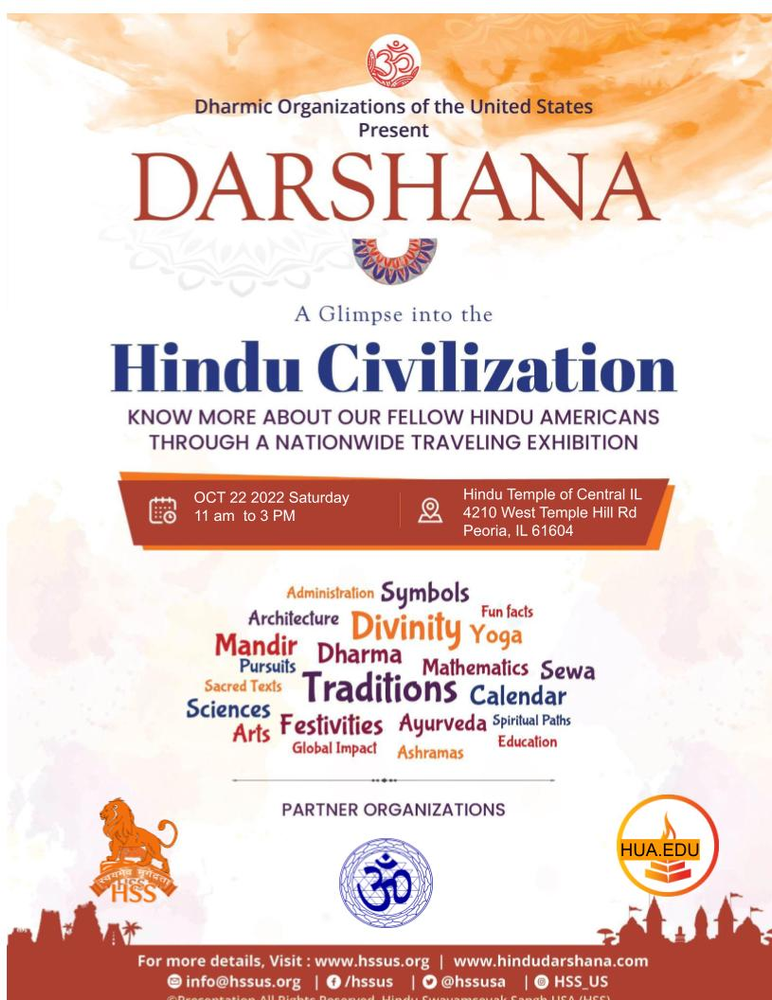
In our daily life, many of us interact with a Hindu in one way or another. Either your doctor, a coworker, a classmate, a close friend, a neighbor, a teacher, a business owner, or even a spouse. Some of us have witnessed a caricature of a Hindu in a TV serial or a cartoon. If you have ever wondered what the Hindu faith is or are curious to know more about your fellow Hindu Americans, this is a golden opportunity.
Let me ask you a question. What do we all want? We all want to be happy. All our endeavors are in that direction. We seek material goods, pleasant experiences, power over others, suitable mates, and many other things which give us fleeting moments of happiness. But is it possible to have everlasting joy? The ancient Hindu sages meditated on this question and came to this answer. Yes, it is possible. We can be permanently happy by discovering our true divine nature. How do we do that?
Hindus believe that the entire creation is made of pure consciousness. Our true nature is pure consciousness. Unfortunately, we have forgotten our true nature. Hinduism’s purpose is to return to our original selves and be permanently happy in our divine state.
The first step is to base our life on an ethical foundation called Dharma. A few qualities of ethical living are described in the Hindu scriptures. The main ones are Ahimsa, non-injury; Satya, truth; and Brahmacharya, a disciplined life of nonindulgence. These are not commandments but are nuanced guidelines. The guidelines are context-based. Our Dharma depends on our social situation. Dharma for a policeman will be different than that of a teacher. In the same person, the Dharma today differs from the Dharma tomorrow. It is different depending on our role at that moment. Our Dharma as a child is different from our Dharma as a husband or parent. It is different when we are working at our job. Dharmic living is doing our duty at the present moment, thereby pouring our hearts out every time we do something, all the time and without attachment. There are lots of Hindu scriptures that help us decide what is ethical in a given situation. Dharma is the internal nature of everything. On a more profound scale, Dharma sustains everything, including us individually, our family, our community, our country, our earth, and the cosmos. Dharma has a much more nuanced definition which the actual exhibition will illustrate.
The second step is Sewa which is selfless service. Also called karma yoga. For many of us, yoga is a contortion of body parts into postures. This aspect of yoga is just a small portion of the concept of yoga. The word yoga means union. It is the union of ourselves with our divine nature. Karma yoga is the action that unites us with our divine nature. We should do our duty because it is the right thing to do and not be result-oriented. Do everything as if it is an offering to the Divine. Hinduism understands that the path of connecting with divinity is difficult and has lots of steps. It needs mastery over oneself. It takes a long time which can span this life, but it also may need multiple lifetimes. In each life, you reach a particular point. In the next life, you begin where you left off and move forward or backward based on your action (karma) in the past birth. Everyone will get there at the end. How long it takes will depend on your actions. What you do now affects the future, either in this life or in the next life. There is accountability and consequence for everything you do. The flip side is that I accept what happens to me; hence I am able to accept sorrows and calamities. What I do and how I deal with my calamities affect my future. This way, we accept what is happening to us and do our best to handle it.
The third step is the choice of three spiritual paths. Hinduism recognizes that all people are different, so there are different paths suited for people based on their different temperaments.
• The first path is called Raj yoga. In this path, there are eight steps, of which the first two deal with practicing ethical restraints and ethical observations. The next three are physical postures and breathing exercises, as well as control of senses., The rest of the steps deal with meditation. This path requires consistent practice and great discipline.
• The second part is Dnyana yoga which is the study of scriptures. Hindus have a massive library of scriptures describing the different paths. This path is intellectually strenuous, and a seeker needs a subtle mind to grasp the concepts.
• The third path is Bhakti yoga, which is the path of Devotion. Essentially, we rest our minds and hearts in God. Anybody can do that, as there are no prerequisites.
This raises the question, Which or what God? In Hinduism, there are varieties of ways in which divinity or God is conceptualized
1) The first concept is pure consciousness which is described by the symbol pronounced as Om. Pure consciousness has no attribute and is infinite. This concept is difficult for many people to wrap their minds around.
2) The second concept is Ishwara which is divinity with attributes. The all-knowing, all-powerful, all-controlling supreme being., which has no physical form, and our mind is open to the abstract.
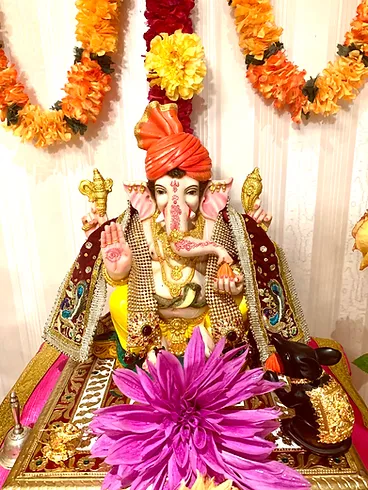
3) The third concept is the Divine in a personal form. People can connect much more easily to a personal form. With forms comes a personality and a story. If you know a story, you feel intimate with that form. You develop a close personal connection with that particular form of God. This tangible form is called a murti, represented by statues, photos, and physical symbols or objects. The mind stays easily focused on the physical form away from distractions. Although there are many physical forms of God, there is only one supreme being. Hindus worship one supreme being who can appear in many forms. We can use whichever form of divinity the divinity chooses to manifest itself.
Choose any of these paths. Take part of this and part of that. Mix and match. Let’s find the divinity within ourselves and recognize it in the whole creation. Let us be happy.
This is Hinduism in a nutshell. Our Darshana exhibition opens the shell somewhat for us to peer in and glimpse the unlimited.
Since ancient times stories of the prosperity and civilizational advancement in the Indian subcontinent have attracted foreign invaders for centuries. Many of those invaders were repulsed or subsequently driven out. Some willingly assimilated into the intricately interwoven fabric of the Bharatiya (Indian) culture and added to it. Unfortunately, the pattern of destructive invasions started in 711 AD with Muhammed bin Qasim, an Umayyad general who invaded Sindh. After this, a long list of invasions occurred, which left severe destruction of the culture, places of learning, and worship in their path. No ancient Hindu temple is intact in the entire northern half of India. This was accompanied by the mostly forced conversion of the native Hindu population to Islam. The long-term effect of this multigenerational trauma on the public psyche was very severe. Towards the end of British rule, people of the subcontinent were free to decide for the future. But instead of focusing on individual freedom, socioeconomic upliftment, and regional security, the Muslims demanded the partition of the subcontinent with the resultant genocide during the forced migration and the continued Kashmir violence.
The effect still resonates in the relationship between the Hindus and the Muslims who chose to remain in India (Muslims increased from 9.4% in 1951 to 14,2% in 1991- source www.factly. in). The effect is now evident even in America, with recent appeals by certain communities to avoid patronizing businesses and brands owned by people of the other community. (https://truthout.org/articles/activists-plan-boycott-of-us-companies-backing-indias-anti-muslim-policies/
12/n Just last weekend Mr. Iqbal, a #Hinduphobe member of the Islamist group – IAMC, which promotes Pieter Friedrich, was ranting against "Patels" and asking Muslims not to "shop at Patel Brothers". Eerily reminiscent of Nazi Germany's boycott of Jewish owned business in 1930s. pic.twitter.com/WRl9dfnlhr
During the pre-independence period, Mahatma Gandhiji attempted to build bridges between the Hindu-Muslim communities through actions such as supporting the Khilafat movement to modifying the famous Hindu bhajan Raghupati Raghava Raja Ram (adding the phrase Ishwar Allah Tero Naam to the lyrics). Many other well-known and not so known attempts were made. However, these failed miserably with the resultant separation of the Islamic countries of Pakistan and Bangladesh and a secular India. Moreover, the politics of division initially begun by the Britishers and continued by the subsequent Indian political parties resulted in worsening mutual suspicion and fracture of trust between the two communities, who together are inheritors of the rich cultural heritage of the entire subcontinent.
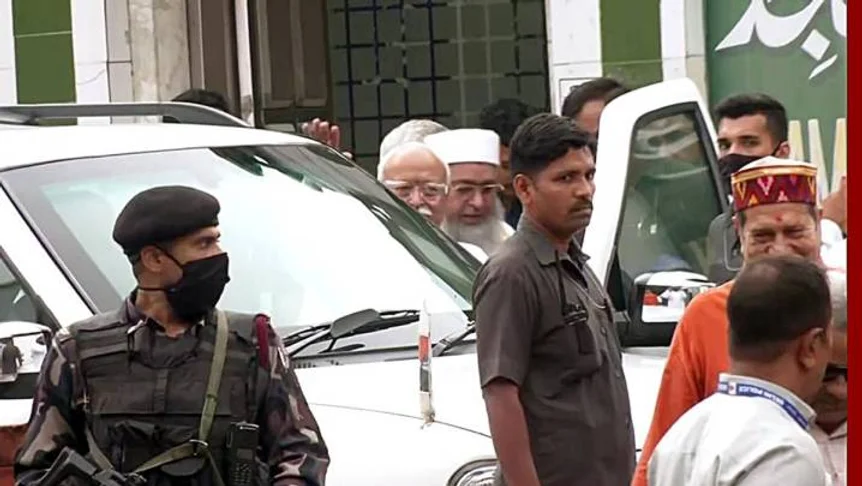
With the clear understanding that reconciliation and a united way forward are essential for the continued development of the entire population of India, recently, a group of five prominent Indian Muslims initiated a meeting and subsequently met with Rashtriya Swayamsevak Sangh (RSS) chief Mohanji Bhagwat on Aug 22, 2022, at Keshav Kunj RSS office in New Delhi. What struck out about this meeting was that a news conference or a press release did not follow it. Somehow the information about this meeting reached the media, and the resultant curiosity resulted in a series of interviews of these persons individually and in groups by the members of the press. The rest of this article is based on multiple video interviews and news articles about this meeting. All the statements attributed to the RSS Sar Sanghachalak (Chief) are quoted by the Muslim participants (with minimal paraphrasing by this author. Sources are listed below). The Muslim luminary participants of this discussion (henceforth addressed as visitors- since they visited the RSS office) were Najeeb Jung, Former Lieutenant Governor of Delhi, SY Quraishi, Former Chief Election Commissioner of India, Shahid Siddiqui, Editor of Nayi Duniya, and former Member of Parliament-Rajya Sabha, Lt. Gen Zameer Uddin Shah Ex Vice Chief of Army and the hotelier Saeed Shervani.
The visitors reiterated that ‘we are not politicians with large followings nor have received a mandate from any organization to represent the Indian Muslims, but this meeting was a humble effort from some common citizens to attempt reconciliation and rapprochement between two communities because we believe that is the only way forward for India to go ahead, which is the desire of any nation loving Indian.’ Furthermore, they believed that since the RSS is the largest organization of Hindus in the world, it was a good starting point to talk to the chief of the RSS and put out their concerns, hear his concerns, and take the matter forward on how together they can try to improve relations between communities and take steps to ensure there is no polarization between Hindus and Muslims.
The visitors hoped that if they were successful in opening a dialogue, they could convert this small initiative into a larger movement in which the people who are now skeptical would join them.
One interviewer Karan Thapar blatantly misinterpreted the Mohanji Bhagwat quote, “Every Indian is a Hindu,” by saying that this means that it does not include all the Indian minorities largest of which are Muslims. Dr. Jung promptly corrected him, saying, “It includes Muslims. Per Bhagwatji, Muslims are part of the larger family. Bhagwat redefined the word Hindu to mean Bharatiya (meaning ‘of Bharat,’ the ancient name of the Indian subcontinent). I am repeating his words that India has to go forward, and that can happen when there is reconciliation and when all communities go hand in hand. That is the clear message he (Mohan Bhagwat) gave us. Not just a message, those were his words”.
He further elaborated, “According to Bhagwat, we accept Muslims in the larger fold of Vedic Dharma, you can practice what you want, how u want”.
Part of this discussion was the open airing of the top grievances in the minds of both communities.
Hindu issues (per Mohanji Bhagwat):
• Hindus feel aggrieved when a large number of Muslims call them Kaffirs (non-believers). The Muslims are not accepting of Hindus. Dr. Jung said that he replied to Bhagwatji, “the Muslims and Christians have to accept that there are many paths that lead to God. Quran is misinterpreted a lot. Quran says your path is yours and mine is mine. Most Muslims and even clerics accept that calling Hindus Kaffirs is wrong. Koran says there is no compulsion in religion”.
• Bhagwat is asking Muslims to voluntarily stop eating beef because it is very sensitive to Hindus. In response to this, Dr. Jung felt that 90% of Muslims will agree to this request since if you want to live in peace, keeping from hurting the Hindu sentiment is essential.
Muslim issues (per visitors):
• Muslims don’t like being called ‘Jihadis’, ‘Pakistani’, or ‘Babur ki Aulad’ (progeny of Babur). Muslims are accused of love jihad. Indian Muslims don’t want to keep needing to prove their patriotism.
• Muslims are believed to be increasing their population to overcome Hindus in numbers by polygamy and not participating in family planning endeavors.
• Muslims feel insecure and are being made to pay a price for mistakes of the past.
One interviewer repeatedly asked the visitors, “Is this a man (Mohanji Bhagwat) whose sincerity you trust”.
“Yes”, was the visitor’s unequivocal reply. “Within one month after our meeting, he visited a mosque and a madrassa, which means he kept up the spirit of our meeting”. Since July, Mohanji Bhagwat also met with different Muslim groups one in Ghaziabad and one in Mumbai.
The visitors quoted Mohan Bhagwat multiple times.
• “I will make my effort, and it will take time to percolate”.
• “At the highest level of RSS, we have discussed this issue”.
• “Twenty percent is not a minority. They (Muslims) have to be part of the growth process”.
• “Hindutva does not exclude Muslims”.
• “India cannot exist without Muslims”.
• “We cannot conceive of India progressing without its Muslims”.
• “Everything will be done according to the constitution of India”.
They further added that Mohanji Bhagwat will appoint four RSS leaders to continue the talks. The visitors sincerely believed that if any hard-headed Hindu organization makes statements like calling for the genocide of Muslims, he (Bhagwat) will oppose that.
One of the interviewers asked about the nay-sayers who expressed that meetings such as these give legitimacy to RSS, and whether RSS is using this meeting for its PR purpose only. The visitors replied, “RSS has the support of at least half the Hindu population. Not only party workers in the ruling BJP but many in opposition parties also support RSS. An RSS volunteer is the Prime Minister of India and so are Chief Ministers of many states. Why do you think they need our credibility? Even if they are doing this for their image, it is good for everybody”. To the detractor who called them elitists, the visitors replied, “We are not fools. We live in public”.
“Open dialogue is the only way forward. No other country cares about Muslims. In Burma, in China, Muslim genocide is rampant. Pakistani is wagging its tail in front of China. No Arab nation is opposing China about its treatment of Muslims”.
The visitors mentioned that of the telephone calls they received, 90 percent of Muslims and non-Muslims supported this initiative. “There is overwhelming support in India for the idea of reconciliation. This is the time that the idea must come to fruition. We must engage, not only with RSS but also with the Jamat-e-Islami, the ulema of Deoband school”.
Per the visitors, planning for subsequent meetings is being made in which other issues like the issue of CAA and NRC will be brought up.
Watching the interviews filled me with hope. Am I being too naïve? The history of more than a thousand years suggests that the difficulties are seemingly unsurmountable. But a thousand years is a small period of time for inhabitants of Bharatvarsha (Indian subcontinent). Our ancient scripture Isha Upanishad says, “A wise man beholds all beings in the self and the self in all beings; therefore, he does not hate anyone”. Hopefully, all of us internalize this eternal wisdom, and not let differences in ways of worship alienate us from our true divine nature.
Recently we visited the Indian Pueblo Cultural Center in New Mexico near Albuquerque and perused the exhibition on the Ancient Puebloan culture and history. We learned about the massive destruction of the Native Americans by successive waves of colonizing nations of Spain, Mexico, and the United States. There was intentional genocide of people for their land and natural resources, presumed unintentional mass death by exposure to foreign pathogens brought by the colonizers, the exploitation of natives for labor, as well as destruction of their culture and religion by forced religious conversion. The story was sad and heart-wrenching.
However, the Pueblo Indians have survived and currently practice some of their original cultures passed down through successive generations from oral traditions. They now practice Catholicism as a fusion of Roman Catholicism and native rituals. On the contrary, any remnant of the pre-Islamic culture in the Middle East1 or the Pre-Christian European Religions2 has been almost completely destroyed. There are no practitioners of the indigenous Arabian polytheism or ancient Semitic religions. Very few, if any, practitioners of Mandaeism, Manichaeism, or Zoroastrianism exist. Zoroastrianism practitioners called Parsis exist in India and have prospered (One of the largest business houses in India – the Tata family is Parsi.). Pre-Christian European religions like Norse Forn Sidr, Druidism, and Roman polytheism, among others, have been completely wiped out, except for some fringe elements of the society.
In India, the onslaught of Islam for nearly two thousand years led to extensive conversion and destruction of places of culture and worship. India got partitioned into Islamic Pakistan, Islamic Bangladesh, and secular majority Hindu India. Most major places of worship of Hindus in northern India were destroyed by the religiously intolerant invaders, resulting in such an intergenerational psychological trauma that the Hindus have built very few grand religious structures even after independence in 1947. The geographic extent of Hinduism, which once extended from modern Afghanistan to Indonesia3, is now confined to mainly India and sprinkling of diaspora throughout the world. The hundred years of British colonization of India did not see extensive conversion or destruction. The British colonizers committed innumerable atrocities in India. Well-known are the three million preventable deaths during the Bengal famine of 19434, stealing nearly a trillion dollars’ worth of material wealth5 and destroying the ancient Hindu educational system6. But they were benign compared to the other colonizers like the Belgians in Congo, the Spaniards in Central and South America, as well as the Portuguese in Goa, Angola, and Mozambique. The Macaulay education system destroyed the Hindu educational system resulting in self-doubting generations of Hindus who, till now, seek validation from the west for every aspect of life. Still, the destruction was not as complete. I can speak, read, and write in my ancestral language Marathi. However, India would have been in a far worse situation if Spain or Portugal had ruled India. I quake with tribulation when I read about the actions of the Spaniards in South America and Central America, as well as the Portuguese in the Indian state of Goa and Angola. I am thankful to have still my Hindu name and access to the philosophical treasure trove of ancient Hindu wisdom.
We cannot change the painful history of oppressed groups, but we can work to protect ourselves in the future. The people following these ancient traditions must come together and support each other. There is a sizeable silent number of good people in this world who are outside these traditions but are good humans. If they become aware of their numbers and strength, these people can pressure their governments to form a bulwark against current and future onslaught against the ancient traditions. While waiting on the bench near the exit, I overheard angry murmurs from the visiting group of young adults in the museum from other states and some from other countries expressing the need to do something for the oppressed people. I smiled with hope in my heart for our collective future.
One organization attempting to unite ancient traditions is the International Center of Cultural Studies. https://www.iccsglobal.org
Featured image is A picture from the exhibit “Pivot Skateboard Desk Art Exhibit- celebrating rapid transition between traditional and say-day life of Native Americans.”
I am an optimist. I sincerely believe that if every human felt a bond with another, we may be able to overcome greed, lust for power, and insecurities and end all wars and resultant carnages. The more things we have in common, the better chance of this being possible (although all of us being humans was not good enough till now). A common festival celebrated all over the world by all humans irrespective of religion, race, geographic location, or social status, celebrated with OTHERS would be a good step in this direction. A festival celebrated by Hindus called Raksha-Bandhan is a good candidate for this World Festival.
Traditionally, Raksha-Bandhan has been a festival during which sisters tie a decorated silken thread, a Rakhi, to the wrists of their brothers which establishes a bond or contract where the brother pledges to protect the sister, and the thread acts as an amulet with sister’s blessing to protect the brother. This was especially important when a married sister lived at a considerable distance from her parents’ home, and this festival was an occasion where the brother could visit her without protest from hostile in-laws. The sister would prepare a feast and welcome her brother. The brother in turn would give gifts to his sister, unfettered by his own wife. This relation between brother and sister could be non-biological, and there are many historical stories where a Rakhi-brother came through his obligation to help his Rakhi-sister in distress.
In modern times, with many women being physically stronger than men, and physical strength being superseded by ballistic weapons, women routinely protect men from violence as police, soldiers, and bystanders. Additionally, physical strength is no longer the only shield, given that political power, financial power, and legal acumen may be very effective protective forces. Therefore, the organization to which I belong – Hindu Swayamsevak Sangh, USA (Hindu Volunteer Organization, USA) conducts a festival of tying Rakhis to police personnel, firefighters, as well as public officeholders, in addition to other volunteers of the organization. These Rakhis are tied regardless of gender, with a non-verbalized contract to protect each other when need arises. For the last sixteen years, more than a few dozen chapters have visited their brothers and sisters in the police station, fire stations, and elected official offices to explain the significance of the festival and tie the silken thread. This year we plan to expand to include sanitary workers, emergency communication centers, and locally any service providers who maintain safety of the general public.
If this concept was expanded to and embraced by the general American public to appreciate and acknowledge not just the safety and security providers but also each other, crossing racial, socio-economical, and especially in the current environment, the political divide, this would strengthen our mutual bond. Assume for a second this concept taking hold in all countries and their citizens tying Rakhis to each other on one worldwide mutually agreed upon day, wherever all humans encounter each other. On the day, people will carry a bunch of Rakhis in their pockets as they leave their houses. Governments will issue biodegradable, nutrient infused viable plant seeds containing Rakhis for free distribution on railways and bus stations as well as airports. After the festival these Rakhis can be planted in any soil and seeds will germinate to give rise to plants. People will tie Rakhis to each other in international business meetings, security and peace
negotiations, borders between countries, general passengers on airports, and even in the United Nations general assembly. Think about the impact on the overall human psychology where a physical action and the Rakhi – a physical memento – will remind every person the shared bond of mutual protection and welfare, even for one particular day of the year.
Just something to think about, and possibly act on in the ‘not so distant’ future.
There is a fable of a boy who is prone to angry outbursts. His father tells him to hammer a nail in the wooden fence post every time he is angry and abuses someone, and then remove that nail after he has apologized and made amends. After a week the boy proudly shows his father the post where he had hammered about a dozen nails and pulled them out. The father pats him on the back but points out the holes in the wood which remain despite all the amends.
I wondered as to how many holes I have left on the psyche of my loved ones over the years. The Hindu scripture, Bhagwat Gita, states that to be able to receive the divine truth about the nature of things, an individual should possess twenty-six divine qualities. One of these is Akrodha, absence of anger, exemplified in the following story. One day a man asks a saint how he constantly remains calm and loving to everybody. The saint ignores him and instead tells the man that he will die in a weeks’ time. Knowing that the saint is a highly spiritually developed individual, the man believes him and immediately goes home. He puts his affairs in order, mends his relationship with his estranged brother and is extra loving to his family. He also gives up long standing grudges with his neighbors. On the seventh day, he touches the feet of the saint and says that he is ready to leave his human body with a serene mind. The saint advises him to contemplate on his last week and henceforth live his entire life, keeping in mind that the next instance could be his last.
While some anger can motivate people to take an action against injustice, overall, the state of anger decreases cognitive and discernment ability. In terms of anger, human beings are at three levels. At the lowest level are openly belligerent people who are always waiting for a pretext to launch at someone. Some of these individuals think that they use their anger as a strategic tool to get what they want. At the middle level are the people who are also constantly angry but suppress it enough to be able to function in society. They use passive aggressive behavior, cynicism, and excessive critical analysis to manifest their pent-up anger. Finally, the remaining people are happy people who occasionally get angry for believing that someone is preventing them from acquiring something that will make them happy or that someone is responsible for their current unhappiness. These are the people who do not hold grudges and shortly return to their pleasant state. Each individual should self-realize their own situation, and only then will their evolution to the Akrodha state begin.
The following are some of the techniques suggested by learned people: 1. Understand that regardless of the currently perceived imperfection, as a whole, the Universe is perfect. 2. Imagine yourself bathed with blue light, contrasting the red aura surrounding angry people. 3. Put a five-dollar bill in an anger management jar every time you get angry, which is aimed at building subconscious association of anger with loss of something previous. 4. Miss a meal after an anger outburst. 5. Offer one flower a day to the picture of the person who is the target of your anger, thereby completely reversing the emotional process. 6. Do three nice things to that person, with or without the knowledge of the target person. Over time the anger becomes a conscious process, which then you can control and voluntarily discard.
Now we have all the gear, terrain charts, and know-hows to reach the goal of Akrodha. By realizing my own anger issues, and deciding to do something about it, I may already have begun my odyssey. Few fortunate people are very close to this goal, while many will never feel the need to start. Let’s pray that all of us who want to, will reach there.
My family has had some ancestors who were highly spiritually evolved individuals. My paternal grandmother’s father was a householder yogi (yogi- one who seeks union of individual consciousness with the Universal consciousness) who held a day job as a government employee and raised a large extended family, but he was also an advanced yoga practitioner. Once, my grandmother explained to me his technique of meditation, where he turned both his eyes inwards and held concentration for a long time. He would see a light between his eyes, which he explained to her was the divine presence in his body. I tried the technique as a child but never saw anything. Over the years, I have realized that what he explained as a light was symbolic of the inner light. The light that drives away ignorance, illuminates the true knowledge, and takes us from being mere instinctual animals to the Divine.
As the winter season approaches the countries in the northern hemisphere, each culture counters the long hours of darkness with festivals which involve symbolic lighting of lights. In Hinduism, the most famous fall/winter festival is Deepavali (October 27th for 2019), which means a row of lights. Historically, Deepavali was a celebration of the victorious return of King Rama with his wife who was kidnapped by an evil King Ravana sometime in the 15th century BCE. The victory is celebrated by lighting lamps, wearing new clothes, decorating the house, starting new account books, and distributing sweets. However, the deeper meaning is to reignite the light within. Just like during practice of any skillful event, we go through a dry run. Similarly, the external manifestation of Deepavali symbolizes cleaning the self (body and mind) and creating an environment of joy and well-being, which precedes the restarting of the quest for higher spiritual goals by lighting the pilot light of the spiritual furnace. The physical action of lighting the oil lamp has symbolic significance. The oil represents the bad tendencies of the person. The wick represents the ego. When lit with spiritual knowledge, the bad tendencies slowly get exhausted, and finally the ego also disappears. The flame is always directed upwards, symbolizing the higher aim. As the spiritual knowledge is shared, many lights are lit, and darkness of ignorance vanishes.
Deepavali has five days. The first day is Dhanteras, when Dhanvantari – the Deity of health – is worshipped. The second day is Narak Chaturdashi, where symbolically, an evil demon is slayed. The third day is when Deity of Prosperity – Laxmi is worshipped. The fourth day is when wives seeks blessings for their husbands, and in return, they gift their wives to appreciate the other half of the family arch under whose care the rest of the family members flourish. The fifth day is when sisters seek blessings for their brothers, who appreciate their sisters with gifts. This sequence of events symbolizes the ascent of the person. Prior to any spiritual quest, the physical body is to be strengthened. A cramping aching back or joints will not let a person sit undistracted for a long time. Then the outside disturbing elements (demons of sorts) are to be subdued to establish external peace. After peace is established, the material affluence is gained so that the worldly duties, like taking care of the immediate family and the extended (whole creation) family, is achieved. Then comes the appreciation of the spouse without whose support none of this would be possible, and finally the representative of the family who took care of us before we went on to start our own family. After completion of these worldly duties, we are ready for seeking the absolute.
Regardless of which pathway you follow, and which spiritual medium is your guide (guru, messiah, book, prophet or non-manifest entity), these steps in one form or the other will definitely lead you to your ultimate goal- the manifestation of the light within!
In prehistoric times the good and the evil forces churned the ocean of the cosmos, and one of the unique objects which the Divine granted to the churners was a wish granting tree. One day a traveler comes across this tree and sits down in the shade, not knowing the special nature of the tree. Admiring the dense shade of the foliage, he wishes that he had a bed to take a nap. Suddenly a bed manifests. After his nap he wishes for food, which then materializes in front of him. Then he desire for a drink, and an assortment of libations are presented. After his immediate needs are satisfied, he wonders where all the goodies came from, and whether there were ghosts on the tree. Immediately, ghosts show up. He gets very scared and worries that the ghosts will eat him, and they do!
We are constantly under a wishing tree. Our conscious mind, body, emotion, and prana (life force) when aligned together will grant us our wishes, whether they are success in profession, studies, or relationships. However, for most of us these forces conflict with each other. We hamper our own progress by putting up obstacles of self-doubt, false comparison, and blaming others. Frequently, we hear someone say, “But I am only a human.” This is an extremely tragic misconception that the highest life form is used as an epitome of weakness. As a human we can achieve what we truly want. But what do we want?
In a certain village, there was a young boy who could not walk. He used to watch other kids play, and since he could not join them, he would hold their stuff, bring them water, and get joy from being part of the group. One day he heard of the wishing tree and decided to ask it to cure his legs. He reached the tree and instead of going directly, waited and watched from a small distance. First, a group of children came to the tree and asked for candies and toys. The tree showered them with lots of delicious candies and toys. But gobbling the candy gave them tummy ache and they got bored with the toys. The kids came back and threw the remaining candies at the tree. An old man came asking for a beautiful young bride. In few weeks, the man got tired from being suspicious that his young wife may be interested more in the younger neighbor than him. Some men came and asked for fame, fortune, and power. Fame was followed by jealousy. Fortune followed by greed, and power followed by enemies. If you ask for freedom, then the risk of getting lost is inherent. In a short amount of time, people who were begging the tree for boons wanted to cut the tree and burn it to the ground. Everybody blamed the tree. Nobody realized that all their misery was due to desire and fear. The quest to satisfy desire was like throwing gasoline to extinguish a fire. Similarly, fear resulted in suspicion, cowering for safety, and the inability to advance due to fear of failure. The boy then realized that the only way to make the tree work for you was to wish for somebody else’s benefit. The joy of enabling someone else to become happy was the true satisfier of desires and overcomer of fears.
This is the secret of the Kalpataru. When a human aligns all mind, body, emotion, and prana (life force) for the betterment of others, all their wishes come true. The next human you meet today, just smile, and truly wish him well. If you are going to ask, “How are you,” then plan to wait, listen, and care as to how they really are feeling and if you could help in any way. When you say good-bye, do truly wish the person the best of everything. Overtime you will not only get your wishes granted by the Kalpataru, but you will become a Kalpataru.
My salutations to the guru who opens the eyes of the one who is blind due to the darkness of ignorance with an ointment of knowledge.
The first full week of May is celebrated as Teachers Appreciation week in USA. I fondly remember Teachers’ day in my school in India when the graduating 10th grade students took on the role of teachers for a day, and taught lessons. As I grew older, the impact of the teacher became more and more evident to me. Not only we learned from teacher the subject content, but also learned how to learn. They taught me how to think and at their best, they taught me how to differentiate good from bad masquerading as good.
The word Guru is formed from root words Gu- darkness and Ru-dispeller of. In Hindu tradition, a Guru is placed in an exalted position. Any Hindu who has achieved prominence in a field, will proudly proclaim their educational lineage. This is especially true among classically trained musicians and dancers, who will place a photograph of their teacher in front of them during a recital. Children are told many inspirational stories of great teachers and their students. Often repeated is a story of the King Shivaji who offered his kingdom as the honorarium to his Guru Saint Ramdas. The Guru in turn asked the King to rule in his name, thereby setting a standard for the behavior of the ruler and principles for administration. In modern times our school teachers embody these attributes. I can vividly remember the times I have glanced into classrooms at the school where we conduct a reading program. The patience and dedication with which the teacher interacted with students especially some with behavior difficulties was superhuman. Even gifted students can be exacting at times. But, day after day, year after year, decade after decade, the teacher turns out men and women who will shape the future of mankind. These special beings deserve more than a thank you card. In USA, Hindu Swayamsevak Sangh, an organization to which I belong, conducts Guru Vandana Program annually. Last year seventy chapters invited teachers to a ceremony where they were felicitated in a traditional Hindu ritual with garlands, offerings and obeisance.
There are countless ancient manuscripts in Hindu literature and philosophy where texts are attributed to a name but were authored over thousands of years. This is because each subsequent writer wrote under the name of his teacher, who had himself written under the name of his own teacher. Thus, the first teacher’s name carried on for centuries. Just imagine this in today’s world of copyright and patents.
The first teacher of a child is the mother. This education begins in the uterus prior to exposure to the outside confusing, cacophonic world. This stresses the responsibility of the expectant mother and the people in her vicinity in maintaining the ambience where virtuous thoughts and acts prevail. Keeping such a pristine environment is difficult but attempt should be made in that direction.
The relationship between student and teacher is bidirectional. Given the god-like status of the teacher, it behooves them to maintain their behavior to that standard, not just in the school environment but also at home, on weekends and on vacation. A student should never see the teacher in a less than optimal situation. I understand that some will say, “I did not sign up for this tall order. Just give me my salary and I will educate your children.” That’s ok. But for the rest, I bow my head to you. May you complete your evolution from teacher to Guru.
A few weeks ago, I was browsing the Darshana exhibit on Hinduism: https://hindudarshana.com. I was overwhelmed by the appreciation of the great humanistic view of the Hindu Dharma and the universally applicable philosophy it teaches to all humans regardless of their way of worship. I was glad that we were sharing this marvel with our fellow Americans through the avenue of the exhibition throughout the USA. Sadly, a few days after the exhibition, many of our esteemed public official guests who had graced the exhibition received letters from a group of miscreants spreading false information about Hindus, Hindu organizations, and Hinduism to besmirch the goodwill generated by the exhibition. I contemplated why somebody would engage in this behavior.
I realized that the people who denigrate Hindus generally fall into five categories:
1. The first category is the good-natured people who are misguided by the articles and news items in the mainstream media. Many respectable media houses selectively highlight unfortunate events in India. They rarely have stories of any positive stories about Hindus or India. These media sources will selectively splice stories to demonstrate how a Hindu group in India violently reacted to some provocation and will not talk about the inciting act itself. Historical wrongs like the destruction of the temple at Ayodhya (the birthplace of Lord Ram) will not be discussed. Instead, the reclamation of the ancient space will be addressed in a negative light (for review on this topic please read, https://pattekar.medium.com/the-epochal-beginning-of-the-restoration-of-one-of-the-holiest-sites-of-hindus-a-story-of-loss-3e2f19d70e5). Attacks on Hindus are never addressed in American news. Hindus are lumped as Indians or minorities described by their specific religions. The prime example of this phenomenon is the selective reporting about the riots in Gujarat in 2002. None of these stories mention that the riots were a reaction to the 58 Hindu pilgrims being burnt alive by a communal mob. Atrocities committed by minorities in India are never given airtime. No American media reported on the recent decapitation of a Hindu shopkeeper by a minority mob in India for expressing support for a Hindu politician. The only people interviewed for news items are those with a particular slant to support the media’s intentional preconceived bias. The Hindu genocide in Kashmir gets minimal airtime on media like NPR in contrast to the widespread negative coverage of the Indian government’s attempt to maintain the rule of law. The good-natured American people who read the articles believe them without understanding the background and the multifaceted premise.
The onus for responding to these people falls entirely on the American Hindus. Hindus in their daily lives should interact with their neighbors and colleagues and take the initiative to explain any news about Hindus and India to friends and colleagues. Hindus should also be more represented in the media, a refrain voiced by many for a long time.
2. The second category is the religious zealots who are frustrated by the resistance shown by Hindus to their attempt to convert them to their religion. These zealots spend millions of dollars and extensive effort to convert Hindus. They want to spread misinformation, disinformation, and mal information about Hinduism and Hindus to decrease the confidence their vulnerable Hindu targets have in their Hindu upbringing and philosophy. These missionaries also aim to increase the monetary donation collected from their supporters to “harvest the souls” of Hindus. Nice American people who will never hurt a fly in their own life will donate their hard-earned money to the missionaries with a misguided good intention of “pulling the Hindus out of the darkness of Hinduism”. When we hear our American friends or acquaintances say proudly that they’re going to India for missionary activities, please question them on why they want to practice the violence of breaking the Hindu society. To quote the great Hindu teacher Swami Dayanand Saraswati, “Conversion is an act of violence because it hurts deeply, not only the other members of the family of the converted but the entire community that comes to know of it”.
I have seen extensive conversion activity targeted toward Hindu students in American Universities. These students are very emotionally vulnerable due to financial, psychological, and educational stress. The vulnerable young students are preyed upon by people to convert them to their religion. This psychospiritual genocide of Hindu University students can be counteracted by the Hindu American people living in University towns who should take an interest in the welfare of Hindu students. This can be done by socially engaging the existing students and new arrivals. The established Hindus should connect with Hindu student organizations at the universities, participate in cultural programs and invite student groups to their homes, temples, and social functions.
3. The third category is people who themselves, their loved ones or their ancestors have been abused by the many bad people who have misinterpreted and misrepresented Hindu scriptures to discriminate and exploit their Hindu brethren for generations. These people have perverted the original ancient horizontal organizational system of classification of society. This system divided people into groups called varna based on an individual’s natural inclination as well into professional family guilds of jati. The system was corrupted into a vertically stratified caste system where the groups who were in power by their knowledge or physical/economic strength exploited and abused the people from the lower weaker strata. On one end of the spectrum, I have firsthand witnessed discrimination against people based on their caste during my student days in villages around my medical school. On the other end, I have also intimately experienced the noblest human beings of the ‘so-called upper castes’ who strived for uplifting people from the lowest social groups. I am a product of a mixed jati parentage myself. Discrimination based on jati and varna is illegal in India since the establishment of the Republic of India, in the year 1950, although in certain quarters of Hindus, this behavior unfortunately persists.
Every Hindu especially those in the privileged groups should take it upon themselves to integrate the people of marginalized communities into their social circles. This has to be done on an individual basis. In terms of America, this means keeping your eyes open and figuring out who among your colleagues and neighbors are from the community which has been historically mistreated by the socially advantaged Hindus in India and taking it upon themselves to form friendships and includes them in the religious rituals and by just be a true Hindu.
4. The fourth category is the academics who have made a career by calling themselves experts on Hinduism by selectively highlighting adverse societal phenomena and interpreting every possible Hindu principle to twist it into its worse possible interpretation. These are highly intelligent malevolent individuals who willfully ignore the true universally benevolent nature of Hindu Dharma. These people can only be counteracted by Hindus entering the liberal arts fields of study. Unfortunately, in America, most Hindus are in STEM careers. If more American Hindus including non-Hindu Americans, with a true understanding of Hinduism, enter the academic world and present the Hindu principles, these rabid wolves in sheep’s clothing will be exposed.
5. Lastly, falling into the fifth category are those Hindus who believe that since they have achieved fame in one field like acting, modeling, or business, they have an acquired qualification to make ignorant baseless blanket statements about Hinduism. These people usually parrot whatever their friends want to hear and cause grave damage since many young Hindus value their opinion, which is circulated on popular social media. The only way to neutralize these people is to immediately repudiate their statements on the same media platform by a large number of true scholars.
based on an individual’s natural inclination as well into professional family guilds of there may be many more categories in which I believe the readers would come up with their observations. I implore you my friends, to please not be a passive witness but be proactive and if needed, reactive to this onslaught on Hinduism. Please make sure that the beautiful treasure trove of universal principles is shared with humanity and not relegated to some musty corner of obscurity.
In our daily life, many of us interact with a Hindu in one way or another. Either your doctor, a coworker, a classmate, a close friend, a neighbor, a teacher, a business owner, or even a spouse. Some of us have witnessed a caricature of a Hindu in a TV serial or a cartoon. If you have ever wondered what the Hindu faith is, or you are curious to know more about your fellow Hindu Americans, there is a golden opportunity close to you.
We all want to be happy. All our endeavors are in that direction. We seek material goods, pleasant experiences, power over others, suitable mates, and many other things which give us fleeting moments of happiness. But is it possible to have everlasting happiness? The ancient Hindu sages meditated on this question and came to this answer. Yes, it is possible. We can be permanently happy by discovering our true divine nature. How do we do that?
Hindus believe that the entire creation is made of pure consciousness. Our true nature is pure consciousness. Unfortunately, we have forgotten our true nature. The entire purpose of Hinduism is to get back to our original selves and be permanently happy in our divine state.
The first step is to base our life on an ethical foundation which is called Dharma. To live ethically, there are a few qualities that are described in the Hindu scriptures. The main ones are Ahimsa, which is non-injury, Satya which is truth, and Brahmacharyawhich is a disciplined life of nonindulgence. These are not commandments but are nuanced guidelines. The guidelines are context-based. Our Dharma depends on our social situation. Dharma for a policeman will be different than that of a teacher. In the same person, the Dharma today is not the same as the Dharma tomorrow. It is different depending on our role at that moment. Our Dharma as a child is different than our dharma as a husband or as a parent. Dharmic living is doing our duty at the present moment, thereby pouring our heart out every time we do something, all the time and without attachment. There are lots of Hindu scriptures that help us decide what is ethical in a given situation. Dharma is the true internal nature of everything. On a more profound scale Dharma is what sustains everything, including us individually, our family, our community, our country, our earth as well as the cosmos. Dharma has a much more nuanced definition which the actual exhibition will illustrate.
The second step is Sewa which is selfless service. Also called karma yoga. For many of us, yoga equates to a contortion of body parts into postures. This aspect of yoga is just a small portion of the concept of yoga. The word yoga means union. It is the union of ourselves with our divine nature. Karma yoga is the action that unites us with our divine nature. We should do our duty because it is the right thing to do and not be result-oriented. Do everything as if it is an offering to the Divine. Hinduism understands that the path of connecting with divinity is difficult. It needs mastery over oneself. It takes a long time which can span this life but also may need multiple lifetimes. In each life, you reach a particular point. In the next life, you begin where you left, and move forward or backward based on your action (karma) in the past birth. Everyone will get there at the end. How long it takes will depend on your actions. What you do now affects the future either in this life or in the next life. There is accountability and consequence for everything you do. The flip side is that I accept what happens to me, hence I am able to accept sorrows and calamities. What I do and how I deal with my calamities affect my future. This way we accept what is happening to us and do our best to handle it.
The third step is the choice of three spiritual paths. Hinduism recognizes that people are different. So there are different paths suited for different people based on their different temperaments.
The first path is called Raj yoga. In this path, there are eight steps of which the first two deal with practicing ethical restrains, and ethical observations. The next three are physical postures and breathing exercises as well as control of senses., The rest of the steps deal with meditation. This path requires consistent practice and great discipline.
The second part is Dnyana yoga which is the study of scriptures. Hindus have a massive library of scriptures describing the different paths. This path is intellectually strenuous, and a seeker needs a subtle mind to grasp the concepts.
The third path is Bhakti yoga, which is the path of Devotion. Essentially, we rest our minds and hearts in God. Anybody can do that as there are no prerequisites.
This raises the question, Which or what God? In Hinduism, there are varieties of ways in which divinity or God is conceptualized.
The first concept is pure consciousness which is described by the symbol pronounced as Om. Pure consciousness had no attribute and is infinite. This is a difficult concept to wrap their minds around for many people.
The second concept is Ishwara which is divinity with attributes. The all-knowing, all-powerful all-controlling supreme being. This has no physical form, and our mind is open to the abstract.
The third concept is the Divine in a personal form. People can connect much more easily to a personal form. With forms comes a personality and a story. If you know a story you felt intimate with that form. You develop a close personal connection with that particular form of God. This tangible form is called a murti. This is represented by statues, photos, and physical symbols or objects. The mind stays easily focused on the physical form away from distractions. Although there are many physical forms of God, there is only one supreme being. Hindus worship one supreme being who can appear in many forms. We can use whichever form of divinity that the divinity chooses to manifest itself.
Choose any of these paths. Take part of this and part of that. Mix and match. Let’s find the divinity within ourselves and recognize it in the whole creation. Let us be happy.
On many occasions, I have been asked by non-Hindus, about the essence of Hindu Dharma. Like many of us, I have struggled in the brief moments to try to achieve the balance between barely skimming the surface and diving too deep into the gold mine which is Hindu Dharma. A few years ago, I came across the remains of an old pamphlet in our temple bookshelf in Peoria IL, which was tattered, describing the 5 Ps of Hindu Dharma. On further ruminating, I added some more Ps and rephrased the original material. Unfortunately, I do not remember who had published the original booklet and cannot give due credit to the author who planted the seed in my mind.
Please note that this is the outline of an elevator speech, so please forgive me if some key concepts are missing. Once the elevator interaction progresses to friendship and further discussion over lunch, dinner, or liquid imbibements, you are free to pontificate based on your knowledge.
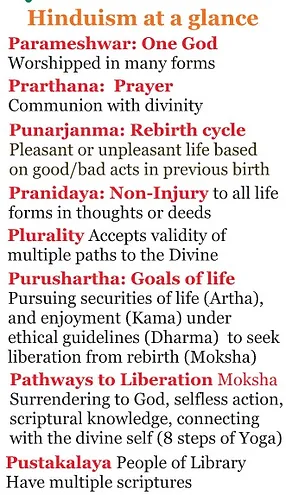
Here are my 8Ps of Hinduism:
,P,arameshwar: One God. Hindus believe in one God who is worshipped in many forms. There is the freedom to choose a physical form (statue, object, drawing, plant, or animal), or no form based on your preference.
,P,rarthana: Prayer. Vocal or silent prayer which is the communion of Hindus with the Divinity.
,P,unarjanma: Rebirth cycle. Pleasant or unpleasant life experiences in the current life are based on the good/bad acts in the previous birth. This serves as an all-encompassing Divine justice system, with no ‘get out of jail Free- card’. This can be expounded with details on the karma concept, punishment mitigating actions, as and when time permits.
,P,ranidaya: Ahimsa – Non-injury to all life forms in thoughts or deeds.
,P,lurality: Acceptance of validity of multiple paths to the divine. Hindus have no issues with other religions and do not try to actively proselyte.
,P,urusharthas: Goals of life. Pursuing security of life (Artha – money, shelter, food, etc) and enjoyment (Kama– sensuous pleasure), but under ethical guidance (Dharma – righteous living) to seek liberation from the cycle of rebirth (Moksha).
,P,athways to liberation (Moksha): Surrendering to God (Bhakti Yoga), selfless action (Karma
Yoga), gaining scriptural knowledge (Dnyana Yoga), connecting with the divine self (Raj Yoga- ashtanga yoga for some).
,P,ustakalaya: Hindus are people of the library and have multiple scriptures to guide us (some transcribed by seers and some authored by spiritually advanced humans). Many consider Bhagwad Gita as a convenient handbook for initial study.
An additional P can be added which is ,P,rerana from Bharat, acknowledging India as the fountainhead of this profound philosophy.
I hope these Ps act as pointers that will lead to an in-depth discussion and sharing thereby enabling greater understanding and friendship.
One of the major factors for a person’s satisfaction with life is the alignment between a person’s internal values and physical actions. Many times, people express their internal values verbally but due to external and internal constraints, their actions do not match their values. The conscious and subconscious awareness of this discrepancy results in a psychic imbalance and self-doubt. On an evolutionary basis, our brain is programmed to make decisions for performing actions that would increase the probability of our survival. Once the person’s survival is assured, further decisions are taken to obtain comforts and sensual pleasures. Early in evolution, our day-to-day decisions affected the possibility of surviving or dying on a near-constant basis. In most of the areas of the world, as civilization progressed most of our decisions are not that critical, except in areas of natural or man-made calamities. Our brain takes information from our surroundings through the five senses. This information is matched to patterns of previous experiences in form of self memories and shared knowledge (including learned prejudices) and the definitions of norms that have been established by the company we keep. Many times, the information conveyed by the sense organs is flawed. If we are driving on the interstate road on a hot humid summer day, we may see a large collection of water in the middle of the road. The eyes send that information to the brain. Fortunately, due to previous experiences and knowledge, wisdom takes over and the probability of a large body of water in the middle of the interstate is deemed to be not possible at that time. We ascribe this finding by the eyes to the phenomenon of mirage and continue to drive. Another more nuanced example is the thoughts that arise in our mind when a well-dressed good-looking person (based on the local standards) smiles at you in a public place versus an unattractive poorly dressed person of similar age, sex, and race doing the same action. On honest self-reflection, we will acknowledge that the thoughts are grossly different which I do not need to elaborate.
The metaphorical third eye which when opened has the power to see clearly through the illusions seen by the physical two eyes. There is an incident in ancient history described in the epic Ramayan when Lakshman and Sita hear the demon Mareech who had transfigured into a golden deer, screaming in Lord Rama’s voice. Lakshman uses his third eye to see through this falsehood, which unfortunately Sita does not use, resulting in the subsequent unfortunate sequence of events for her. Many times our two physical eyes delude us into associating poverty, way of dressing, and physical stereotypes with negative characteristics. It is our third eye that helps us cross the abyss of otherness and recognize the shared divinity with other beings. When someone trips and falls on a pavement, the homeless panhandler to whom he gave a scornful eye a few minutes ago, maybe the first person to rush to help. The third eye of Shiva is described in Puranas (ancient allegorical Hindu scriptures) as having the power to burn anything it sees when it opens up. This burning is not the physical ignition, but the light cast by the faculty of wisdom on the illusion presented by the sensory organs. A popular story of how Shiva burns Kamadeva the deity of love, when Kamadeva disturbs Shiva’s meditation, in order to evoke the feelings of love in the ascetic Shiva for Parvati. Most of us who are involved in intense concentration activities like studying, artistic endeavors, or spiritual pursuit, can agree that sensory organs bring in information in the most inopportune moments which causes an interruption in our thought processes and drift our attention by disturbing thoughts. By using different meditation techniques such as observing breathing, counting numbers, and chanting a mantra, we try to override the input from the sensory organs. These techniques are our third eye in action. The process of applying a bindi by women and tilak by men is a daily reminder that we possess this third eye which we should use to master the input to our brain from
the sensory organs. This can be as mundane as controlling the desire to walk to the kitchen when the aroma of food permeates our nose, if we are on a calorie-restricted regimen, ignoring the text messages from our friends when we are studying for our school work, or the desire we feel when an attractive person of opposite sex walks in our visual field. This also includes the thoughts which arise in our minds when external events cause happy or painful thoughts in our minds. The third eye will also help in achieving a state of equanimity. Achievement of this state is a constant struggle with a very steep upward slope.
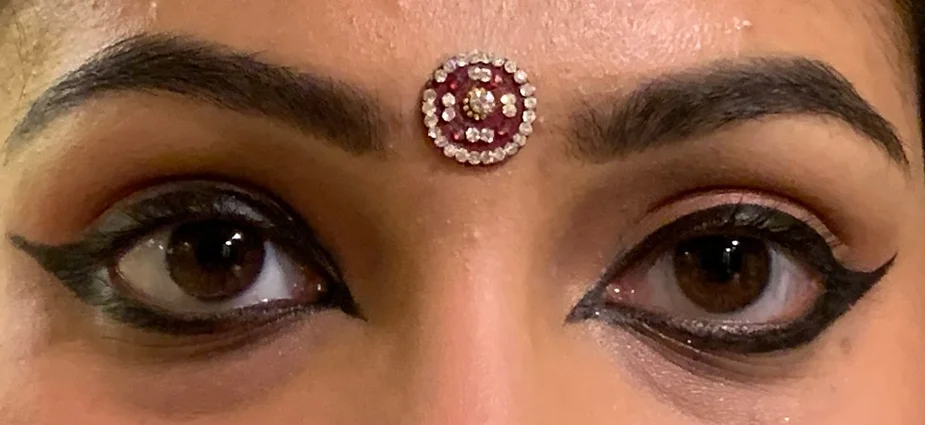
Next time you see somebody applying the forehead dot, realize that that person is on a quest to master his or her own senses. Based on our situation we may not be able to apply physical bindi or tilak. But the physical action of applying an invisible pressure to the point between your eyebrows would be a great reminder. I pray to the divine that our third eye is open as much as possible and burn the distractions that try to steer us away from our goal of realizing our true nature.
Please note that I sincerely apologize to others who have other great explanations for the reason to apply been the bindi or tilak. These thoughts are my own, based on the teachings of various wise persons. I do not disagree or contravene with other valid explanations.