Blog

  • Mahabharata, Bene Israel, and Ethics of War

    Mahabharata, Bene Israel, and Ethics of War

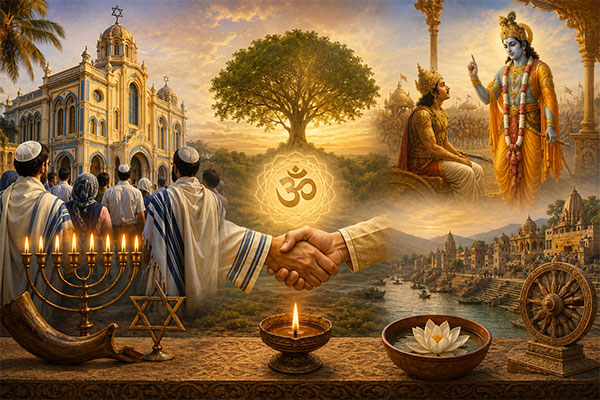
    As a close friend waited for his flight at Tel Aviv’s Ben Gurion Airport, he noticed several Bene Israel families among the travelers and immediately texted me. Years earlier, I had told him about my Jewish neighbors while growing up in Maharashtra, India. The Bene Israel are descendants of Jews who sought refuge in India as early as the second century BCE. Over many centuries they adopted Marathi, my mother tongue, while faithfully preserving Jewish traditions such as the Sabbath, circumcision, and kosher practices. They flourished without persecution, and their synagogues continue to stand as respected places of worship.

    For many Jews outside India, the Bene Israel remain little known. Yet their history offers one of the world’s most remarkable examples of religious coexistence. For nearly two millennia, Jews lived among a Hindu majority without experiencing the state-sponsored antisemitism, expulsions, or pogroms that scarred so much of Jewish history elsewhere. India did not merely tolerate its Jewish communities; it allowed them to preserve their faith while becoming an integral part of the nation’s cultural life.

    That history reflects something distinctive about India’s civilizational ethos. Hindu thought has long embraced the conviction that truth may be approached through multiple paths and that every human being possesses an inherent spiritual dignity. This worldview did not eliminate political conflict or social divisions, but it created a space for religious minorities, including Jews, to flourish without abandoning their identity.

    As I reflected on my friend’s message, I was reminded of another enduring gift of Indian civilization: the Mahabharata. Like the Hebrew Bible, it is far more than an ancient narrative. It is a sustained meditation on power, justice, leadership, loyalty, and the moral burdens that accompany the defense of a people. Its questions remain startlingly contemporary because they address dilemmas that every civilization eventually confronts.

    The Mahabharata should not be read as a political blueprint for modern conflicts, nor should its heroes be mapped onto contemporary nations. Its enduring value lies elsewhere. Like the Hebrew Bible, it explores what happens when a people committed to moral principles must also wield political power. The epic refuses easy answers. Victory never erases moral responsibility, and righteousness never guarantees freedom from tragedy.

    The epic’s central concept is ‘Dharma’, a term that encompasses justice, duty, moral order, and ethical responsibility. Throughout the story, even its noblest figures struggle to discern what dharma requires under impossible circumstances. The supposed moral paragon, elder brother Yudhishthira, makes painful mistakes. The greatest warrior, Arjuna, hesitates before battle, overwhelmed by the prospect of killing relatives and teachers. Krishna, the Divine incarnate himself, counsels actions that challenge conventional notions of morality when he believes the preservation of justice requires them.

    These struggles echo a recurring theme within Jewish tradition. The Hebrew Bible, the Talmud, and later Jewish thinkers likewise refuse to portray righteous leaders as morally flawless. Abraham argues with God for the sake of Sodom. Moses loses the privilege of entering the Promised Land. King David’s greatness coexists with profound moral failure. Jewish ethics, like the Mahabharata, recognizes that leadership often requires navigating competing obligations rather than choosing between obvious good and evil.

    Nowhere is this tension more evident than in the ethics of war. The Bhagavad Gita, set on the eve of the Mahabharata‘s climactic battle, does not celebrate violence. Arjuna’s reluctance to fight arises from compassion, not cowardice. Krishna does not dismiss those concerns. Instead, he teaches that the use of force may sometimes become a painful duty when all peaceful alternatives have failed. Yet he also insists that action must remain free of hatred, vengeance, and selfish ambition.

    Jewish thought has wrestled with similar questions for centuries. The tradition recognizes both the necessity of self-defense and the moral limits that accompany the use of power. The challenge is never merely how to prevail, but how to preserve one’s ethical character while confronting those who seek one’s destruction.

    These ancient insights resonate far beyond India. Israel’s modern history has required its citizens to confront many of the same enduring questions that have occupied moral thinkers across civilizations: How does a democratic society defend itself against existential threats? How does military necessity coexist with ethical restraint? How can security be pursued without losing sight of the humanity of those caught in conflict?

    The Mahabharata offers no simple political answers. Indeed, one of its deepest lessons is that even a just victory carries immense human cost. After the devastating war at Kurukshetra, the victorious Pandavas inherit not triumph but a shattered civilization. Their kingdom survives, yet countless families mourn their dead. The epic reminds readers that war may sometimes be unavoidable, but it is never something to celebrate.

    This perspective feels particularly relevant today. Israelis continue to confront terrorism and genuine threats to their security, while Palestinians have endured decades of displacement, suffering, and uncertainty. Durable peace cannot emerge from military strength alone, even when that strength is indispensable. Nor can it emerge from denying a nation’s legitimate right to defend itself. The moral challenge lies in holding both truths simultaneously.

    Underlying the Mahabharata is another profound principle of Hindu philosophy: Universal Oneness. The Upanishads teach that the same divine reality dwells within every human being. The Bhagavad Gita describes the truly wise as those who perceive the same spiritual essence in every person, regardless of status or circumstance. This vision does not abolish conflict or erase the necessity of justice. Rather, it insists that even an adversary must never be stripped of human dignity.

    That insight finds a striking parallel in Judaism’s teaching that every person is created b’tzelem Elohim-in the image of God. Although the two traditions emerge from very different theological foundations, they converge on a shared moral intuition: genuine strength is inseparable from reverence for human life.

    The history of India’s Jewish communities demonstrates that these principles need not remain abstract philosophy. For nearly two thousand years, the Bene Israel, Cochin Jews, and Baghdadi Jews maintained their distinct religious identities while living peacefully among a Hindu majority. Their experience does not suggest that India was a utopia, nor does it erase the complexities of its history. But it stands as a remarkable example of a civilization confident enough in its own traditions to allow another ancient faith to flourish.

    In an age increasingly defined by polarization and civilizational distrust, that history deserves renewed attention. The story of India’s Jews reminds us that coexistence is not merely an aspiration but a lived historical reality. And the Mahabharata reminds us that the measure of a civilization lies not only in its capacity to defend itself but also in the wisdom and restraint with which it exercises power.

    Perhaps that is the deepest lesson shared by Hindu and Jewish civilizations. Both understand that strength and compassion are not opposing virtues. Both insist that justice requires courage as well as humility. And both remind us that the ultimate purpose of power is not domination, but the preservation of a moral order in which human dignity can endure, even amid the tragedies that history sometimes makes unavoidable.


  • Beyond Success: Indian Americans and Universal Oneness

    Beyond Success: Indian Americans and Universal Oneness

    A fuller description of the Indian American community is needed, one that speaks not just to achievement but to character

    Indian Americans are usually portrayed through the language of success: spelling-bee victories, elite degrees, high incomes, corporate leadership. These familiar markers overlook a deeper, more enduring trait: a commitment to service rooted in the Hindu principle of Universal Oneness.

    In the 1980s Bollywood film Albert Pinto Ko Gussa Kyoon Aata Hai?, Albert complains that Hindi cinema cannot imagine a Goan or a Christian doing much beyond singing, feasting, and drinking. American popular culture shows a similar failure of imagination, whether in Raj Koothrappali of The Big Bang Theory, Baljeet Tjinder of Phineas and Ferb, or Dr. Lawrence Kutner of House.

    Indian characters are cast again and again as the brilliant scientist, the gifted physician, or the anxious overachiever, feeding a public image of the Indian American as perpetual coder, doctor, immensely rich technocrat, or a groom arriving on an elephant. Even Alex Parrish in Quantico, played by Priyanka Chopra, had to become half-white to be an action hero.

    Indian festivals receive the same selective treatment. The camera delights in color, food, and spectacle, then loses interest just as the philosophy begins. Diwali becomes simply the “festival of lights,” detached from its deeper teachings about truth, duty, discipline, and the triumph of wisdom over ignorance. The lamps are highlighted; what they are meant to illuminate is not.

    A fuller description of the Indian American community is needed, one that speaks not just to achievement but to character. This large, internally diverse community, spanning regional, linguistic, generational, and denominational differences, is best captured not by a résumé or a net worth, but by its manifestation of the ideal of Universal Oneness.

    The Hindu ideal of Vasudhaiva Kutumbakam, “the world is one family,” teaches that the world is one family, that service is a duty, and that success finds its highest meaning when it benefits others. One’s responsibility does not end at the boundaries of family, ethnicity, religion, or nationality. Its practical expression is sewa: selfless service performed without expectation of recognition.

    Across the United States, Hindu individuals, temples, and organizations stock food pantries, prepare meals, respond to disasters, organize blood drives and health fairs, tutor children, assist refugees, support seniors, and volunteer at shelters. Hindu chaplains comfort patients, military personnel, prisoners, students, and grieving families of all faiths or none.

    A physician running a free screening, a student packing backpacks, a family serving meals after a hurricane; these moments occasionally earn a one-cycle evening news segment, but never the feature story. No Hollywood film or TV show has ever alluded to this kind of pan-humanistic quality in its Indian-American characters. This attribute clearly reveals something wealth and test scores cannot: a culture of responsibility.

    One public expression of this ethic is Universal Oneness Day, observed by Hindu Swayamsevak Sangh USA and other Hindu groups through a civic celebration of the Raksha Bandhan festival. Traditionally, an occasion honoring affection and protection, it is extended civically as volunteers tie rakhis to first responders, defense personnel, and public officials, affirming that mutual care binds society together. Universal Oneness Day thus turns a family tradition into a civic one, promoting social harmony, interfaith friendship, gratitude toward public service, and the conviction that every person belongs to a wider human family. It asks people not merely to coexist, but to take responsibility for one another.

    This is a richer way to understand Indian Americans than the familiar catalogue of achievements. Detractors may point to caste-based discrimination, linguistic animosity, and economic disparity within India itself. Yet despite centuries of invasion and forced religious conversions, a colonial policy of “Divide and Rule” that critics say continued, only slightly more subtly, for decades after independence, and an education system some argue has downplayed India’s own history, India remains the only nation of its size and diversity to stay so durably united, and it continues to rise. Only in India can it happen that the majority of devotees at the Catholic basilica of St. Mary in Mumbai, or at the Muslim dargah of Ajmer Sharif in Rajasthan, are practicing Hindus. That same instinct to honor the Divine in all its forms shows up in how most Indian Americans treat their fellow human beings and animals in this country.

    This spirit of Oneness is not foreign to America, a nation built by newcomers and their children, many of whom served it long before being fully accepted by it. By recognizing and embracing the Universal Oneness already carried by so many of its citizens of Indian origin, America as a whole stands to embody that same spirit.

  • Leading a Purposeful Life

    Leading a Purposeful Life

    On U.S. college campuses, suicide remains one of the leading causes of death among young adults which is a stark reminder of a deepening crisis of meaning and mental health. Past-year suicide attempt rates among international students have been reported in the range of roughly 1.2% to 2.2%, compared with estimates of 0.1% to 1.6% among domestic students. Moreover, an estimated 5 to 10 percent of college students each year report experiencing suicidal ideation. Some studies also indicate that within South Asian communities, certain subgroups such as Asian Indian students may report higher levels of suicidal thoughts than other South Asian ethnic groups. These sobering figures underscore not only the urgency of improving mental health support, but also the deeper need to help students cultivate connection, resilience, and a sense of purpose during one of the most formative periods of their lives.

    Having spent years listening to great teachers of Hindu philosophy and having navigated what I believe has been more than my fair share of adversity, I have tried to distill the following thoughts as guidance for my younger friends who may be feeling lost or low at this moment.

    The Gift of Human Birth

    According to Hindu philosophy, a human being arrives in this world after countless births as lower life forms, where existence was governed purely by instinct. The mere fact of being born human, an entity endowed with free will, is itself a rare gift. Through that free will, a person has the capacity to elevate themselves to the highest possible state of being, or, by their own choices, to consign themselves to unnecessary suffering.

    The Vedas describe four Purusharthas or the four goals of human life: Dharma, Artha, Kama, and Moksha. Lower animals, guided entirely by instinct, seek only Artha and Kama. Artha, in its broadest sense, encompasses security and survival. Kama refers to pleasure derived through the senses.

    Sadly, many human beings live in much the same way, spending the bulk of their lives chasing safety and sensory gratification. And yet every human being holds within them a higher potential. Only a few consciously choose to pursue Dharma, the timeless principles that sustain and uphold life, creating harmony within the individual, within society, within the world, and throughout the cosmos. Fewer still aspire to the highest goal of human existence: Moksha which is the realization of the Divine Self.

    Hindu Dharma does not reject enjoyment. It does not ask you to renounce Artha or Kama. It says: pursue them, but pursue them within the framework of Dharma, while keeping the ultimate aim of Moksha in view. Live a life rooted in Dharma so that each day, however modestly, you are moving toward Moksha.

    If life were a game of bowling, hitting a strike would represent Moksha. The bumpers along the lane would represent Dharmic principles, the guardrails that keep you on course. The polishing and drying of the ball, along with whatever pre-shot ritual a bowler performs, represent Artha and Kama. All the elaborate preparation and showmanship may impress onlookers, but it counts for nothing if you throw a gutter ball. Skilled players, of course, have internalized awareness of the gutters and rarely need the bumpers. Their discipline has become second nature.

    A purposeful life, therefore, is a life lived in Dharma.

    D.H.A.R.M.A.

    • D — Do your duty (svadharma) sincerely at whatever stage of life you find yourself.
    • H — Honor truth and self-discipline.
    • A — Act without attachment to outcomes.
    • R — Respect all beings with compassion.
    • M — Meditate and reflect regularly.
    • A — Align with righteousness in thought, word, and deed.

    Everyone’s path toward Dharma will be different, shaped by the actions of one’s past — whether of this lifetime or, as Hindu philosophy holds, of previous ones. The effects of those past actions manifest in this life as gifts and as limitations: the circumstances of your birth, the innate abilities you carry, the particular challenges you face. All of these together determine the unique contours of your Dharmic journey.

    To live a Dharmic life is to use your unique gifts and limitations to make consistent contributions toward a worthy cause you genuinely believe in, while intentionally building a life you love.

    In the beginning, the most meaningful cause may simply be yourself — and that is perfectly fine. You grow from there. You begin climbing the steps of evolution. For highly evolved spiritual beings, there are no discrete steps, only a gentle and continuous slope. For them, the boundary between self and other has dissolved entirely. Everyone, ultimately, is the Self.

    How to Actually Live a Purposeful Life

    1. Write Your Own Obituary

    The most clarifying first step I know is to write your own obituary. What do you want to be remembered for? What would you want people to say when they speak at your funeral? “He was…” “She was…” Sit with those answers. They will give you a starting point — however rough — for your sense of purpose.

    2. Understand That Purpose Evolves

    Your sense of purpose will not remain static — nor should it. In youth, it tends to center on personal growth: exploring creativity, mastering a skill, building strong and healthy relationships. As you mature, that purpose naturally expands, becoming less about self-development and more about meaningful contribution and service.

    Andrew Carnegie was, early in his life, one of the most ruthlessly profit-driven industrialists in America. Later, he underwent a profound philosophical transformation and ultimately gave away more than ninety percent of his fortune. Warren Buffett, too, built immense wealth through Berkshire Hathaway, yet has pledged to donate over ninety-nine percent of it.

    Purpose can evolve. Allow yours to.

    3. Know Yourself

    What are your genuine strengths? Your blind spots? Your triggers and recurring patterns? Which qualities support the vision of life you have begun to form? What energizes you rather than depleting you? What are your impediments — and be honest here, because you can only address deficits once you have truly acknowledged them.

    Arnold Schwarzenegger reinvented himself multiple times — leaving a small Austrian village to become a world-class bodybuilder, then patiently mastering English to pursue a Hollywood career despite repeated rejection and later entering public service as Governor of California. David Goggins transformed himself from being overweight and directionless into a Navy SEAL, ultramarathon runner, and motivational speaker. Neither man was born exceptional. Both were relentless in self-knowledge and self-correction.

    Self-knowledge fuels growth. There is simply no substitute for it.

    4. Identify What Energizes You

    Ask yourself: what problems do I feel genuinely drawn to solve? The answer will reflect your core values. Values such as integrity, compassion, curiosity, freedom, excellence, family, and justice are not abstract ideals — they are the bedrock upon which meaningful action is built. Write down your top five. Then ask: what specific activities give expression to these values?

    Eknathji Ranade, inspired by Dr. Hedgewar and Swami Vivekananda, devoted his entire life to the spiritual and national regeneration of India. His guiding values were selfless service, organizational rigor, and spiritual nationalism. He led the construction of the Vivekananda Rock Memorial and founded the Vivekananda Kendra — a nationwide organization dedicated to rural development, education, and character-building.

    Bryan Stevenson founded the Equal Justice Initiative, which provides legal representation to people who have been wrongly convicted, unjustly sentenced, or denied adequate legal defense. His core conviction is that “each of us is more than the worst thing we have ever done.” He has helped overturn wrongful convictions and challenged excessive sentencing, including life imprisonment for children.

    What aligns with your core values endures — sustained by conviction, not by circumstance.

    5. Set Meaningful, Aligned Goals

    Break your purpose down into three horizons:

    • Long-term direction (e.g., “I want to help people heal.”)
    • Medium-term goals (e.g., “Train in counseling.”)
    • Short-term habits (e.g., “Read twenty minutes daily on psychology.”)

    Thomas Edison developed the practical incandescent light bulb through methodical trial and error, testing over six thousand materials before arriving at a workable filament. He famously noted that he had not failed — he had simply discovered ten thousand approaches that did not work. Verghese Kurien transformed India’s dairy industry not through any single dramatic breakthrough, but through decades of steady, grassroots effort. By organizing small farmers in Anand, Gujarat into cooperatives and building reliable systems for milk collection, processing, and distribution, he quietly catalyzed the White Revolution, making India one of the world’s largest milk producers.

    Steady, consistent effort outweighs sudden giant leaps on the road to anything worth doing.

    6. Build Supportive Relationships

    Deliberately cultivate relationships that support the purpose you have identified. Seek mentors. Nurture friendships with people who challenge you in constructive ways. Seek out communities that share your values. The right people will amplify your efforts in ways you cannot anticipate. Stay away from chronic naysayers.

    Narendra Modi found early guidance and community within the Rashtriya Swayamsevak Sangh, where mentors shaped his discipline, his thinking, and his long-term vision. Steve Jobs co-founded Apple alongside Steve Wozniak, whose technical brilliance complemented Jobs’ design sensibility and commercial instinct. Mentors like Mike Markkula helped ground his ambition in business discipline.

    Accept people as they are, but understand that you, and only you, have the right to decide where each person belongs in your life, not where they wish to be placed. Ask yourself honestly: do the people around you enlarge you, or diminish you? And be prepared to accept that sometimes listening to the right person means acknowledging that you were wrong. That is among the most difficult things any of us can do.

    7. Cultivate Discipline and Resilience

    Unfortunate things have a way of arriving at the most inconvenient times. The best-laid plans fall apart. Any given day can simultaneously be the best of times and the worst of times. And even an ordinary life, free of tragedy and crisis, can become stagnant and dull if it is not directed toward something meaningful.

    Living with purpose requires:

    • Doing the hard thing when the easy path beckons.
    • Staying consistent when motivation has faded.
    • Recovering from setbacks without excessive self-reproach.
    • Saying no to distractions that are not aligned with your direction.

    Discipline protects purpose when motivation fades.

    I suffered a stroke two months before my planned retirement at fifty-one. The entire left side of my body was completely paralyzed. It has now been more than five years. Years of intensive work — motivating myself to exercise every single day, learning new recovery techniques, staying current with the latest research on stroke rehabilitation, all while managing the financial demands of daily life. And here is what I can tell you: I have not yet reached my maximum recovery. That moment will come only when I leave this body. I intend to keep fighting until then. Make every breath count.

    Resilience deepens purpose. Adversity, if you let it, will clarify what truly matters.

    8. Keep Evolving

    Periodically reassess your goals. A purposeful life is not a fixed blueprint — it is a living process. The destination may remain the same, but the path will need adjustment along the way.

    Leo Tolstoy achieved fame and wealth through War and Peace and Anna Karenina, yet by the late 1870s he was gripped by a profound existential crisis that left him questioning the very meaning of existence. He ultimately rejected materialism and devoted himself to a life of moral simplicity — a transformation that profoundly influenced Mahatma Gandhi. Emperor Ashoka began his reign as a conqueror of extraordinary brutality, including the devastating Kalinga War. Shattered by the suffering he had caused, he renounced violence and devoted the remainder of his reign to Buddhist principles of compassion and ethical governance.

    Growth is transformation. Do not be afraid of who you are becoming.

    9. Live in the Present

    Purpose is not only about some distant future. It is about how you show up today. Living in the present means giving your full attention to what Dharma demands of you right now — without being paralyzed by regret over the past or anxious about what lies ahead. Deep, wholehearted engagement in whatever you are doing right now transforms ordinary moments into meaningful ones. Constantly close the gap between who you are and who you aspire to be.

    Take the Controls

    My dear friends, if your life is like an airplane journey, then your childhood and early youth are the takeoff — and that phase is very nearly complete. The engines have roared. The runway is behind you. You are now rising toward cruising altitude. This is the phase where direction matters most.

    An airplane on autopilot will keep flying — but only toward whatever destination was programmed into it. If the coordinates are wrong, it will carry you confidently to the wrong place.

    Many people live exactly that way. They drift. They react. They follow the crowd. And then one day they wake up and wonder, “How on earth did I get here?”

    If you want your life to be purposeful, meaningful, and worthy of leaving a legacy, you must take the controls. Do not fly on autopilot.

    Be conscious of your direction. Be intentional with your choices. Be awake to your Dharma.

    Own today. Shape tomorrow. Become eternal.

    That is how you live a life of purpose.

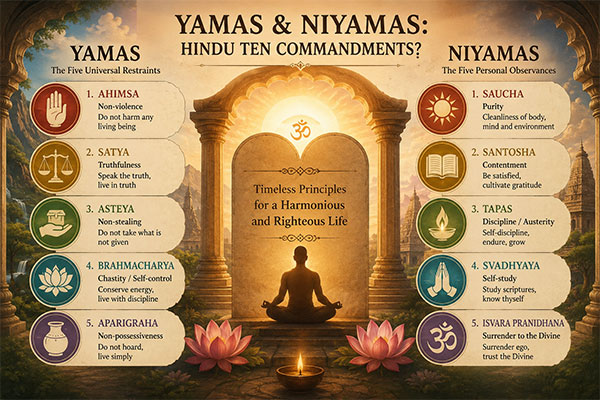
  • Yamas & Niyamas: Hindu Ten Commandments?

    Yamas & Niyamas: Hindu Ten Commandments?

    The recent passage of the law by the state of Louisiana requiring all state-funded schools and universities to display the biblical Ten Commandments in classrooms has sparked extensive controversy. The Ten Commandments, central to Judeo-Christian ethics, are seen by supporters as timeless moral principles essential for a just society. They argue these commandments promote values like honesty, respect, and responsibility, fostering social cohesion and personal integrity.

    However, critics contend that this law can be problematic in diverse societies. They argue that the commandments are rooted in a specific historical and cultural context and imposing them may infringe on individual freedoms and the principle of the separation of church and state. They suggest that if you need students to be reminded of moral principles at educational institutions, other sources of such guidelines are available. I would suggest that a more universal set of guidelines for a just and moral society can be found in the first two elements (angas) of the eight elements (Ashtanga) described in Sage Patanjali’s Yogasutra. The Yogasutra is the compilation of ancient wisdom, stated in 196 aphorisms composed before the 5th century CE. Although, the aphorisms are intended as guidelines for individuals seeking complete spiritual freedom (moksha), choosing to follow the guidelines will benefit the people regardless of their beliefs. The keyword is ‘choosing’. An individual can opt to follow the guidelines to better themselves and the society as a whole.

    The first set of five guidelines is called Yamas (Restraints). These guide our interaction with the external world.

    1. Ahimsa (Non-injury): Non-injury in thoughts and actions. Ahimsa should be practiced by living our life maintaining a conscious intention of causing the least possible injury to other living beings. A self-directed injury should also be curtailed by forgiving our own perceived transgressions from personal expectations.

    2. Satya (Truth): Truthfulness in conduct and speech. Fundamental to the practice of Satya is the ability and willingness to distinguish between truth and point of view.

    3. Asteya (Non-stealing): Taking only what is freely given. This guideline superficially seems to pertain to material things but can include stealing somebody’s happiness or wasting the limited shared universal resources like fresh water, food, etc.

    4. Brahmacharya (Abstinence): Personal energy conservation by avoiding overstimulation of senses. Sensual tempering can range from complete asceticism to gradual moderation.

    5. Aparigraha (Non-hoarding): Freedom from wanting more. Accumulating more than needed can be avoided by realizing what you already have, and a feeling of gratefulness towards it.

    The second set of five guidelines is called Niyamas (Observances). These guide an individual’s self-care:

    Saucha (Cleanliness): Cleaning is an act of separating two entities, one of which is undesired at that moment. The separation is done by daily or very regularly consciously selecting the desired entity. The undesired entity can be physical like spilled food or grim on the body; emotional like distressing memories associated with a person or place, and mental like immoral desires arising towards an object or person.

    Santosh (Satisfaction): Santosh is accepting life as it is. It does not mean abandoning efforts to better oneself. To practice Santosh is to be content at every moment, but continuously strive to better the overall situation.

    Tapas (fiery discipline): Tapas means the willingness to put effort by developing discipline, enthusiasm, and an intense desire to improve. Derived from the root word ‘tapa’, means to become hot. This results in the friction between your entrenched habits and the new self you want to be.

    Swadhyaya (self-study): One meaning of the niyama is the study of written works by enlightened people. But another meaning is the study of self. Being an honest, but compassionate observer of self. Having empathy and working on oneself leads to empathy towards the world.

    Ishwara pranidhana (Detachment from the result): The actual translation is completely offering yourself to the power that makes everything possible. For people with the belief or conclusion that there is such a higher power, the concept is easier. For people who do not believe in such an entity, it can be understood as letting go of the results of your actions after you have put in the best effort using the other nine guidelines.

    Whether the Yamas and Niyamas are better guidelines than the Ten Commandments depends on your personal beliefs, spiritual goals, and cultural context. Both sets of guidelines have their own merits and are suited to different paths of ethical and spiritual development. Some people might find that integrating aspects of both can provide a well-rounded approach to ethical living.

  • Are we the inadvertent ‘useful idiots’ for global terrorists: How the West Has Provided Shelter to Terrorist Organizations and Its Global Consequences

    Are we the inadvertent ‘useful idiots’ for global terrorists: How the West Has Provided Shelter to Terrorist Organizations and Its Global Consequences

    Throughout their post-colonial history, under the aegis of the principles of individual freedom of conscience and freedom of speech, Western nations have often served as safe havens for individuals and groups fleeing persecution in their native countries. This policy may be the result of the collective transgenerational guilt from the colonial atrocities committed by their ancestors.

    Unfortunately, this redemptive action has sometimes overshot its target, allowing terrorist operatives to percolate along with the genuine persecuted asylum seekers, thereby facilitating the bad actors to find sanctuary, reorganize, and enhance their activities.

    In 1964, Ayatollah Khomeini was exiled from Iran by the Shah, beginning a period of residence in several countries before he ultimately settled in the Paris suburb of Neauphle-le-Château in 1978. During his time in France, Khomeini gained unprecedented access to global media, which he leveraged to orchestrate the Islamic Revolution. This movement culminated in the west-friendly Shah’s overthrow in 1979 and the establishment of a strict Shia Islamic theocratic regime in Iran. The revolution not only transformed Iran but also inspired a wave of Islamist movements across the Middle East. Many of these movements adopted violent methods to pursue their goals, leading to widespread destabilization of the region. Today, this legacy continues to shape the ongoing confrontations between Iran, its proxy groups, and Israel.

    Another example is the refuge and support, particularly in the United States, garnered by the Irish Republican Army (IRA), which sought to end British rule in Northern Ireland and unify Ireland. During the Troubles from 1968-1998, the IRA received financial and moral support from Irish-American communities, some of whom viewed the organization as freedom fighters rather than terrorists. Fundraising through organizations like NORAID (Irish Northern Aid Committee) provided the IRA with resources to continue its campaign of violence, which resulted in thousands of deaths over several decades.

    In the 1990s and early 2000s, London earned the moniker “Londonistan” due to the concentration of Islamist radicals who found refuge in the city. The British government’s reluctance to crack down on these figures, citing civil liberties, eventually led to a radicalization problem plaguing the UK and other Western nations. The 2017 prediction of Sheikh Abdullah bin Zayed, Foreign Minister of UAE, that in future far more radical extremists terrorists will be coming from Europe compared to the middle-east has been prophetic in the recent years. The London bombings in 2005 and subsequent fairly regular terrorist attacks across Europe are stark reminders of how the sheltering of extremists can lead to violence. Figures such as Abu Hamza al-Masri, Omar Bakri Muhammad, and Anjem Choudary used their bases in London to promote jihadist ideologies, recruit followers, and, in some cases, plan attacks not only in the UK, but also send recruits to commit terrorist acts in countries like India, Pakistan, Algeria, and Egypt. Fortunately, the numerous arrests of potential perpetuators with ties to ISIS in the last ten years by the FBI’s Joint Terrorism Task Force has prevented a major terrorist attack on US soil.

    European governments have been criticized for their leniency, towards the Liberation Tigers of Tamil Eelam (LTTE) fighting for Tamil homeland in Sri Lanka by allowing unhindered financial contributions and political backing from Tamil diaspora communities. Similar accusations have been made regarding Kurdistan Workers’ Party (PKK), which has been fighting for Kurdish autonomy.

    Since early 1980’s, Canada has been a focal point of controversy regarding its handling of Khalistani terrorists, who aim to form an independent Sikh nation in the northern Indian state of Punjab. Taking advantage of Canada’s commitment to multiculturalism and free speech, organizations violently advocating for Khalistan separatism have proliferated, resulting in the bombing of Air India Flight 182 in 1985, by Sikh extremists which killed 329 people, most of whom were Canadian citizens. The current Prime minister Justin Trudeau, for the sake of political expediency continues to turn a blind eye to the extremist activities. His government is dependent on the support of the New Democratic Party (NDP) which is led by Jagmeet Singh, a vocal supporter of the Khalistani separatist movement. Unperturbed of the terrorism against Canadians by the Khalistani extremists, in 2018, Canadian Prime Minister Justin Trudeau during a visit to India invited a convicted Khalistani terrorist to an official event.

    In recent years, the United States has also seen the rise of Khalistani violent activism within its borders, particularly in states with large Sikh populations such as California and New York, as exemplified by the March 2023 attack on the Indian Consulate in San Francisco. A hands-off approach, prioritizing civil liberties over crackdowns on these groups, may come back to haunt U.S., if American citizens who are against the Khalistan movement are harmed by these terrorists. A careful watch is needed on groups like “Sikhs for Justice (SFJ)” which the Indian government has accused of being a front for terrorist activities, and banned in India, but continues to operate freely in the United States.

    Only by a stricter oversight of extremist groups, better intelligence sharing with affected countries, and most importantly, not being blinded by short-term benefits in the global geopolitical arena can Western nations ensure that their noble traditions do not degenerate into the fleecing of the gullible.

  • Why the USA Needs Its Own Equivalent of the Rashtriya Swayamsevak Sangh (RSS)?

    Why the USA Needs Its Own Equivalent of the Rashtriya Swayamsevak Sangh (RSS)?

    The strength and prospects of a society lie in its ability to unite its people through shared values, cultural roots, and active participation in community life. India’s Rashtriya Swayamsevak Sangh (RSS), loosely translated as National Volunteer Association, is a voluntary organization that blends cultural preservation and grassroots mobilization to address national challenges. As the United States struggles with cultural polarization, declining civic engagement, and a weakening sense of identity, creating an equivalent organization—adapted to American values—could help restore unity, promote civic responsibility, and cultivate a shared sense of purpose.

    Originally, RSS was founded in 1925 during the British colonization period by Dr. Keshav Baliram Hedgewar, to remedy the weakened Hindu society, which was fragmented based on internal socioeconomic stratification, as well as external religious-economic onslaught. After the 1947 Partition of British India with the separation of the Islamic republics of Pakistan and subsequently, Bangladesh, RSS aimed to strengthen the people of the secular Republic of India by uniting the people across religious, linguistic, caste, and regional lines. Mislabeled as a Hindu chauvinistic organization by its malfeasant opponents, RSS defines a “Hindu” as anyone who regards India as their spiritual and cultural homeland, irrespective of their religion, and has fostered inclusivity through efforts like the Muslim Rashtriya Manch and Rashtriya Sikh Sangat. Through a network of shakhas (branches), the RSS provides ideological training, leadership development, and community service, impacting millions of lives. Its initiatives have inspired over 100,000 non-profits addressing diverse facets of Indian society.

    This model of fostering unity in diversity and empowering ordinary citizens is particularly relevant for the U.S., a nation marked by its heterogeneity. An American equivalent of the RSS could address modern challenges by emphasizing shared principles like democracy, liberty, and equality while celebrating the nation’s cultural heritage.

    The decline in civic participation has left American communities fragmented and weakened. Voter turnout remains low, and fewer people engage in local organizations or volunteer activities. A grassroots organization like the RSS could revitalize civic engagement by encouraging Americans to take active roles in governance, community service, and public discourse. It could inspire individuals to invest in their neighborhoods, solve problems collaboratively, and rebuild trust in collective action.

    One of the RSS’s strengths is its emphasis on leadership development on individual and organizational levels, rooted in discipline, selflessness, and service. Leaders like Indian Prime Minister Narendra Modi exemplify the transformative potential of this approach. The United States would greatly benefit from a similar pipeline of values-based leaders. The RSS system which includes regular close association with idealistic elders, along with a unique blend of inspirational games, stories, and songs, causes beneficial subconscious psychic impressions (actual term sanskar in the Sanskrit language) over the years, that transform children and young adults into dedicated leaders who are inclined and capable of shouldering the burdens of the society. In the U.S., where underserved urban and rural areas often lack positive role models and constructive outlets for teenage angsts and frustrations, such a system could foster integrity, empathy, and resilience among young people, preparing them to tackle modern challenges and lead with a sense of purpose.

    RSS excels at rapid crisis response, from disaster relief to supporting vulnerable populations. A similar American organization could enhance community resilience by preparing citizens to address natural disasters, public health emergencies, and social challenges. This culture of mutual aid and solidarity would empower communities to be self-reliant and collaborative in times of need.

    Along with the many organizations started by its members, RSS has played a vital role in preserving India’s cultural traditions. In the U.S., an equivalent organization could celebrate the nation’s diverse heritage while fostering a sense of shared history. By highlighting contributions from all cultural groups, it could create a unifying narrative that respects diversity and instills pride in the American story.

    While the idea of creating an RSS equivalent in the U.S. is very appealing, it is not without challenges. The U.S. is a highly individualistic society, and any such organization would need to strike a balance between fostering collective action and respecting personal freedoms. Additionally, care must be taken to ensure that the organization does not become exclusionary or overly politicized, as this would undermine its mission of unity. To succeed, the organization would need to be strictly culturally American (will need to be agreed by experts), with not even perceived overtones from any other culture, financially transparent, overtly inclusive, and adaptive to the ever-evolving unique cultural and social dynamics of American society. It should prioritize civic education, leadership development, and community service, ensuring that its activities resonate with people from all walks of life.

    A long time has been wasted because of the regular propaganda and constant denigration of RSS by many well-known and powerful malevolent actors in the West, together with their Indian henchpersons. As we approach the 100th year of its founding, an appreciative analysis of RSS is warranted by unbiased stakeholders in America to cull philosophic and methodological aspects, which can be emulated for the betterment of American society. Based on those findings, an organization inspired by the RSS could help the U.S. navigate its current challenges by promoting unity, civic pride, and community resilience. By fostering leadership, preserving cultural heritage, and addressing polarization, such a movement would reaffirm the American ideal of e pluribus unum—out of many, one—and lay the groundwork for a more inclusive, cohesive, and prosperous society.

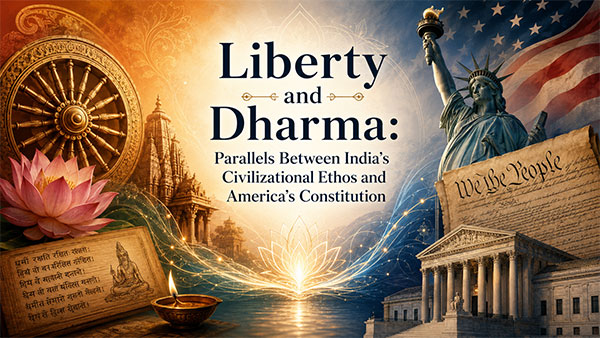
  • Liberty and Dharma: Parallels Between India’s Civilizational Ethos and America’s Constitution

    Liberty and Dharma: Parallels Between India’s Civilizational Ethos and America’s Constitution

    Today, as I replaced the American flag on the pole in front of my home, I found myself reflecting on how deeply grateful many of us Hindus, who form a minuscule percentage of the U.S. population—are to the United States Constitution. Its protection of religious freedom has allowed our community to flourish openly and confidently. In many ways, the spirit of the Constitution resonates with core principles found in Hindu philosophy. The First Amendment’s guarantee of religious liberty reflects the pluralism of the Rigveda’s declaration: “Ekam sat vipra bahudha vadanti”—Truth is one; the wise call it by many names. The constitutional commitment to equality before the law parallels the Hindu understanding that the same divine reality dwells in all beings.

    This parallel led me to reflect on history. Just as Hindus thrive freely in America, two small but historically significant groups—the Jews and the Parsis (Zoroastrians) have found in India not only refuge but the freedom to flourish. From the ancient Jewish settlements on the Malabar Coast to the arrival of Zoroastrian refugees in Gujarat after the Islamic conquest of Persia, India stands out as a civilization where these communities were not systematically persecuted. A key reason lies in the philosophical and scriptural foundations of Hinduism.

    Jewish communities have lived in India for over two millennia. The Cochin Jews arrived as traders, possibly even before the Common Era. The Bene Israel trace their origins to ancestors who were shipwrecked on the Konkan coast, south of present-day Mumbai, around the 2nd century BCE. In the 18th and 19th centuries, Baghdadi Jews fled persecution under Ottoman rule and settled in Bombay and Calcutta.

    What is remarkable is that these communities maintained their religious identity without facing state-sponsored antisemitism of the kind experienced in medieval Europe or elsewhere. There were no Indian equivalents of the expulsions from England in 1290 or Spain in 1492, nor pogroms like those in Eastern Europe. Jewish communities in India built synagogues, engaged in trade, and contributed to society while preserving their faith and traditions.

    The Parsis, followers of Zoroastrianism, arrived in India between the 8th and 10th centuries CE, fleeing religious persecution in Persia after the Arab conquest. According to the Qissa-i-Sanjan, they sought refuge in Gujarat. A local Hindu ruler granted them asylum on the condition that they adopt certain local customs, such as speaking Gujarati and respecting regional traditions.

    Over time, Parsis became one of India’s most successful and respected communities, contributing disproportionately to commerce, industry, and philanthropy. The Tata family and many other Parsi leaders played transformative roles in India’s modernization. Yet throughout their long history in India, they were allowed to maintain their religious practices, fire temples, and distinct identity.

    The tolerance extended to these communities is deeply rooted in Hindu philosophy. The Rigveda verse “Ekam sat vipra bahudha vadanti” quoted at the beginning of the article, affirms that ultimate truth is singular, though understood and expressed in many ways. This early Vedic insight leaves room for multiple religious paths without anxiety or hostility. Similarly, the Maha Upanishad offers the timeless phrase: “Vasudhaiva kutumbakam”—The whole world is one family. This universalist outlook transcends narrow communal boundaries and encourages a broader sense of shared humanity. In the Bhagavad Gita (4.11), Lord Krishna tells Arjuna: “Ye yatha mam prapadyante tams tathaiva bhajamy aham”—As people approach Me, so do I receive them; all paths, Arjuna, lead to Me. Here, the divine acknowledges diverse modes of worship as valid approaches to the same ultimate reality. Such scriptural affirmations undercut exclusivist claims that only one religion possesses absolute truth.

    Unlike traditions with centralized ecclesiastical authorities, Hinduism historically lacked a single institution capable of enforcing uniform orthodoxy. It evolved as a diverse family of philosophies and practices. This decentralization made large-scale religious persecution less likely. Moreover, Hindu society traditionally organized itself around community and occupation  (jaati) rather than creed. Jews and Parsis were integrated as distinct communities within a broader social mosaic rather than viewed as theological threats.

    Hinduism’s generally non-proselytizing character also reduced religious friction. There was no widespread drive to convert others. Jews and Parsis, who likewise did not seek converts aggressively, fit comfortably into this pluralistic framework.

    The concept of dharma, righteous duty, and moral order further reinforces this pattern. In the Ramayana, Lord Rama declares: “To one who seeks refuge in me even once, saying ‘I am yours,’ I grant fearlessness from all beings. This is my vow.” Though expressed in epic form, the moral principle of granting protection to those who seek shelter resonates with India’s historical acceptance of refugees. India has also provided refuge to other persecuted communities, including Syrian Christians and, in modern times, Tibetan Buddhists. While Indian history is not entirely free from conflict, the absence of systematic state persecution of Jews and Parsis stands in marked contrast to many other parts of the world.

    The story of Jews and Parsis in India represents a unique historical synthesis: vulnerable refugee communities finding security within a majority culture grounded in philosophical inclusivity. Hinduism’s scriptural affirmations of unity amidst diversity, its decentralized religious structure, and its ethic of hospitality helped create an environment where minorities could live without systemic persecution. In many ways, this mirrors the ideals of the United States Constitution. Both frameworks—though born in different civilizations—seek to uphold diversity, dignity, liberty, and moral responsibility within a shared social order. As I look at the American flag outside my home, I am reminded that the principles allowing Hindus to flourish in America are not foreign to my heritage. They echo an ancient conviction: that truth may be approached in many ways, and that the world, ultimately, is one family.

    Photo credit: https://en.wikipedia.org/wiki/Synagogues_in_India

  • Navigating Aladdins Gold Casino: A Player’s Journey

    Navigating the realm of online gaming can be a thrilling experience, and aladdin’s gold casino stands out as a distinctive platform in this competitive market. Known for its rich selection of games and user-friendly interface, Aladdin’s Gold Casino offers both novice and seasoned players a unique gaming adventure.

    Game Catalog Overview

    The gaming catalog at Aladdin’s Gold Casino is extensive, featuring a variety of options that cater to diverse player preferences. From traditional table games to state-of-the-art video slots, the selection is designed to appeal to every type of player.

    • Slots: Hundreds of themed video slots with varying paylines.
    • Table Games: Popular choices like blackjack, poker, and roulette.
    • Specialty Games: Unique options such as bingo and scratch cards.

    Players can discover the latest releases and classic favorites from renowned software providers, ensuring a high-quality gaming experience. The platform frequently updates its library, adding fresh titles to keep the gaming experience engaging and dynamic.

    Bonuses and Promotions

    The bonus ecosystem at Aladdin’s Gold Casino is structured to attract new players while rewarding loyal customers. New users benefit from a generous welcome package that often includes match bonuses and free spins.

    Returning players can take advantage of various promotions, including cashback offers and referral bonuses. The wagering requirements associated with these bonuses are generally competitive, making it easier for players to maximize their winnings.

    Bonus Type Details Wagering Requirement
    Welcome Bonus 100% match bonus up to $500 30x
    Free Spins 50 free spins on selected slots 50x

    Trust and Safety Features

    Security at Aladdin’s Gold Casino is paramount, with the platform employing industry-standard encryption technology to protect player information. It is fully licensed, ensuring compliance with regulatory standards that promote fair play and responsible gaming.

    Players can also find services related to responsible gaming, including options for setting deposit limits and accessing self-exclusion tools. This commitment to player welfare builds trust and confidence among users.

    FAQ

    • What payment methods are available? Players can choose from various methods, including credit cards, e-wallets, and cryptocurrencies.
    • Is Aladdin’s Gold Casino safe to play at? Yes, it is licensed and employs robust security measures to protect player data.
    • What types of games can I find at this casino? A wide variety of games, including slots, table games, and live dealer options are available.

    With its rich catalog, attractive bonuses, and a strong focus on player safety, Aladdin’s Gold Casino presents an appealing option for anyone looking to explore the world of online gaming. Whether you’re a new player or returning to the platform, a rewarding experience awaits.

  • The Exciting Gameplay at Deloro Casino You Can’t Miss

    Deloro Casino stands out in the crowded online gaming landscape, bringing a unique mix of excitement and engagement that players simply cannot overlook. With a wide array of games and enticing promotions, this platform promises a rich gaming experience. More information can be found at https://delorocasinovip.com/.

    A Diverse Game Catalog

    One of the most appealing features of Deloro Casino is its extensive game library, catering to various player preferences. Featuring titles from prominent game developers, players can explore anything from classic slots to innovative table games. The platform continually updates its offerings, ensuring that the most recent and popular games are always available.

    • Slot Games: A vast selection, including progressive jackpots.
    • Table Games: Classics such as blackjack, poker, and roulette.
    • Live Casino: Real-time gaming with professional dealers.
    • Specialty Games: Unique options for those seeking something different.
    • New Arrivals: Regular updates with the latest titles.

    Bonuses That Enhance the Fun

    Deloro Casino excels in providing a comprehensive bonus ecosystem, attracting both new and returning players. From enticing welcome bonuses to loyalty rewards, players have numerous opportunities to maximize their gaming experience. The terms for claiming and using these bonuses are transparent and fair.

    Bonus Type Details Wagering Requirements
    Welcome Bonus 100% up to $500 30x
    Reload Bonus 50% on deposits every weekend 25x
    Cashback Offers Weekly cashback on losses N/A

    Mobile Gaming Experience

    In today’s fast-paced world, mobile compatibility is crucial for players seeking convenience. Deloro Casino offers a seamlessly optimized mobile experience, allowing players to enjoy their favorite games on tablets and smartphones without compromising on quality. Whether through a dedicated app or a browser-based version, the mobile platform is designed to enhance accessibility.

    FAQs about Deloro Casino

    Is Deloro Casino safe and reliable?
    Yes, Deloro Casino operates under a valid license, implementing strong security measures to ensure player safety.

    What types of games are available?
    The platform features a wide selection, including slots, table games, and live casino options.

    Can I play on mobile devices?
    Absolutely, Deloro Casino is fully optimized for mobile play, providing an excellent gaming experience on the go.

  • Exploring Jaak Casino’s Journey Through Licensing

    Jaak Casino has emerged as a notable player in the online gaming market, showcasing a commitment to player safety and security through its rigorous licensing journey. The establishment of a solid regulatory framework is essential for any operator looking to provide a trustworthy gaming environment. Jaak Casino, available at jaak casino, goes a step further by ensuring compliance with strict provisions laid down by licensing authorities.

    Licensing and Regulatory Framework

    Jaak Casino operates under a license issued by the UK Gaming Commission, one of the most respected regulatory bodies in the industry. This license demonstrates the casino’s adherence to high standards of fairness, transparency, and player protection. Additionally, the platform is also compliant with the regulations set by the Malta Gaming Authority, further solidifying its reputation as a reliable online gaming destination.

    The significance of such licenses cannot be overstated. They serve as an assurance to players that the operator is regularly audited and follows strict guidelines, which includes game fairness and responsible gambling practices. With these licenses, Jaak Casino reinforces its dedication to offering a safe gaming experience.

    Player Protection Measures

    Beyond licensing, Jaak Casino implements robust player protection measures. The platform utilizes advanced encryption technology to safeguard player data and financial transactions. These security protocols ensure that sensitive information remains confidential and protected from unauthorized access.

    • Regular audits by independent authorities
    • Responsible gaming initiatives, including self-exclusion options
    • Transparent terms and conditions regarding promotions and gameplay
    • Access to resources for players struggling with gambling addiction
    • 24/7 customer support available in multiple languages

    Compliance and Fair Play

    Jaak Casino is committed to the principles of fair play and compliance. The licensing bodies require operators to use random number generators (RNGs) to ensure unbiased game outcomes. This commitment to fair play is pivotal in fostering trust among players and maintaining a loyal customer base.

    In addition to RNGs, the casino frequently updates its game catalog, collaborating with reputable software providers. This enhances the gaming experience, ensuring that players have access to a diverse range of games while also being assured of their fairness.

    Aspect Details Importance
    Licensing UK Gaming Commission & Malta Gaming Authority Ensures player protection and regulatory compliance
    Security Encryption Technology Protects player data and transactions
    Fair Play Random Number Generators Guarantees unbiased game outcomes

    FAQs about Jaak Casino’s Licensing Journey

    Is Jaak Casino licensed and regulated? Yes, it holds licenses from the UK Gaming Commission and the Malta Gaming Authority.

    How do these licenses ensure player safety? They enforce strict standards for fairness, transparency, and responsible gaming measures.

    What security measures does Jaak Casino implement? The casino uses advanced encryption technology to protect player data and secure transactions.

  • Discover the Safety Protocols at Snatch Casino

    In the competitive landscape of online gaming, Snatch Casino stands out for its commitment to player safety and security. By implementing robust safety protocols, it aims to provide a secure and enjoyable experience for its users, ensuring their personal and financial information is well protected.

    Understanding Licensing and Regulation

    Snatch Casino operates under a stringent licensing framework, which is crucial for any online gaming platform. Licensed by reputable authorities, the casino adheres to legal standards that promote fair play and security. This regulatory oversight ensures that players can trust that the games are fair and that their rights are protected.

    In addition to licensing, Snatch Casino employs various audits by independent third parties, ensuring that the games’ outcomes are random and verifiable. Regular testing and certification by these entities enhance player confidence, knowing their gaming experience is compliant with industry standards.

    Advanced Encryption and Data Protection

    Player safety extends beyond licensing; data protection is paramount at Snatch Casino. The platform utilizes state-of-the-art encryption technology, specifically SSL (Secure Socket Layer) encryption, to safeguard sensitive information such as personal and banking details. This technology encrypts data during transmission, making it virtually impossible for unauthorized parties to access.

    Moreover, the casino implements strict data protection protocols, limiting access to player information only to authorized personnel. This commitment to data security aligns with international standards, ensuring that players’ privacy is a top priority.

    Promoting Responsible Gaming

    Snatch Casino demonstrates a strong commitment to responsible gaming, offering various tools and resources to help players gamble responsibly. These measures include deposit limits, self-exclusion options, and access to counseling for those who may need support. By promoting responsible gaming, Snatch Casino fosters a safe environment where players can enjoy their gaming experience without adverse effects.

    • Deposit limits to control spending.
    • Self-exclusion options for personal accountability.
    • Resources for seeking help and support.
    • Age verification processes to prevent underage gambling.
    • Educational materials on responsible gaming practices.

    Support and Assistance

    Comprehensive support channels are vital for ensuring player safety and satisfaction at Snatch Casino. The platform offers multiple ways for players to seek assistance, including live chat, email support, and a detailed FAQ section. This commitment to customer service ensures that players can quickly resolve any issues or concerns, enhancing their overall gaming experience.

    Additionally, responsiveness and availability of support representatives play a crucial role in player trust. Fast response times and knowledgeable staff help create a welcoming environment for both new and returning players, reinforcing the casino’s reputation as a safe gaming site.

    Safety Protocol Description Importance
    Encryption SSL technology protects player data. Ensures information security.
    Licensing Regulation by governing bodies. Enhances trust and fairness.
    Responsible Gaming Tools Support for player accountability. Promotes a healthy gaming experience.

    FAQ about Safety at Snatch Casino

    Is Snatch Casino licensed?
    Yes, Snatch Casino operates under strict licenses from reputable authorities, ensuring a secure gaming environment.

    What encryption technology does Snatch Casino use?
    Snatch Casino employs SSL encryption to protect all player data and transactions.

    How does Snatch Casino promote responsible gaming?
    The casino offers tools such as deposit limits and self-exclusion options to help players manage their gaming activity responsibly.

  • A Detailed Look at Queen Play Casino’s Game Selection

    Queen Play Casino has emerged as a notable contender in the online gaming industry, offering an extensive array of games that cater to various player preferences. With its rich selection of slots, table games, and live dealer experiences, queenplay casino stands out for its commitment to providing high-quality entertainment.

    Diverse Game Library

    The game catalog at Queen Play Casino is both diverse and comprehensive, featuring hundreds of titles from renowned software developers. Players can explore various categories, including classic slots, video slots, table games, and a vibrant live casino section. This variety ensures that players with different tastes and gaming styles can find their preferred titles.

    Slots dominate the selection, boasting games with captivating visuals and exciting themes. Popular titles often include progressive jackpots that can yield substantial payouts. In addition to slots, traditional table games like blackjack, roulette, and baccarat are readily available, catering to players seeking classic casino experiences.

    Live Casino Experience

    The live dealer section at Queen Play Casino provides an immersive gaming environment, where players can interact with real dealers in real-time. This feature enhances the overall gaming experience, making it feel more authentic and engaging. Games like live blackjack, live roulette, and game shows are accessible, ensuring a dynamic atmosphere for players who enjoy the thrill of playing against real dealers.

    With high-definition video and smooth streaming technology, players can enjoy seamless navigation within the live casino, bringing the excitement of a physical casino right to their screens.

    Key Providers

    Queen Play Casino collaborates with top-tier gaming developers to deliver high-quality games. Collaborators include:

    • Microgaming
    • NetEnt
    • Evolution Gaming
    • Play’n GO
    • Big Time Gaming

    This partnership ensures that players benefit from innovative gameplay mechanics, stunning graphics, and fair outcomes across all game categories.

    Game Availability and Accessibility

    Players can enjoy all of Queen Play Casino’s offerings on various devices, including desktops and mobile devices, ensuring that entertainment is always on hand. The platform is optimized for mobile gameplay, enabling players to experience their favorite games on the go without sacrificing quality.

    Quick loading times and a user-friendly interface round out the mobile experience, making it easy for players to navigate and find engaging games.

    Table: Game Categories at Queen Play Casino

    Game Type Key Features Popular Titles
    Slots Diverse themes, Progressive jackpots Starburst, Mega Moolah
    Table Games Classic gameplay, Various betting limits Blackjack, European Roulette
    Live Casino Real dealers, Interactive experience Live Blackjack, Dream Catcher

    FAQs

    What types of games are available at Queen Play Casino?
    Queen Play Casino offers a wide range of games, including slots, table games, and live dealer experiences.

    Is Queen Play Casino accessible on mobile devices?
    Yes, Queen Play Casino is optimized for mobile play, allowing users to enjoy games on smartphones and tablets.

    Which software providers contribute to the game selection?
    The casino partners with leading developers like Microgaming, NetEnt, and Evolution Gaming to provide high-quality games.

  • What Do Experts Say About Boomerang Casino’s Reputation?

    Boomerang Casino has emerged as a notable player in the online gaming industry, drawing attention for its diverse offerings and player-centric approach. According to industry experts, an in-depth review of https://boomerang1.net reveals important insights into its reputation, trustworthiness, and overall player experience. The analysis below delves into various aspects of the casino, shedding light on what sets it apart and areas where it excels.

    Trust and Security at Boomerang Casino

    One of the primary concerns for players when choosing an online casino is security. Boomerang Casino stands out due to its robust licensing and regulatory framework. It operates under a reputable license, ensuring compliance with international standards for fairness and player protection. Moreover, the use of advanced encryption technology offers an additional layer of security for user data and financial transactions.

    Experts emphasize the importance of these factors, as they foster a sense of trust among players. The casino also promotes responsible gaming practices, which further enhances its credibility.

    Diverse Game Selection

    Another cornerstone of Boomerang Casino’s appeal is its extensive game catalog. With offerings from leading software providers, players can access a wide variety of slots, table games, and live dealer options. This extensive selection caters to different preferences and skill levels, making it an attractive option for casual players and high rollers alike.

    • Over 1,500 slot titles available
    • Wide range of table games including poker and blackjack
    • Live casino section with real-time dealers
    • Regularly updated library with new games
    • Mobile-optimized gaming experience

    Bonuses and Promotions

    Experts point out that Boomerang Casino’s bonus ecosystem plays a significant role in its reputation. The casino offers competitive welcome bonuses, ongoing promotions, and a loyalty program designed to reward frequent players. These incentives not only enhance the gaming experience but also provide valuable opportunities for players to maximize their stakes.

    Bonus Type Details Wagering Requirements
    Welcome Bonus 100% up to €500 + 200 free spins 40x
    Weekly Reload Bonus 50% up to €300 30x

    Customer Support and User Experience

    The quality of customer support can significantly impact a player’s experience at any online casino. Boomerang Casino provides various channels for support, including live chat, email, and an extensive FAQ section. According to player reviews, the support team is responsive and helpful, ensuring that players can resolve any issues swiftly.

    The platform’s design is user-friendly, facilitating easy navigation and quick access to games and promotions. This usability is particularly crucial for first-time visitors who may require assistance as they familiarize themselves with the platform.

    FAQ

    • Is Boomerang Casino trustworthy? Yes, it operates under a legitimate license and employs security measures to protect players.
    • What types of games are available? Boomerang Casino offers a diverse range of slots, table games, and live dealer experiences.
    • Are there bonuses for new players? Yes, the casino provides an attractive welcome bonus along with various ongoing promotions.

  • Pocketwin Casino’s Game Providers: Quality You Can Trust

    In the ever-evolving world of online gaming, pocketwin casino stands out due to its commitment to quality and a diverse range of games produced by top-tier providers. This platform focuses on delivering an engaging and reliable gaming experience while partnering with some of the industry’s most reputable developers. Understanding which game providers contribute to PocketWin’s offerings is essential for players looking for assurance in the quality and integrity of their gaming experience.

    Game Providers at PocketWin Casino

    PocketWin Casino features a selection of games from leading software providers, ensuring that players enjoy high-quality graphics, sound design, and gameplay mechanics. The primary game providers powering PocketWin’s platform include:

    • Microgaming
    • Red Tiger Gaming
    • NetEnt
    • Play’n GO
    • Thunderkick

    Each of these developers is known for their innovative approach to game design, offering a wide variety of themes and gameplay styles. From classic slots to modern video games, players can access an impressive library catering to diverse preferences.

    Why Provider Quality Matters

    The quality of game providers significantly impacts the overall user experience at PocketWin. Players benefit from:

    • High-quality graphics and animations that enhance gameplay.
    • Regular updates and new game releases keeping the catalog fresh.
    • Reliable game mechanics and fair outcomes, ensuring transparency and trust.
    • Mobile compatibility across various devices, allowing for seamless gaming experiences.
    • Responsive customer support through well-designed user interfaces.

    These factors make it imperative for players to feel confident in the games they are engaging with, as reputable providers employ rigorous testing standards. This guarantees both fun and fairness for the users.

    Highlighted Games and Features

    Among the standout games offered at PocketWin Casino, players can explore a range of options such as:

    Game Title Provider Key Feature
    Starburst NetEnt Expanding Wilds
    Gonzo’s Quest NetEnt Avalanche Feature
    Book of Dead Play’n GO Free Spins

    These games not only rank highly among players but also showcase the expertise of their developers in creating engaging and rewarding gaming experiences. The integration of various unique features and themes keeps players coming back for more.

    Conclusion

    With its selection of reputable game providers, PocketWin Casino ensures a reliable, enjoyable, and engaging gaming experience. Players can trust in the integrity of the games available, knowing that they are powered by respected developers. This platform ultimately fosters a secure and entertaining environment for all enthusiasts of online gaming.

    Frequently Asked Questions

    1. What game providers does PocketWin Casino use?
      PocketWin features top providers like Microgaming, NetEnt, and Play’n GO.
    2. Are the games fair at PocketWin?
      Yes, the games are developed by reputable providers who adhere to strict fair play standards.
    3. Can I play on my mobile?
      PocketWin Casino is mobile-friendly, allowing users to enjoy games on various devices seamlessly.

  • What Are the Pros and Cons of Spinson Casino?

    Spinson Casino is an emerging player in the online gaming landscape, attracting attention for its diverse gaming catalog and user-friendly interface. As an online casino enthusiast, it’s essential to evaluate the spinson online casino to understand its advantages and disadvantages before committing to this platform.

    Pros of Spinson Casino

    Spinson Casino offers several notable benefits that enhance the gaming experience for players. First among these is its extensive range of games, featuring hundreds of titles from leading software providers. This ensures a vast selection that caters to various player preferences, from slots to table games and live dealer options.

    Additionally, the casino is known for its attractive promotional offers, including a generous welcome bonus for new players. These bonuses often come with reasonable wagering requirements, making it easier for players to take advantage of them. Moreover, the loyalty program rewards regular players, providing incentives for continued engagement.

    Another advantage is its commitment to player security. Spinson Casino utilizes advanced encryption technology to protect personal and financial information, giving players peace of mind. The platform also promotes responsible gambling practices, offering resources and tools for players to manage their gaming activities effectively.

    Cons of Spinson Casino

    Despite its numerous strengths, Spinson Casino is not without its drawbacks. One common concern is the limited availability of certain payment methods. While popular options like credit cards and e-wallets are supported, some players may find the absence of cryptocurrency options disappointing.

    Furthermore, although the platform boasts a user-friendly interface, some users report navigating the site can be challenging at first. There may be a slight learning curve for newcomers unfamiliar with online casinos. Additionally, customer support, while available, has been noted to respond slower than desired during peak times.

    Payment Methods and Security

    Payment Method Processing Time Fees
    Credit/Debit Cards 1-3 business days None
    E-wallets Instant None
    Bank Transfers 3-5 business days Varies by bank

    Players should carefully consider these factors when selecting a payment method at Spinson Casino, especially regarding processing times and any associated fees.

    FAQs

    • Is Spinson Casino safe to play? Yes, it utilizes encryption technologies to protect player data.
    • What bonuses are available? Spinson Casino offers a welcome bonus and ongoing promotions for loyal players.
    • How can I contact support? Customer support is available via live chat and email, but response times may vary.