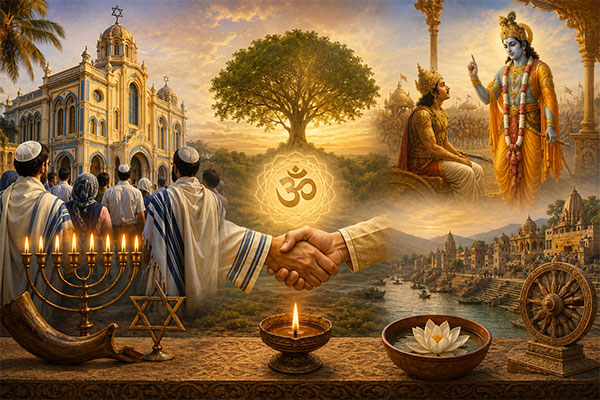
As a close friend waited for his flight at Tel Aviv’s Ben Gurion Airport, he noticed several Bene Israel families among the travelers and immediately texted me. Years earlier, I had told him about my Jewish neighbors while growing up in Maharashtra, India. The Bene Israel are descendants of Jews who sought refuge in India as early as the second century BCE. Over many centuries they adopted Marathi, my mother tongue, while faithfully preserving Jewish traditions such as the Sabbath, circumcision, and kosher practices. They flourished without persecution, and their synagogues continue to stand as respected places of worship.
For many Jews outside India, the Bene Israel remain little known. Yet their history offers one of the world’s most remarkable examples of religious coexistence. For nearly two millennia, Jews lived among a Hindu majority without experiencing the state-sponsored antisemitism, expulsions, or pogroms that scarred so much of Jewish history elsewhere. India did not merely tolerate its Jewish communities; it allowed them to preserve their faith while becoming an integral part of the nation’s cultural life.
That history reflects something distinctive about India’s civilizational ethos. Hindu thought has long embraced the conviction that truth may be approached through multiple paths and that every human being possesses an inherent spiritual dignity. This worldview did not eliminate political conflict or social divisions, but it created a space for religious minorities, including Jews, to flourish without abandoning their identity.
As I reflected on my friend’s message, I was reminded of another enduring gift of Indian civilization: the Mahabharata. Like the Hebrew Bible, it is far more than an ancient narrative. It is a sustained meditation on power, justice, leadership, loyalty, and the moral burdens that accompany the defense of a people. Its questions remain startlingly contemporary because they address dilemmas that every civilization eventually confronts.
The Mahabharata should not be read as a political blueprint for modern conflicts, nor should its heroes be mapped onto contemporary nations. Its enduring value lies elsewhere. Like the Hebrew Bible, it explores what happens when a people committed to moral principles must also wield political power. The epic refuses easy answers. Victory never erases moral responsibility, and righteousness never guarantees freedom from tragedy.
The epic’s central concept is ‘Dharma’, a term that encompasses justice, duty, moral order, and ethical responsibility. Throughout the story, even its noblest figures struggle to discern what dharma requires under impossible circumstances. The supposed moral paragon, elder brother Yudhishthira, makes painful mistakes. The greatest warrior, Arjuna, hesitates before battle, overwhelmed by the prospect of killing relatives and teachers. Krishna, the Divine incarnate himself, counsels actions that challenge conventional notions of morality when he believes the preservation of justice requires them.
These struggles echo a recurring theme within Jewish tradition. The Hebrew Bible, the Talmud, and later Jewish thinkers likewise refuse to portray righteous leaders as morally flawless. Abraham argues with God for the sake of Sodom. Moses loses the privilege of entering the Promised Land. King David’s greatness coexists with profound moral failure. Jewish ethics, like the Mahabharata, recognizes that leadership often requires navigating competing obligations rather than choosing between obvious good and evil.
Nowhere is this tension more evident than in the ethics of war. The Bhagavad Gita, set on the eve of the Mahabharata‘s climactic battle, does not celebrate violence. Arjuna’s reluctance to fight arises from compassion, not cowardice. Krishna does not dismiss those concerns. Instead, he teaches that the use of force may sometimes become a painful duty when all peaceful alternatives have failed. Yet he also insists that action must remain free of hatred, vengeance, and selfish ambition.
Jewish thought has wrestled with similar questions for centuries. The tradition recognizes both the necessity of self-defense and the moral limits that accompany the use of power. The challenge is never merely how to prevail, but how to preserve one’s ethical character while confronting those who seek one’s destruction.
These ancient insights resonate far beyond India. Israel’s modern history has required its citizens to confront many of the same enduring questions that have occupied moral thinkers across civilizations: How does a democratic society defend itself against existential threats? How does military necessity coexist with ethical restraint? How can security be pursued without losing sight of the humanity of those caught in conflict?
The Mahabharata offers no simple political answers. Indeed, one of its deepest lessons is that even a just victory carries immense human cost. After the devastating war at Kurukshetra, the victorious Pandavas inherit not triumph but a shattered civilization. Their kingdom survives, yet countless families mourn their dead. The epic reminds readers that war may sometimes be unavoidable, but it is never something to celebrate.
This perspective feels particularly relevant today. Israelis continue to confront terrorism and genuine threats to their security, while Palestinians have endured decades of displacement, suffering, and uncertainty. Durable peace cannot emerge from military strength alone, even when that strength is indispensable. Nor can it emerge from denying a nation’s legitimate right to defend itself. The moral challenge lies in holding both truths simultaneously.
Underlying the Mahabharata is another profound principle of Hindu philosophy: Universal Oneness. The Upanishads teach that the same divine reality dwells within every human being. The Bhagavad Gita describes the truly wise as those who perceive the same spiritual essence in every person, regardless of status or circumstance. This vision does not abolish conflict or erase the necessity of justice. Rather, it insists that even an adversary must never be stripped of human dignity.
That insight finds a striking parallel in Judaism’s teaching that every person is created b’tzelem Elohim-in the image of God. Although the two traditions emerge from very different theological foundations, they converge on a shared moral intuition: genuine strength is inseparable from reverence for human life.
The history of India’s Jewish communities demonstrates that these principles need not remain abstract philosophy. For nearly two thousand years, the Bene Israel, Cochin Jews, and Baghdadi Jews maintained their distinct religious identities while living peacefully among a Hindu majority. Their experience does not suggest that India was a utopia, nor does it erase the complexities of its history. But it stands as a remarkable example of a civilization confident enough in its own traditions to allow another ancient faith to flourish.
In an age increasingly defined by polarization and civilizational distrust, that history deserves renewed attention. The story of India’s Jews reminds us that coexistence is not merely an aspiration but a lived historical reality. And the Mahabharata reminds us that the measure of a civilization lies not only in its capacity to defend itself but also in the wisdom and restraint with which it exercises power.
Perhaps that is the deepest lesson shared by Hindu and Jewish civilizations. Both understand that strength and compassion are not opposing virtues. Both insist that justice requires courage as well as humility. And both remind us that the ultimate purpose of power is not domination, but the preservation of a moral order in which human dignity can endure, even amid the tragedies that history sometimes makes unavoidable.
Leave a Reply