Blog

  • Debate

    Debate

    As our next Presidential election looms closer, we are all listening to the media, the sheer barbarism of the public arena vocalization filled me with great anguish as to how far we have fallen. On the current political debate stages, behavior like blatant lying, interrupting the opponents, childish insults have become a norm for the people vying to hold offices of public trust. In stark contrast is the ancient Hindu technique of debate called Purva (prior) paksha (side)and Uttar (later) paksha (side).

    The aim of any honest debate is to conclude what is the truth. Each debater brings his or her relative truth to the table. Based on their past experiences either intellectual or physical, each debater tries to prove that their relative truth is as close as possible to an absolute truth. For this to occur each debater must debate based on his perspective, and not based on personal ego or an undisclosed agenda. Further, each should be willing to embrace the resultant conclusion of the debate. Prior to the debate the opponents make a wager on the result. The usual wager in ancient India was that the defeated debater and his followers becomes the disciples of the winner. Purva paksha phase of the debate starts when each of the opposing debaters, states in greatest possible detail the perspective of his opponent. For this to occur each debater must have the deepest understanding of the stated position of his opponent. The rival then agrees that the opponent has indeed expressed his position correctly. Then the process is repeated by the other debater. This exercises also forces each debater to realize any weakness in his own perspective. Once the rivals agree that they have demonstrated the clear understanding of each other’s position, then comes the next phase of Uttara paksha.

    The first part of Uttara paksha is Khandana, where each debater presents the rebuttal of the antagonist’s position. Then comes Siddhanta, which is the perspective of the debater. Finally, as one of the debaters fails to provide rebuttals, the judge declares the winner, and the defeated party accepts the perspective of the winner. A classic example of this kind of debate occurred in 7th or 8th century (around middle of 600 CE) between the great philosopher Shankaracharya who was a proponent of Advaita (Monoism- which states unity of God, soul and world — ‘everything is God’) and Mandana Mishra who was proponent of Mimansa (a more ritualistic school of philosophy). Since Shankaracharya was a young monk in his mid-twenties, Mandana who was much older and a well-established scholar gave him the opportunity to choose the judge.

    Shankaracharya chose Mandana’s wife Ubhaya Bharati who was a great scholar in her own accord. The wager was that the losing scholar would become a renunciate (monk) and accept the winner’s school of philosophy. After intense and long debate Mandana was defeated. Just as he was going to take the vow of renunciation, his wife who did not want to lose her husband, challenged Shankara, saying that a wife is one half of the husband. Therefore, Shankara must debate her too, prior to proclaiming his victory. Ubhaya being a clever woman in addition to being a scholar, debated Shankara with questions involving marital issues.

    Shankara being a celibate has no marital knowledge. Being a fair contestant, she gave him a weeks’ time to get the knowledge. Incidentally, a King of a neighboring kingdom died at that time. Shankara using his yogic powers transmigrates his soul into the dead Kings body and the body becomes alive. By living as the King with his many wives and discussing in depth the intricacies of marriage with one of the wise queens, Shankara gains the requisite knowledge and by the end of the week departs the Kings body and returns to his own. Next day he soundly defeats Ubhaya based on his new found knowledge augmenting his profound knowledge and wisdom. Both the husband and wife then become Shankaras disciples and after his death at the age of 32 years, carry on his school of philosophy.

    Imaging our Presidential candidates debating using Purva paksha and Uttara paksha technique. Even if the defeated does not accept the perspective of the opponent, the fact that he/she learns about the opponents position and the basis for holding that position, will make politics very civilized and through it the government will truly be OF the civilized people, FOR all the people and BY the reasonable people.

  • The  Restoration of One of the Holiest Sites of Hindus: A Story of Loss and Recovery: Ram Janmabhoomi

    The Restoration of One of the Holiest Sites of Hindus: A Story of Loss and Recovery: Ram Janmabhoomi

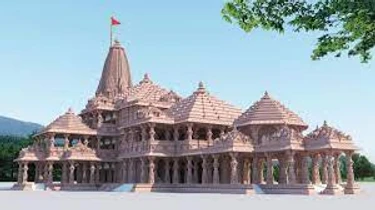
    It is seldom that an event occurs in the history of a civilization which is a culmination of centuries of struggles, sacrifices of hundreds of thousands of people, and perseverance of belief in a system of law and order. On August 5th, 2020 the foundation stone was laid for the project to rebuild Lord Rama’s birthplace temple in Ayodhya, India.

    Lord Rama is believed by Hindus to be the 7th Avatar of the Divine (personified as Vishnu — the Sustainer in Hindu belief system). Hindus believe that whenever the balance between the good and evil is disturbed in the favor of evil, Divinity takes a tangible form called an Avatar, and appears on Earth to destroy the evil and restore the balance.

    Lord Rama was born around 5000 BC, precisely January 10, 5114 BC, a date derived based on the position of astronomical objects recorded in the epic Ramayan which describes the saga of his life. He is called Purushottam (foremost among humans) due to his qualities as an ideal son, husband, and king. His obedience to his father, his quest to rescue his wife kidnapped by the evil Ravana, his destruction of Ravana and the liberation of the people, and his ultimate sacrifice to abandon his beloved pregnant wife for maintaining the moral fiber of his kingdom, is the story which has inspired Hindus, and even non-Hindus, who have read the story over thousands of years. His designation as a ‘human being’ brings him closer to us ordinary humans, such that each one of us can aspire to inculcate some of his qualities in our daily existence.

    The temple at the site of his birth, which was in existence since time immemorable, was destroyed by Mir Baqi Tashkandi, a general of the invading Uzbek King Babur, a descendant of Genghis Khan. This was not an isolated incident, as hundreds of thousands of temples have been destroyed by religious fanatic Mughal rulers in India prior to the British takeover. The destructive activities were recorded with relish in their memoirs. On my last visit to New Delhi, it pained me to see easily recognizable pieces of the destroyed original Hindu temples in the so-called architectural marvels constructed by the invaders. The Lord Rama birth site, being one of the very sacred places for Hindus, had a total of 77 attempts made over centuries to reclaim it at the cost of hundreds of thousands of lives of warriors and holy men, as well as ordinary men, women, and children.

    After the British left India, the former unbroken India was partitioned into Islamic Republic of Pakistan, Islamic Republic of Bangladesh, and Secular Republic of India, which does not have a state religion. After independence in 1947, Hindu organizations petitioned to the Indian judicial system that Lord Rama’s birthplace, which was called ‘dispute land’ and was off-limits to the public, be handed over for reconstruction of a grand temple consistent with its historical and religious significance. The movement to reclaim Lord Rama’s birthplace united all Hindus, regardless of innumerable divisions in the overall Hindu society. The Indian judicial system took a long time in this case due to political and antisocial interference. Finally, on November 9th, 2019, after the presentation of extensive archeological evidence, the Supreme Court of India ordered the 2.77 acres to be handed over to a trust to build the temple. The trust of the Hindu people in the judiciary system is something to reckon. It took 72 years post-independence for a site of immense Hindu religious significance, which was forcefully taken nearly 500 years ago, to be regained by the due process of law.

    The history of Hindus is rife with instances where due to their internal divisions, they could not put up a united front against the invading hordes, resulting in destruction of culture and forceful religious conversion of the locals into the faith of the invaders. Today, we Americans are now the most divided in living history. We need to find the common core values which make us all American and bring those to the forefront while putting our differences behind us. Our enemies are bleeding us to death with a thousand cuts, and we are not realizing their significance. Poisonous false propaganda is being infused, which is making fellow Americans hate each other with a ferocity previously reserved only for the vilest enemy. We need to unite soon before it is too late. As Benjamin Franklin rightly said, “We must, indeed, all hang together, or most assuredly, we shall all hang separately.”

  • Freedom

    Freedom

    There is an ancient fable. One day a caravan of 100 camels and drivers is traveling in the desert. The caravan loses its way and ends up outside a village at dusk. The travelers put up their tents and start tying the camels. They realize that 99 camels have their ropes and stakes, but one of the stakes and rope set is missing. The drivers are worried that if not tied down, the camel will walk away and may join other herds, get lost, or worse. The camel drivers start looking around and go to a hut on the border of the village. An old man living in the hut does not have any rope or a stake to spare. However, he suggests that the drivers should tie the camel with an imaginary rope, given that darkness has fallen, and the camel will not see the rope. The camel drivers laugh at him and think that the old man is senile. But since they cannot find any rope or stakes, they reluctantly go back to the 100th camel and act as if they are tying a rope around his neck and hammering the stake into the ground. Afterwards, they pat the camel, order him to sit down and throw some fodder in front of him. The next morning, they get up and untie all the camels who then start walking, but the 100th camel tied with the imaginary rope does not stand up. Since there was no rope to untie, the camel drivers thought that the camel would be able to just get up and walk. However, after multiple attempts and even beating the camel with a stick, the 100th camel does not get up. Finally, the camel drivers perform the entire action of untying the imaginary rope and digging out the stake from the sand. The camel then immediately gets up and starts walking.

    Each of us has the 100th camel within us. If we think and make a mental list, there are many imaginary fears and nooses which we have hung around our neck, some by our own hands, while others are created and hung by smart merchants of everything. Depending on where we were born, to whom, among which group of people, at what particular time, and who we meet on our way through life, we allow ourselves to be tied down by these imaginary chains, borders, limitations, and expectations, which prevent us from exploring our true potential and experiencing the true freedom.

    A word of caution, though! Freedom of one sometimes ends up as bondage of another. Someone’s freedom of expression from the majority can end up muzzling the expression of the minority (by thought, color, orientation, origin and all other classifications), who experience fear of the effect of their own expression. Conversely, the unfettered freedom of the minority, which when taken over a limit, can also poke into the eyes of the majority. While these disruptive processes are sometimes needed, they should not be taken lightly.

    Similarly, complete freedom may not always be a good thing and sometimes may be very dangerous. A paper kite can only soar high in the sky only if it is tied to a string. As long as the string is long and gives the kite enough freedom, it can ride the winds of opportunities. But the moment the string breaks, the moral restraint or a bond of love breaks; after an ephemeral flight of freedom, the kite ends up in tatters on a branch of a tree or in a ditch.

    The last few weeks of isolation and furlough from employment have given me free time and freedom for the mind to explore and realize that freedom is good and enjoyable, as long as you have safe and voluntary confinement to return to when needed.

  • Hindu MANDIR (temple): Its MEANING AND SIGNIFICANCE

    Hindu MANDIR (temple): Its MEANING AND SIGNIFICANCE

    Why do we go to the temple? This question sometimes comes to our mind, especially after we have not gone to the temple for some time or when there are other interesting things that conflict with temple events. Sometimes children ask us that question either due to genuine self-introspection, part of teenage angst and rebellion, or an excuse to pursue other more alluring events. This write-up is not a sermon, but an attempt to provoke more thinking. Just as each one of us has his/her own relationship with our parents; no one can or has the right to censure others on their relationship with the divine parent.

    According to Hindu Philosophy if Bhagavan (God) is present everywhere, why do I have to go to the temple?

    I have used this allegory to explain the significance of mootis (consecrated statues) in the temple. Radio waves (like Bhagavan) are everywhere, but you need a fine-tuned radio receiver to listen to music. The fine-tuning is done by ‘prana pratishstan’ ceremony performed at the time of the consecration of the temple when we invoke the divine to reside in the moortis. The temple is the concert hall which is best suited to appreciate the music.

    Another way of thinking is that the temple is a giant super magnet charged by the divine and each of us is a tiny magnetic material that becomes magnetized when we visit the temple and spend some time there. The magnetism persists for some time after we leave. Hence, we must return periodically to recharge.

    Visiting the temple is also like visiting our favorite grandparents with a beautiful house whose advice and help we seek, who grant us gifts, and where we can be children again by eating sweet prasad (blessed sweets distributed in the temple), sing and occasionally dance.

    None of these allegories are perfect but based on our own situation may be more or less applicable.

    It is true that Bhagavan is present everywhere, and the miracle of manifestation can be seen everywhere, but have we attained the mental state to experience the ultimate cause of everything? Visiting a temple, experiencing the auspicious ambiance, and doing devotional services are processes that are designed to calm our senses, to guide them inwards, thereby helping us to prepare for experiencing our divine nature.

    Most of us are not self-aware of our true quest to realize our divinity. Occasionally, in fleeting moments we become aware and then quickly get immersed in our daily routines just like card-players in a train who occasionally glance out of the window to realize where they are and where they are going, but again get too engrossed in the card game, sometimes ending up traveling to wrong places. After many cycles of reincarnations based on our karma, we get more and more in-tune with our ultimate aim of moksha (merging with divinity). The serene surroundings of the temple are very conducive to bringing self-awareness.

    The moortis or consecrated statues in the sanctum of the temple have forms that were revealed to ancient seers during their state of deep meditation, while some represent artists’ interpretation of historic descriptions from scriptures narrating ancient history. Both human male, female forms as well as forms featuring a fusion of both human and animal morphology are present. These various Deity forms are worshipped in multiple ways according to the scriptural injunctions and depending upon one’s inclination and devotional attitude. The beauty of Hindu Dharma is that one is free to choose and worship any of these manifestations. This great diversity in the approach corroborates with the infinite variety of human attitudes and experiences and is valid as long as the underlying unity is understood.

    The temple is a giant collection of symbolism as well as spiritual aids which is available to all devotees to use based on the individual stage of their personal spiritual journey. To aid us in fostering is the attitude of contemplation, there is a statue of a tortoise that pulls in its head and four legs, representing our five senses which we should turn inwards when we concentrate on Bhagwan. There is also a statue of Nandi the bull vehicle of Lord Shiva who teaches us to be patient, as he has sat in front of Shiva motionless for eons, calm but alertly waiting for Shiva’s next order.

    After a recent adverse health event, I was fortunate to have our local temple and fellow temple devotees to help get my body and mind back on road to recovery and experience the Divine bliss through rekindling the relationship with Bhagavan.

  • Diwali: More than a Hindu Festival of Lights

    Diwali: More than a Hindu Festival of Lights

    Diwali, the Hindu festival, is nowadays simplified as “the festival of lights.” Unfortunately, it is reduced to the display of electric string lights, shopping at ‘Diwali sales,’ and indulging in sweets. However, Diwali is actually a multifaceted celebration to teach and remind us of important principles of being a noble human.

    Hindus are ancient people, who are distributed over a large geographical area and have a long history, in addition to varied local resources. Hence, there is extensive diversity in the way Diwali is celebrated. Diwali is celebrated in October/November on the dark fortnight of this period. It is celebrated by Hindus, Sikhs, and Jains in India and around the globe. There are approximately 1.3 billion self-identified Hindus in the world. There are 3.3 million Hindus in the USA, according to the 2016 census, which is 1% of the American population. The reason I say self-identified is that there are many people who follow Hindu principles but do not actually identify themselves as Hindus.

    Diwali is derived from the Sanskrit word “Deepavali,” which means “row of lights.” Many historical events have occurred during Diwali, and these events are celebrated and remembered regionally or globally with varied stories and traditions. For example, Lord Ram, the 7th avatar (human manifestation of the divine), defeated the evil king Ravana who had abducted Ram’s wife Sita and was committing atrocities on people. Furthermore, the sixth Sikh Guru Hargobind, who was imprisoned by the mogul emperor Jehangir, was released on this day, along with 52 other kings. Mahavir, the last Jain Tirthankar, also attained Nirvana during Diwali.

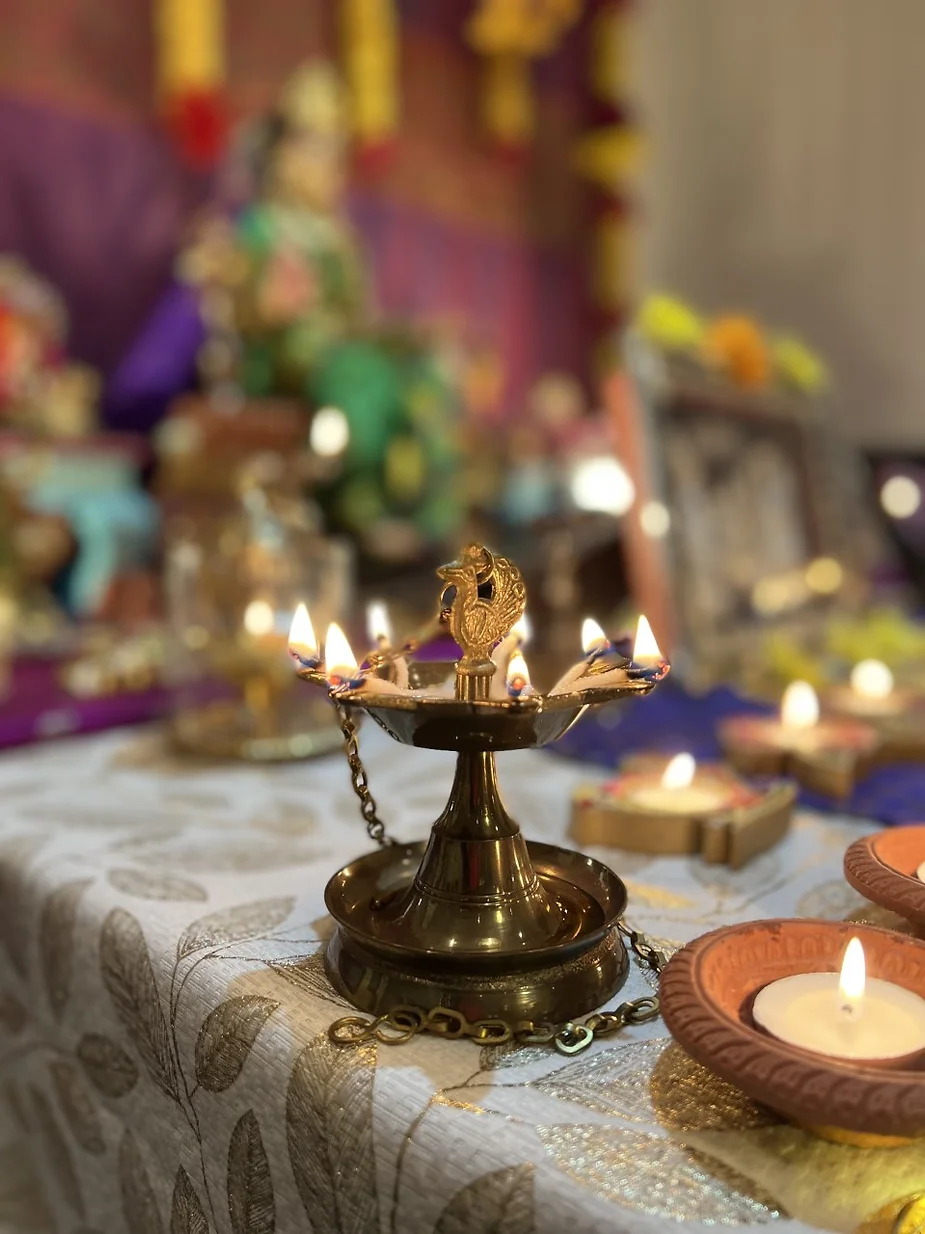
    So, how do we celebrate Diwali? Hindus clean and decorate their houses, draw Rangolis (floral designs on the ground made by colored powder or flowers), indulge in sweet and savory snacks, shop, exchange gifts and food with friends and neighbors, and light fireworks. We also visit the temple, make offerings to the deities of spiritual and material prosperity, donate to the needy, and light earthen oil lamps and other types of lights around the house. In fact, the lighting of the earthen lamp has great significance for Hindus. The earthen lamp represents the recyclable mortal body (dust to dust). The light symbolizes knowledge. The oil or ghee (clarified butter) in the lamp represents our negative tendencies, and the wick is our ego. When we light the lamp (body) with the flame (knowledge from our teacher), it slowly exhausts the oil (negative tendencies), and the wick (ego) perishes. The knowledge takes us to higher ideals, similar to how the flame burns upwards. One single person of knowledge can share knowledge with others without diminishing his own knowledge, just as a single lamp can light hundreds of lamps.

    Six days of Diwali

    Day 1: Vasu Baarus — 12th Day of Lunar Calendar

    Vasu means brilliance or wealth. Baarus means the 12th day. This day pays homage to the cow and calf, representing wealth, motherhood, fertility, and sustenance.

    Why is the cow considered sacred? Hindus see cows as particularly generous creatures. A cow gives lots to the human being but takes almost nothing from us, just like our biological mother and mother of all, the earth. Cow worship is acknowledgment and appreciation of these holy qualities. In every agrarian house, there is a cow whose milk is drunk from childhood and throughout life. The male cow plows the field and is a mode of transportation — the bullock cart. Thus, the cow is considered part of the human household family. Cows not only give milk and innumerable milk derivatives, which are used as food, but they also give cow urine with medicinal properties, and cow dung, which is used for its antimicrobial properties, as a fuel, and for bioremediation of environmental pollutants. Cows not only take care of us during their entire life but also after their death, through leather and making fertilizers from their bones. In addition, Hindus associate various animals with different gods and consider these animals sacred. These include monkeys-Lord Hanuman, elephants and mice-Lord Ganesha, and tigers-Goddess Durga, among others, but none is revered as much as the cow, who is associated with Lord Krishna.

    Day 2: Dhanteras — 13th Day of Lunar Calendar

    Dhan is the abbreviation for Lord Dhanvantari. the deity of health and medicine. Teras means the 13th day. This day is celebrated in India and around the world as National Ayurveda Day. Ayurveda is the world’s oldest holistic healing system developed in India and is now getting popular in America and around the world. Dhan also means wealth, representing both material and spiritual wealth, as well as health (health = wealth). Consequently, Dhanteras is a massive shopping day in India, in addition to other forms of celebrations.

    Day 3: Narak Chaturdashi — 14th Day of Lunar Calendar

    Narakasur was a tyrannical demon king who had a boon that he could not be killed by a man. Satyabhama, the wife of Lord Krishna — the 9th avatar, thus killed the demon and released the 16,000 women whom Narakasur had kidnapped. The lesson from this story is that women should not wait for a knight in shining armor. Women should don the armor themselves, pick up a weapon, and vanquish the offenders themselves, or use other legal ways as in modern society. The demon may be a politician, powerful celebrity, workplace colleague, a roadside ruffian, or even negative characteristics of oneself. For Hindus, the women are not damsels in distress or delicate flowers but goddesses of power and strength. The traditions of this day include special ritualistic baths and worship and lighting of lamps to eradicate the negative energies.

    Day 4 Laxmi Pujan — No Moon Day

    The worship of Laxmi, the deity of prosperity, is important because we should respect wealth and not misuse it for inappropriate and immoral purposes. During the dark winter months, you need material wealth to survive. Only the ‘haves’ can feed the ‘have nots.’ Wealth provides security for you and everyone else because Hindus believe that the entire creation is a family. The business community starts new account books on this day. In villages during olden times, grains were shared with the 12 guilds (balutedars) who served the village throughout the year as a part of a complex barter system. In the USA, Sewa Diwali (www.sewadiwali.org) is conducted, a collective initiative by a large number of Dharma-based organizations around the country, who hold food drives and other necessary drives to benefit underserved communities. Last year, more than 300,000 pounds of food were collected from 400 centers and distributed to 200 facilities.

    Day 5: Bali Pratipada/Padwa — 1st Day of Lunar Month

    This day commemorates the defeat of king Bali. He was originally a virtuous person who got corrupted by power and became too arrogant. The Supreme Being thus manifested as Vaman, a dwarf and the 5th Avatar of the divine, to carry out the task. This is a lesson for powerful people to behave righteously, since even an apparent weak person may cause their end. This day is also celebrated as a husband-wife festival in which the wife gives a ritualist bath to the husband with scented oils and perfumes stressing the romantic nature of the relationship, while the husband gives jewelry and gifts to the wife. These gifts belong only to the wife and are not family property.

    Day 6: Bhai Dooj — 2nd Day of Lunar Month

    This is the brother-sister festival. In ancient days and even now, many sisters are far away from brothers’ homes, and brothers do not get a chance to meet them throughout the year. However, on this day, it is the duty of the brother to visit the sister, regardless of how far she is located, or if impossible do so, at least make a virtual video call with her. The brother gives gifts to the sister, and the sister performs ceremonial rituals for the brother and feeds him. In my hometown of Peoria, IL, we conduct a food drive for The Center for Prevention of Abuse (https://www.centerforpreventionofabuse.org/), using the principle of brothers helping the local sisters in distress.

    To review in short:

    Day one — Animal protection and appreciation.

    Day two — Health awareness.

    Day three — Women empowerment.

    Day four — Well-being for all.

    Day five — Removal of arrogance and greed, and homage to the husband-wife relationship.

    Day six — Homage to the brother-sister relationship.

    Thus, Diwali is not just a festival for Hindus, but its principles are applicable to the entire humanity regardless of your mode of worship.

    Om Shanti Shanti Shanti. Om Peace Peace Peace.

  • The Hindu 300 (not the Spartans) — Battle of Paavan Khind

    The Hindu 300 (not the Spartans) — Battle of Paavan Khind

    There are times when the future of an entire dream of independence of an oppressed people rested on the mettle and sacrifice of few people. Few are fortunate to offer themselves as Ahuti (sacrificial offering) in these rare auspicious times in the yajna (sacrificial fire). One such momentous Ahuti was Baji Prabhu Deshpande (1615–1660) and his group of 300 Mavle soldiers.

    In the 17th century, then-contemporary India was ruled by foreign Muslim rulers who subjected the local Hindu populace to great atrocities and coerced conversion practices using brutal force and money. .Massive destruction of Hindu temples took place during these times, and mass conversion occurred of Hindus to Islam. Like a beam of light piercing these dark times was born King Shivaji, a son of local Chieftain whose intellect, cunning, and noble character inspired men of all faiths and varied strata of society to come together under the swallow-tailed Bhagwa flag (saffron flag) which represented the flames of sidewards turned sacrificial fire, and successfully resist the onslaught of foreign subjugation. His inspiration attracted extraordinary men or maybe turned ordinary men into extraordinary, who sacrificed everything for the noble cause.

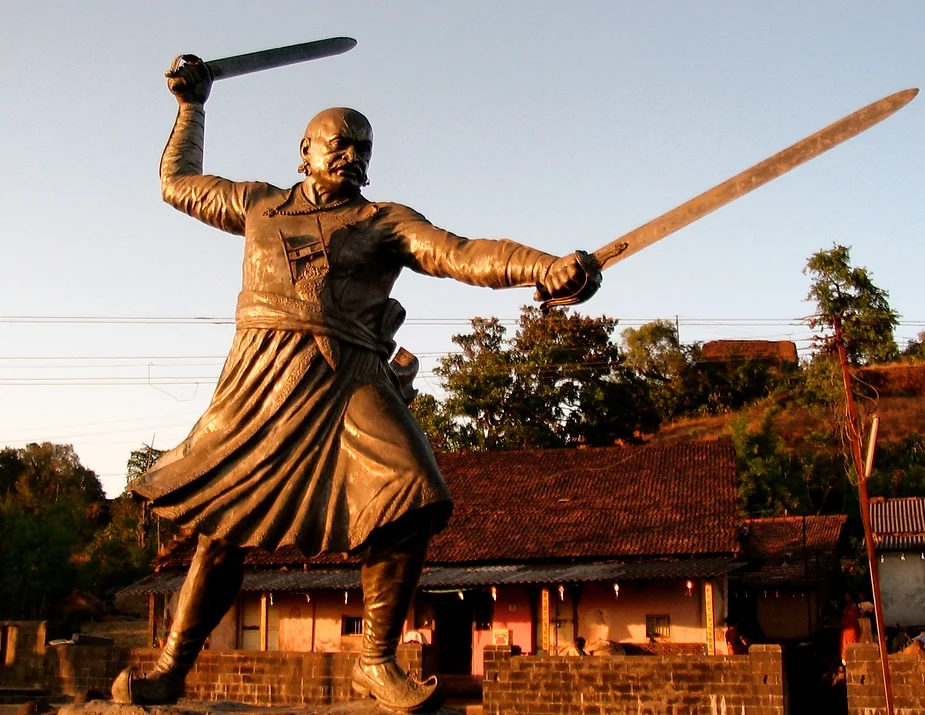
    One of these extraordinary men was Baji Prabhu Deshpande. Baji was initially employed by a small-time enemy chieftain, who King Shivaji defeated. Shivaji was greatly impressed by this man’s valor and explained to him his life’s mission of freedom for the people from the oppressive foreign rulers, persuading Baji Prabhu to join his army. Baji Prabhu devoted himself to the common cause of Swarajya (self-rule). In 1660, Shivaji was trapped in the mountain Fort of Panhala by the Abyssinian general, Siddi Johar, who worked for Adil Shahi, the ruler of Persian origin in southern India. Multiple attempts by Shivaji’s men were made to break the four-month-long siege of the fort but did not succeed. As rations were getting exhausted, a daring plan was hatched to leave the fort from a hidden exit at night, breach the encirclement and escape from Fort Panhala to Fort Vishalgad, at a distance of 65 km. Fort Vishalgad was also surrounded by the enemy’s army but was the closest secure stronghold. The journey took 20 hours by foot over mountains and valleys. Shivaji’s look-alike servant Shiva Kashid dressed up as Shivaji and got down from the Fort with few soldiers, and fled in the direction opposite of Fort Vishalgad, knowing very well that they will be captured and put to death after being recognized. However, this sacrifice and the resultant distraction and disarray allowed Shivaji, Baji Prabhu, and 600 of their men to escape in the opposite direction towards Vishalgad, after fighting and breaking through the ring of encirclement.

    It was a full moon night of July 13th, 1660, with torrential rain, as Shivaji and the soldiers hurried on the mountainous rock-striven path, crossing flooded streams. The party hurried, knowing that they were only a few hours ahead of the enemy. Siddhi Johar realized that he had been fooled by the look-alike decoy and sent his son-in-law Siddi Masud with a vast army of close to ten-thousand soldiers chasing after Shivaji in the direction of Vishalgad. Baji Prabhu saw the flickering light of the torches of Siddi Masud’s army following them, who were gaining on them, being freshly rested while Shivaji’s men were tired from fighting while breaking the encirclement. As they approached Ghodkhind (Ghod-horse, Khind-mountainous pass) a very narrow pass through the mountains about 10 km from their destination, which was the only way to Fort Vishalgad, Baji Prabhu said to Shivaji, “Please take half of the people with you and continue towards Vishalgad, while myself and 300 others will hold back the enemy till you reach safety”. The 300 men with Shivaji were needed to attempt and break the siege of Fort Vishalgad and enter it. Shivaji could see from the number of flickering torches that the chasing army was in thousands and refused to let Baji stay behind. Baji realizing that if Shivaji was killed or captured, the dream of independence would be shattered. He uttered the famous sentence, “Even if hundred thousand die, the savior of a hundred thousand should be saved.” He begged Shivaji to go to Fort Vishalgad and continue with the dream of establishing Swarajya (self-rule) for all the people of the land. Baji requested Shivaji to fire 5 cannon shots, indicating that he had reached the safety of Vishalgad. With a heavy heart, Shivaji departed knowing the fate of these soldiers. Baji Prabhu arranged his soldiers along the extremely narrow path, which was the only way through which the enemy could follow Shivaji. With 50 people flanking the pass and multiple rows of men extending from the wider entrance leading to the narrowest portion, he positioned himself with dand pattas (gauntlet swords) in each hand. Shivaji’s soldiers were the Mavles, who were mostly agriculturists, many of them part-time farmers/soldiers, having families back in the villages. I cannot imagine what must be going through their mind as they faced the onslaught of professional soldiers from the Adil Shahi army, fully aware that they will not be returning to their families and farms. The Siddhis were Abyssinian soldiers. Many brought as slaves but given military ranks after proving their skills. The fact that they rose to such prominence in Adil Shah’s army indicated the fearsomeness of the Siddhis. With the huge mismatch in numbers, facing such an enemy gives us a glimpse of dedication to the cause of freedom. Baji Prabhu and his men held the pass for 11–12 hours. By the time the next afternoon arrived, only 40–50 of the original 300 were left. Baji Prabhu was grievously injured, but no enemy soldier could pass him and his fearsome skill at dand patta. Siddhi Masud observed Baji from the nearby hillock and summoned an Englishman accompanying his troops with a long musket gun. He ordered the Englishman to shoot Baji, as that was the only way anybody could get past him. It is said that the Englishman was looking for an area on his body to shoot so that he would know he hit his target, but Baji’s body was so covered in wounds that there was no clear area on his chest or head.

    The long gun musket shot Baji in the chest, and he collapsed. As the surrounding soldiers tried to drag him to safety and cover, Baji said, “I cannot let a single enemy pass through, till I hear Shivaji has reached safety. Death has to wait till the king has reached safety.” Baji knew that Shivaji had to fight the encirclement surrounding Vishalgad, before entering the fort and reaching safety. Baji stood up and again walked to the narrow pass and continued fighting. Suddenly, the cannon fires started in the distance. As the fifth cannon shot was heard, Baji collapsed and closed his eyes, smiling. The blood of Baji and 300 heroes consecrated the soil of Ghodkhind, which from that day onwards has been renamed as Paavan Khind (Sacred Pass).

    A forty-five-year-old man fighting for 11–12 hours after walking overnight indicates the strength, stamina, and devotion of Baji Prabhu to the cause of freedom and self-rule. . The sacrifice of the other 300 unknown soldiers most likely unknown to even their own descendants is profound. These ordinary soldiers surrounded and supported great heroes and individually did not get accolades or glory just like the particles of mortar holding together great rocks that form the citadel of freedom that protects us.

  • Swabhawa – True nature of things

    Swabhawa – True nature of things

    During adversity, a person’s true nature (Swa- self, bhaava- essence) gets exposed. In normalcy, many of us take on covering to fool others and sometimes ourselves. We take on roles to fit into what we believe is expected from us to be accepted as a member of the society around us. The current pandemic is acting as a cleaver, slicing the outer false shell and exposing the inner true nature.

    Some of us are hoarding food and other essentials in quantities far beyond our wildest imagined needs. From toilet paper and canned meat to protective masks, vast quantities of materials have disappeared from stores as well as online retailers. Some people have hoarded medicines like hydroxychloroquine due to unsubstantiated statements of its ability to cure Covid-19 infections, at the cost of causing shortage to people who really need it for their immunological disorders. Some of these hoarders have become black marketeers. There are others who have built a virtual moat and stockage system around them, with stockpiles of essentials hoping to survive the pandemic by complete isolation, binging on streaming online entertainment, oblivious to the suffering around them.

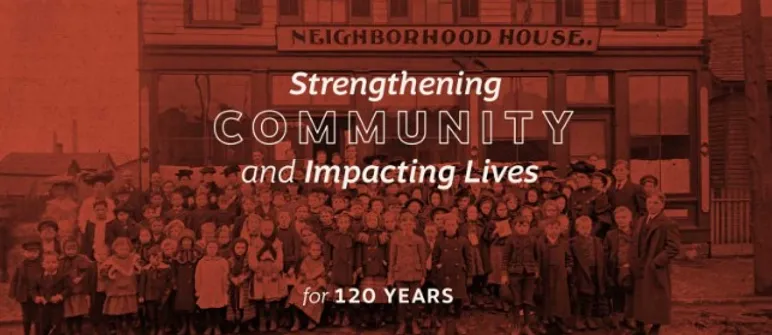
    At the same time, there are others who have seen the distress around them, and their true divinity gets manifest. These are the so called ‘ordinary’ people who become extraordinary. When disaster strikes, they blossom into true heroes. A few weeks ago, my youngest daughter and I had gone to Neighborhood House, a local charity in Peoria (nhpeoria.org), a life-line to many of Peoria’s most vulnerable population, to volunteer for making long shelf life food packages and delivering food to the elderly. On the delivery day, we arrived 5 minutes before the scheduled time. To our surprise, the whole parking lot was filled with volunteers, and in a few minutes all the deliveries were assigned. I was truly humbled by the spirit of service in Peoria.

    My first-hand knowledge is somewhat limited to my organization Hindu Swayamsevak Sangh, USA and its sister organization Sewa International (sewausa.org) who have established help lines covering all the time zones of the country. Requests ranging from home bound elders for grocery delivery, hospitals requesting cloth masks, stranded travelers, immigration help to spousal abuse and emotional/mental support are being handled by the help lines. Feeding the homeless and supporting food banks by conducting food drives are being done. At some places fundraising is being done to order food from local restaurants for the charity free food organizations, so that the local restaurant owners will earn money since their restaurants are closed to public, and the hungry will get food, thereby achieving two good activities in one stroke.

    The medical community starting from the front door greeters/security personnel to the EMT to the doctors and nurses are the brave hearts, holding back the Tsunami of the pandemic, and hopefully soon overturning it. Fortunately, for us in central Illinois, the rampage of the virus is limited compared to New York and Louisiana. Some local children are sending thank you posters to the hospitals. Drawing these pictures of gratitude will encourage our heroes and also ingrain into the children the examples of service before self.

    In Hindu Dharma, God manifests on earth (Avatar) when the balance of good and evil tilts too much in the favor of evil, and God rectifies the situation by annihilating the evil. One particular form of Avatar is called ‘Aveshavatar,’ where for a brief time God manifests special powers through an individual soul and acts through that person. I sincerely believe that each of the people who are helping others whether for an instant or by giving up their life while fighting for humanity are manifesting Aveshavatars channeling the divine force through their thoughts and acts. Lets all close our eyes for a few minutes and listen to our individual divine, manifesting through ourselves or through a prophet/philosopher, and do more than we are already doing.

  • Charity

    Charity

    There is a story of a famous poet Māgha in the 6th century, who was carefree with his wealth and lived in poverty towards the end of his life. One day, a poor man came to his door asking for some money so that he could get his daughter married. Māgha saw that his sleeping wife was wearing two gold bangles. He quietly slipped off one of them from her wrist and donated it to the visitor. When his wife woke up, he hesitatingly told her why he had taken her bangle. His wife admonished him, “How can a father get his daughter married with just one gold bangle. Please take off my other gold bangle and give it to him!”

    Hindu literature is filled with anecdotes of ordinary people performing extraordinary charitable acts without giving it much thought. This originates from the understanding of shared Divinity among all life forms resulting in a feeling of oneness, so that helping someone is like a person’s hand feeding his own mouth. For simple understanding of the process of charity, the Hindu scripture, Bhagawad Gita (17.20-22), states three categories of giving.

    1)A gift that is given without any expectation of benefit or reward is greatly beneficial to both the giver and recipient.

    (2) A gift that is given with the expectation of some advantage is of lower value.

    (3) A gift that is given at the wrong place and at the wrong time, causing embarrassment to the recipient, is harmful to both the giver and recipient.

    Charity essentially is a gift of useful time and resources. Nowadays, it is easier for many people to give under category 2, with the most common expectation being name recognition and advertisement of their economic success. Although we should all strive for the category 1, my personal opinion is that display of wealth is not always bad depending on how you do it. I have been a beneficiary of ‘display of wealth.’ I have received treatment at a hospital which carried the name of the famous Tata family in Mumbai. I used a library which was named after a benefactor who bestowed a large sum on the charitable trust. I have played in a park constructed on a piece of land donated and named after an industrialist. Having donated a large sum of money to a charitable cause indicates that you are wealthy. Of course, I do understand that the above gifts to the public by the generous benefactors were for the betterment of the masses, not just display of wealth. But is it not a great way to let everybody know that you have made it by donating to worthy causes? My suggestion to people who want to display their wealth is to donate more. A name on a plaque on a wall of charitable organization or emblazoned on a hospital or school lasts longer than a latest model expensive car. Further, more people can see it. This display is more glaring than a rare timepiece or jewelry. A hot meal consumed by a hungry person is nutritious regardless of the intention of the donor. Educational material donated to an underserved area organization gives the same quality of knowledge and career boost to children regardless of the selfish reasons of the donor.

    Sense of charity is like a skill. For some it comes naturally. For others, there is a steep learning curve. Small steps till we are comfortable, then one fine day we soar. Initially, perform charitable acts for prestige, self-aggrandization, or display of wealth. When you experience the joy of alleviating the misery of a fellow life form, slowly it transforms you. The hubris of self-importance starts getting washed away by the realization of oneness of giver and receiver, and ultimately oneness of the creation.

    ‘Giving without expectation’ is an epitome of perfection which we should all try to achieve. But just because a rooster cannot fly as majestically like an eagle, it does not stop trying. Some fortunate beings are born eagles, but for many of us, doing small acts of charity will be the building blocks which one day will result into our metamorphosis into a truly selfless charitable being.

    Featured image credit: Lalesh Aldarwish