Within this year, we observe the 350th anniversary of Chhatrapati Shivaji Maharaj’s coronation, a defining moment in the history of India, alongside the 240th anniversary of the Treaty of Paris, a monumental conclusion to the Revolutionary War in the United States.
The year 2023 stands as a significant milestone, commemorating the convergence of two iconic historical events separated by a mere hundred years. These pivotal occurrences gave hope to oppressed people globally, as a small group of resolute and unorganized men defiantly cast aside the shackles of enslavement. Within this year, we observe the 350th anniversary of Chhatrapati Shivaji Maharaj’s coronation, a defining moment in the history of India, alongside the 240th anniversary of the Treaty of Paris, a monumental conclusion to the Revolutionary War in the United States.
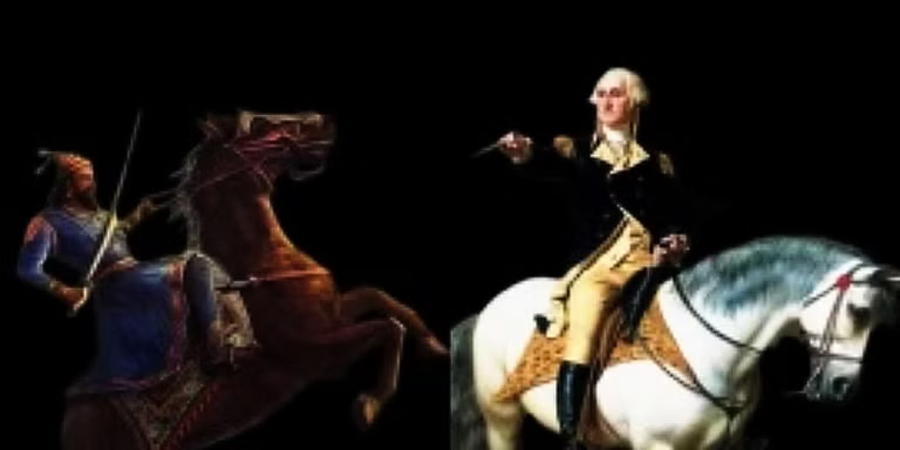
Both of these transformative landmarks of time were spearheaded by exceptional men, namely George Washington and Chhatrapati Shivaji Maharaj, who intriguingly share striking parallels. Despite living on different continents and being born in a very different culture, these two remarkable individuals shared striking similarities in their leadership qualities, strategic prowess, and unwavering commitment to freedom and justice. In this article, I have attempted to shed light on their common attributes that have transcended time and space. Shivaji Maharaj, born in 1630 in present-day Maharashtra, India, dreamed of overthrowing the yoke of foreign rulers (Mughal Empire and Adil Shahi Sultanate) and establishing a Kingdom that would safeguard the rights and interests of his subjects. Similarly, George Washington, born in 1732 in the British American colonies, envisioned a sovereign and self-governing nation that would secure the liberties of its citizens. Both leaders, driven by a profound sense of nationalism and working tirelessly to translate their visions into reality, have secured an everlasting place in the hearts and minds of their countrymen.
Inclusiveness
Both George Washington and Shivaji Maharaj had the ability to build and cultivate trust, bring together people of different backgrounds and perspectives, and make the most of the surrounding talent. Many great personalities of that time like Benjamin Franklin, Thomas Jefferson, Patrick Henry, and John Adams could not get along with each other but under the leadership of Washington, they worked together to get the colossal project of American Independence completed. Similarly, Shivaji was able to develop great lieutenants of different socioeconomic and religious backgrounds like Baji Prabhu Deshpande, Tanaji Malusare, Jiva Mahale, Bahirji Naik, Siddhi Ibrahim, among others. Both Washington and Shivaji Maharaj made sure that everybody’s attention was constantly fixed on the ultimate aim of freedom and not on any personal gains.
Inspiring Leadership
Both leaders were renowned for their ability to inspire and galvanize their followers. Shivaji Maharaj and George Washington commanded unwavering loyalty from their troops through their exemplary leadership styles. They led by example, displaying courage, integrity, and resilience even in the face of adversity. Their charisma and unwavering commitment to their respective causes ignited a sense of purpose and determination among their followers, motivating them to fight for freedom and justice. At the Battle of Princeton, Washington led his soldiers from the front on his horseback. He was only thirty meters away from the British line of fire. During his Presidency, even at the risk of becoming unpopular, Washington suppressed the Whiskey Rebellion, to establish that the government was willing to suppress violent protests of the laws. Among his many examples of supporting justice over political expediency, a prominent one stands when Shivaji severely punished his own victorious general Sakuji Gaikwad who raped the defeated woman leader of the opposing enemy army. Washington’s leadership was marked by his calm and composed demeanor, his ability to instill discipline, and his unwavering commitment to the cause of freedom. Shivaji maintained his calm in the most demanding situations, even when forced to keep his elder son, Sambhaji, at age nine as a surety for the treaty with Mughal general Mirza Raje Jaisingh. Both leaders demonstrated a strong sense of duty and were willing to sacrifice their personal and family lives for the greater good of their nations.
Military Strategies
Shivaji and Washington were military geniuses who employed unconventional tactics to outwit their more powerful adversaries. Shivaji revolutionized guerrilla warfare tactics in the 17th century, utilizing the rugged terrain of the Sahyadri mountains to his advantage and employing lightning-fast cavalry attacks known as “ganimi kava” (guerilla warfare) to destabilize the mighty Mughal Empire. Likewise, Washington’s brilliance as a military strategist was evident during the American Revolutionary War. He skillfully utilized asymmetrical warfare, hit-and-run tactics, and his knowledge of the local terrain to outmaneuver the powerful British forces. Both leaders understood the importance of adaptability, surprise, and exploiting the weaknesses of their opponents. They took help from enemies of the enemy. In 1677, Shivaji Maharaj signed a military alliance with Kutub Shahi Ruler Abul Hasan Tanashah of Golconda against the Mughal emperor Aurangzeb. The American Colonies and France signed this military treaty on February 6th, 1778, which shifted the balance of the Revolutionary War in America’s balance.
Governance and Administration
Shivaji Maharaj and George Washington were not just military leaders; they were also adept administrators. Shivaji Maharaj established a robust administrative system in his kingdom, focusing on justice, welfare, and effective governance. He implemented policies that protected the rights of his subjects and encouraged economic growth. In administration matters, he gave superior positions to his civil officers than to military officers.
Similarly, George Washington played a pivotal role in shaping the governance structure of the United States, contributing to the development of a democratic framework that emphasized individual liberties and the rule of law. He regarded himself as standing aloof from party divisions and emphasized his position as president of the entire country. He meticulously enquired into all the problems facing the new nation and laid the groundwork for his judicious recommendations to Congress.
Within this year, we observe the 350th anniversary of Chhatrapati Shivaji Maharaj’s coronation, a defining moment in the history of India, alongside the 240th anniversary of the Treaty of Paris, a monumental conclusion to the Revolutionary War in the United States.
Vision for their Nations
Shivaji and Washington shared a common vision of creating independent nations that would be governed by principles of justice, liberty, and self-governance. Shivaji dreamt of establishing the ‘Swarajya’ (Land of Self-rule), a realm free from foreign domination, where the rights of all the people would be safeguarded regardless of their religious beliefs. ‘Adnyapatra’, a royal edict on the principles of Shivaji’s policy written by Ramchandra Pant Amatya, who was the Finance Minister of Shivaji, is the formal documentation of his ideals, principles, and policies of state administration. Similarly, Washington envisioned a united and independent United States, where individual liberties and democratic principles would flourish. Both leaders were committed to protecting the rights of their people and providing them with opportunities for social and economic growth. In the summer of 1783, as he was retiring, George Washington sent a letter which was published as a ‘Circular to the States’ outlining his vision for America. It stressed a peaceful and affectionate relationship between all citizens of the United States, regardless of religion. He noted that the Union required all people “to forget their local prejudices and policies” and be willing “to sacrifice their individual advantages to the interest of the Community.”
The legacies of Shivaji Maharaj and George Washington continue to inspire generations. George Washington’s ideals of liberty, democracy, and constitutional governance shaped the foundation of the United States and influenced the course of world history. His belief in the principles of freedom and governance by the people became the cornerstone of the American nation. Similarly, Shivaji Maharaj’s principles of self-rule, social equality, and religious tolerance left an indelible mark on Indian history, serving as a guiding light for future leaders. His establishment of Swarajya laid the foundation for a powerful and prosperous Maratha Empire.
Future leaders of all countries should take inspiration and knowledge from these two great leaders to help better the administration of their own countries.
Last month on my visit to Mumbai, I experienced the celebration of the birth anniversary of Dr. Babasaheb Ambedkar on April 14th. This encouraged me to read the book Dr. Babasaheb Ambedkar: Life and Mission, by Dhananjay Keer, which is the only authentic biography read and approved by Dr. Ambedkar himself. The book inspired me to write this article about this great person, whom I consider one of my philosophic ancestors.
Dr. Bhimrao Ramji Ambedkar, (affectionately called Babasaheb), the exalted Guru to many who fight against social injustice and inequality in India, played a pivotal role in shaping the country’s constitution, championing the rights of marginalized communities, and female empowerment. While his contributions to Indian society are widely recognized, it is essential to appreciate the profound influence that America had on his life and ideologies. His education, exposure to social movements, and philosophical insights gained during his time in the United States shaped his fight against caste discrimination and his quest for social justice in India.
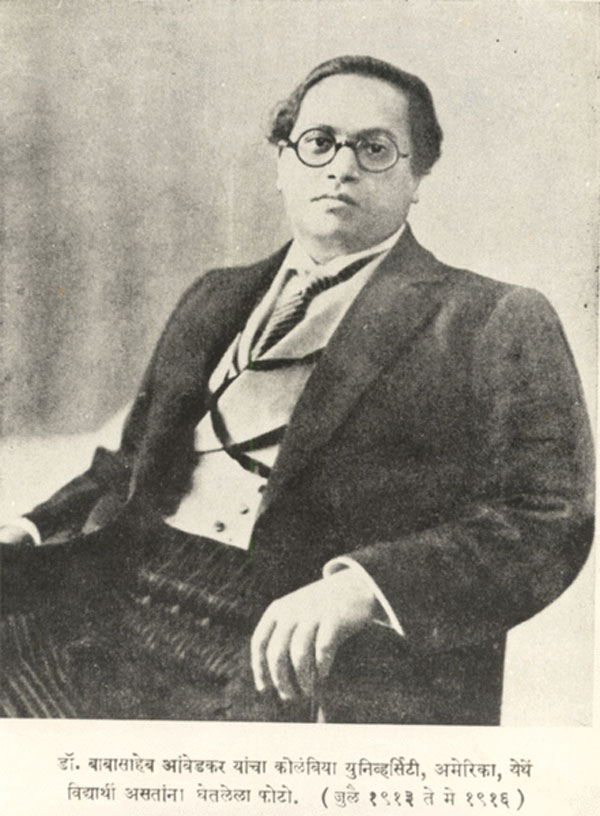
Dr. Ambedkar’s transformative journey began when he was awarded a scholarship at age twenty-two, by Maharaja Sayajirao Gaikwad, the erstwhile nationalist Ruler of Baroda to pursue higher education at Columbia University in New York in 1913. In America, Babasaheb experienced freedom and equality like never before. His interactions with his fellow students and professors as well as seemingly mundane interactions with ordinary Americans sowed the seeds of future self-respect, self-reliance, and his fight against the attitude of the marginalized community of helplessness and accepting their situation at that time as unalterable providence. Dr. Ambedkar wrote: ‘The best friends I have had in life were some of my classmates at Columbia and my great professors, John Dewey, James Shotwell, Edwin Seligman, and James Harvey Robinson.’” (Source: Columbia Alumni News, Dec. 19, 1930, page 12.)
After working hard for two long years he obtained his MA degree in 1915 for his thesis Ancient Indian Commerce. In 1916, he read a paper on Castes in India, their Mechanism, Genesis, and Development, before the anthropology seminar of Dr. Goldenweiser. He simultaneously worked on another thesis, National Dividend of India: A historic and analytical study which was accepted by Columbia University in June 1916. This thesis was published as the book titled: The Evolution of provisional finance in British India. This famous book became a companion to the members of the Indian legislative council and the central assembly at the time of budget discussions during the British regime. He completed his M.A. and Ph.D. in Economics and Sociology at Columbia University and later went on to earn a D.Sc. in Economics from the University of London. These achievements were possible due to his superhuman efforts. Babasaheb studied for 18 hours a day during his stay in America. At the same time, he saved money from his scholarship by subsisting on a cup of coffee, two muffins, and a single meat or fish dish costing him $1.10. A portion of the saved money was remitted back home to support his family. During his stay in New York, he purchased 2000 old books. Unfortunately, many were lost in their transit to India. These educational experiences in America not only broadened his horizons but also deepened his understanding of social issues and the struggle for civil rights.
During his time in America, Dr. Ambedkar had the opportunity to witness and engage with various social movements that advocated for equality and civil rights. He was exposed to the works of prominent African American leaders such as W.E.B. Du Bois and the ideas of the suffragette movement. He drew parallels between the discrimination faced by African Americans and the caste-based discrimination prevalent in India. He witnessed firsthand the fight for the principles of liberty, equality, and justice, during his time in America. Another American personality whose work influenced Dr. Ambedkar, was Booker T Washington, who was the president of the Tuskegee Institute and advocated for progress of Black people through education and entrepreneurship. Drawing upon the strategies employed by African American activists, after his return Dr. Ambedkar initiated peaceful protests, organized mass movements, and advocated for legal reforms to secure the rights of the oppressed Dalit community.
America’s influence on Dr. Ambedkar extended beyond social and political movements. It significantly impacted his philosophical outlook on life and social justice. He adopted the ideals of democracy, individual freedom, and egalitarianism from American thinkers such as Thomas Jefferson and John Dewey. The concept of “one person, one vote” resonated deeply with Dr. Ambedkar, who sought to empower the marginalized communities in India and ensure their representation in democratic processes.
Among Dr. Ambedkar’s many contributions to modern India was his instrumental role as the Chairman of the Drafting Committee of the Indian Constitution in 1947. His exposure to the American Constitution and its emphasis on civil liberties and equality influenced his vision for an inclusive and just society. Dr. Ambedkar incorporated several provisions in the Indian Constitution to safeguard the rights of the marginalized, including affirmative action policies, reservations for Scheduled Castes and Scheduled Tribes, and the abolition of untouchability.
Dr. Ambedkar’s legacy stands as a testament to the transformative power of cross-cultural exchanges on fertile minds and hearts. His enduring impact on anyone seeking the pursuit of a more equitable and inclusive world transcends the borders of India. A proposed Ambedkar statue as a part of a memorial is in the process of being built in the town of Accokeek, Maryland which will serve as a center-point for his legacy in the USA.
Recently we visited the Indian Pueblo Cultural Center in New Mexico near Albuquerque and perused the exhibition on the Ancient Puebloan culture and history. We learned about the massive destruction of the Native Americans by successive waves of colonizing nations of Spain, Mexico, and the United States. There was intentional genocide of people for their land and natural resources, presumed unintentional mass death by exposure to foreign pathogens brought by the colonizers, the exploitation of natives for labor, as well as destruction of their culture and religion by forced religious conversion. The story was sad and heart-wrenching.
However, the Pueblo Indians have survived and currently practice some of their original cultures passed down through successive generations from oral traditions. They now practice Catholicism as a fusion of Roman Catholicism and native rituals. On the contrary, any remnant of the pre-Islamic culture in the Middle East1 or the Pre-Christian European Religions2 has been almost completely destroyed. There are no practitioners of the indigenous Arabian polytheism or ancient Semitic religions. Very few, if any, practitioners of Mandaeism, Manichaeism, or Zoroastrianism exist. Zoroastrianism practitioners called Parsis exist in India and have prospered (One of the largest business houses in India – the Tata family is Parsi.). Pre-Christian European religions like Norse Forn Sidr, Druidism, and Roman polytheism, among others, have been completely wiped out, except for some fringe elements of the society.
In India, the onslaught of Islam for nearly two thousand years led to extensive conversion and destruction of places of culture and worship. India got partitioned into Islamic Pakistan, Islamic Bangladesh, and secular majority Hindu India. Most major places of worship of Hindus in northern India were destroyed by the religiously intolerant invaders, resulting in such an intergenerational psychological trauma that the Hindus have built very few grand religious structures even after independence in 1947. The geographic extent of Hinduism, which once extended from modern Afghanistan to Indonesia3, is now confined to mainly India and sprinkling of diaspora throughout the world. The hundred years of British colonization of India did not see extensive conversion or destruction. The British colonizers committed innumerable atrocities in India. Well-known are the three million preventable deaths during the Bengal famine of 19434, stealing nearly a trillion dollars’ worth of material wealth5 and destroying the ancient Hindu educational system6. But they were benign compared to the other colonizers like the Belgians in Congo, the Spaniards in Central and South America, as well as the Portuguese in Goa, Angola, and Mozambique. The Macaulay education system destroyed the Hindu educational system resulting in self-doubting generations of Hindus who, till now, seek validation from the west for every aspect of life. Still, the destruction was not as complete. I can speak, read, and write in my ancestral language Marathi. However, India would have been in a far worse situation if Spain or Portugal had ruled India. I quake with tribulation when I read about the actions of the Spaniards in South America and Central America, as well as the Portuguese in the Indian state of Goa and Angola. I am thankful to have still my Hindu name and access to the philosophical treasure trove of ancient Hindu wisdom.
We cannot change the painful history of oppressed groups, but we can work to protect ourselves in the future. The people following these ancient traditions must come together and support each other. There is a sizeable silent number of good people in this world who are outside these traditions but are good humans. If they become aware of their numbers and strength, these people can pressure their governments to form a bulwark against current and future onslaught against the ancient traditions. While waiting on the bench near the exit, I overheard angry murmurs from the visiting group of young adults in the museum from other states and some from other countries expressing the need to do something for the oppressed people. I smiled with hope in my heart for our collective future.
One organization attempting to unite ancient traditions is the International Center of Cultural Studies. https://www.iccsglobal.org
Featured image is A picture from the exhibit “Pivot Skateboard Desk Art Exhibit- celebrating rapid transition between traditional and say-day life of Native Americans.”
Many immigrant Hindus including me have stood outside US consulates in India hoping for the approval of their student Visa and consider it a heart-wrenching experience. After I started graduate school in the US, my life drastically changed. Instead of living in an upper-middle-class family household with servants in Mumbai, I was scavenging used furniture from student housing dumpsters, selecting kitchenware from donated items in church basements, and transporting secondhand mattresses to my apartment from the donation place by carrying it on top of our heads with three other friends. This was my introduction to the American Dream. However, this was a tremendous improvement compared to my cultural ancestors who came to the United States before me.
Beginning in the 17th century, Indians were brought to the American colonies as servants by members of the East India Company. There were also some East Indian slaves in the United States during the American colonial era. The Naturalization Act of 1790 made Asians ineligible for citizenship, and the associated rights.
In 1913, the Alien Land Act of California prevented non-citizens from owning land. However, Asian immigrants got around the system by having their Anglo friends or their U.S.-born children legally own the land that they worked on. But since Hindus were not permitted to bring women from India, procreation within the culture was not possible. In some states, laws even made it illegal for Indian men to marry white women. However, it was legal for “brown” races to mix. Hence, many Indian men married Hispanic women.
All the discrimination ultimately culminated into large-scale violence. On Wednesday, September 4, 1907, a mob of more than 500 white men attacked the 250 Hindu (predominantly Sikh) lumber mill workers in Bellingham, Washington. As you know, occasional individual violence sadly persists to date.
The contribution of expatriate Hindus in America towards India’s freedom struggle is immense but not well-known, neither in India nor in the US. Great revolutionaries like Vishnu Ganesh Pingle, Kartar Singh Sarabha, and many other Hindus who returned to the US tried to incite revolt among the Indian troops of the British Army, as well as start an armed revolution. They learned to shoot guns and manufacture explosive devices in the US. Their Ghadir Party, initially called the Pacific Coast Hindustan Association, was formed on July 15th, 1913, in San Francisco to support India’s freedom struggle. Many such heroes sacrificed their young lives in this struggle.
On the educational front, Anandibai Joshi is believed to be the first Hindu woman to set foot on American soil, arriving in New York in June of 1883 at the age of 19. She graduated with an M.D. from the Women’s Medical College of Pennsylvania on March 11, 1886. This tradition continues with American Universities now (2021) having 24,813 Indians at the undergraduate level, 90,333 in graduate programs, and 2,238 in non-degree courses.
One of the first major discussions of Hinduism in the United States was Swami Vivekananda’s (B.A. in Fine Arts) address to the World’s Parliament of Religions in Chicago in 1893. In 1902 Swami Rama Tirtha (Master’s Degree in Mathematics) visited the US for about two years lecturing on the philosophy of Vedanta. In 1920 Paramahansa Yogananda (B.A. in Arts) came and settled in the US. These great philosophic geniuses had a secular education in addition to their mastery of the Hindu ancient wisdom, which made them effective communicators to western audiences. On June 4, 2013, Satguru Bodhinatha Veylanswami became the first Hindu monk and only the third Hindu in history to deliver the opening prayer before the US House of Representatives. I was fortunate to be a witness to that historic event in the visitors’ gallery on that day.
The Vedanta Society was responsible for building the earliest temples in 1905 in San Francisco, but they were not considered formal temples. The earliest traditional Mandir (temple) in the United States is Shiva Murugan Temple in Concord, California, also known as Palanisamy Temple, and was built in 1957.
In the political arena, the first Hindu Sikh Congressman Dalip Singh Saund was elected in 1955. We now have two Congressmen who are declared Hindus, and multiple politicians including the current Vice President raised in a Hindu household.
Finally, the Immigration and Nationality Services (INS) Act of 1965 signed by Lyndon Johnson was passed. This opened the doors to Hindu immigrants who wished to work and start families in the United States. One of those, yours truly, arrived in Cedar Rapids, Iowa via JFK Airport New York on August 3rd, 1993 with an Indian medical degree, $500 in hard currency, and bright starry eyes at the age of 23 years. Today there are approximately four million Hindu Americans who make up 1.2% of the U.S. population. Their impact is felt when you step into a doctor’s clinic/hospital, enter an engineering department of any top-ranked University, stay in a motel, or buy a Dunkin’ Donuts coffee. What you may not know is the slowly increasing number of Hindus in the armed forces, including my son, increasing charitable contribution in innumerable local communities, as well as the massive amount of volunteering and charitable contribution of Hindus in response to the Covid crisis.
In 2016 the Diwali forever stamp was launched by USPS to commemorate the joyous Hindu festival of Deepavali celebrating the victory of good over evil.
The philosophy of opportunity and the generous hearts of Americans has allowed Hindus to contribute to their betterment and the betterment of all Americans as well as lead a life according to the eternal Hindu principle of Vasudhaiva Kutumbakam — the whole creation is a family.
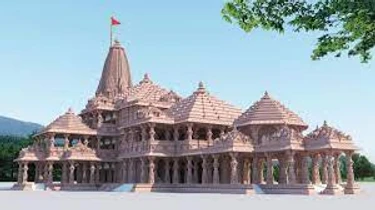
It is seldom that an event occurs in the history of a civilization which is a culmination of centuries of struggles, sacrifices of hundreds of thousands of people, and perseverance of belief in a system of law and order. On August 5th, 2020 the foundation stone was laid for the project to rebuild Lord Rama’s birthplace temple in Ayodhya, India.
Lord Rama is believed by Hindus to be the 7th Avatar of the Divine (personified as Vishnu — the Sustainer in Hindu belief system). Hindus believe that whenever the balance between the good and evil is disturbed in the favor of evil, Divinity takes a tangible form called an Avatar, and appears on Earth to destroy the evil and restore the balance.
Lord Rama was born around 5000 BC, precisely January 10, 5114 BC, a date derived based on the position of astronomical objects recorded in the epic Ramayan which describes the saga of his life. He is called Purushottam (foremost among humans) due to his qualities as an ideal son, husband, and king. His obedience to his father, his quest to rescue his wife kidnapped by the evil Ravana, his destruction of Ravana and the liberation of the people, and his ultimate sacrifice to abandon his beloved pregnant wife for maintaining the moral fiber of his kingdom, is the story which has inspired Hindus, and even non-Hindus, who have read the story over thousands of years. His designation as a ‘human being’ brings him closer to us ordinary humans, such that each one of us can aspire to inculcate some of his qualities in our daily existence.
The temple at the site of his birth, which was in existence since time immemorable, was destroyed by Mir Baqi Tashkandi, a general of the invading Uzbek King Babur, a descendant of Genghis Khan. This was not an isolated incident, as hundreds of thousands of temples have been destroyed by religious fanatic Mughal rulers in India prior to the British takeover. The destructive activities were recorded with relish in their memoirs. On my last visit to New Delhi, it pained me to see easily recognizable pieces of the destroyed original Hindu temples in the so-called architectural marvels constructed by the invaders. The Lord Rama birth site, being one of the very sacred places for Hindus, had a total of 77 attempts made over centuries to reclaim it at the cost of hundreds of thousands of lives of warriors and holy men, as well as ordinary men, women, and children.
After the British left India, the former unbroken India was partitioned into Islamic Republic of Pakistan, Islamic Republic of Bangladesh, and Secular Republic of India, which does not have a state religion. After independence in 1947, Hindu organizations petitioned to the Indian judicial system that Lord Rama’s birthplace, which was called ‘dispute land’ and was off-limits to the public, be handed over for reconstruction of a grand temple consistent with its historical and religious significance. The movement to reclaim Lord Rama’s birthplace united all Hindus, regardless of innumerable divisions in the overall Hindu society. The Indian judicial system took a long time in this case due to political and antisocial interference. Finally, on November 9th, 2019, after the presentation of extensive archeological evidence, the Supreme Court of India ordered the 2.77 acres to be handed over to a trust to build the temple. The trust of the Hindu people in the judiciary system is something to reckon. It took 72 years post-independence for a site of immense Hindu religious significance, which was forcefully taken nearly 500 years ago, to be regained by the due process of law.
The history of Hindus is rife with instances where due to their internal divisions, they could not put up a united front against the invading hordes, resulting in destruction of culture and forceful religious conversion of the locals into the faith of the invaders. Today, we Americans are now the most divided in living history. We need to find the common core values which make us all American and bring those to the forefront while putting our differences behind us. Our enemies are bleeding us to death with a thousand cuts, and we are not realizing their significance. Poisonous false propaganda is being infused, which is making fellow Americans hate each other with a ferocity previously reserved only for the vilest enemy. We need to unite soon before it is too late. As Benjamin Franklin rightly said, “We must, indeed, all hang together, or most assuredly, we shall all hang separately.”
There are times when the future of an entire dream of independence of an oppressed people rested on the mettle and sacrifice of few people. Few are fortunate to offer themselves as Ahuti (sacrificial offering) in these rare auspicious times in the yajna (sacrificial fire). One such momentous Ahuti was Baji Prabhu Deshpande (1615–1660) and his group of 300 Mavle soldiers.
In the 17th century, then-contemporary India was ruled by foreign Muslim rulers who subjected the local Hindu populace to great atrocities and coerced conversion practices using brutal force and money. .Massive destruction of Hindu temples took place during these times, and mass conversion occurred of Hindus to Islam. Like a beam of light piercing these dark times was born King Shivaji, a son of local Chieftain whose intellect, cunning, and noble character inspired men of all faiths and varied strata of society to come together under the swallow-tailed Bhagwa flag (saffron flag) which represented the flames of sidewards turned sacrificial fire, and successfully resist the onslaught of foreign subjugation. His inspiration attracted extraordinary men or maybe turned ordinary men into extraordinary, who sacrificed everything for the noble cause.
One of these extraordinary men was Baji Prabhu Deshpande. Baji was initially employed by a small-time enemy chieftain, who King Shivaji defeated. Shivaji was greatly impressed by this man’s valor and explained to him his life’s mission of freedom for the people from the oppressive foreign rulers, persuading Baji Prabhu to join his army. Baji Prabhu devoted himself to the common cause of Swarajya (self-rule). In 1660, Shivaji was trapped in the mountain Fort of Panhala by the Abyssinian general, Siddi Johar, who worked for Adil Shahi, the ruler of Persian origin in southern India. Multiple attempts by Shivaji’s men were made to break the four-month-long siege of the fort but did not succeed. As rations were getting exhausted, a daring plan was hatched to leave the fort from a hidden exit at night, breach the encirclement and escape from Fort Panhala to Fort Vishalgad, at a distance of 65 km. Fort Vishalgad was also surrounded by the enemy’s army but was the closest secure stronghold. The journey took 20 hours by foot over mountains and valleys. Shivaji’s look-alike servant Shiva Kashid dressed up as Shivaji and got down from the Fort with few soldiers, and fled in the direction opposite of Fort Vishalgad, knowing very well that they will be captured and put to death after being recognized. However, this sacrifice and the resultant distraction and disarray allowed Shivaji, Baji Prabhu, and 600 of their men to escape in the opposite direction towards Vishalgad, after fighting and breaking through the ring of encirclement.
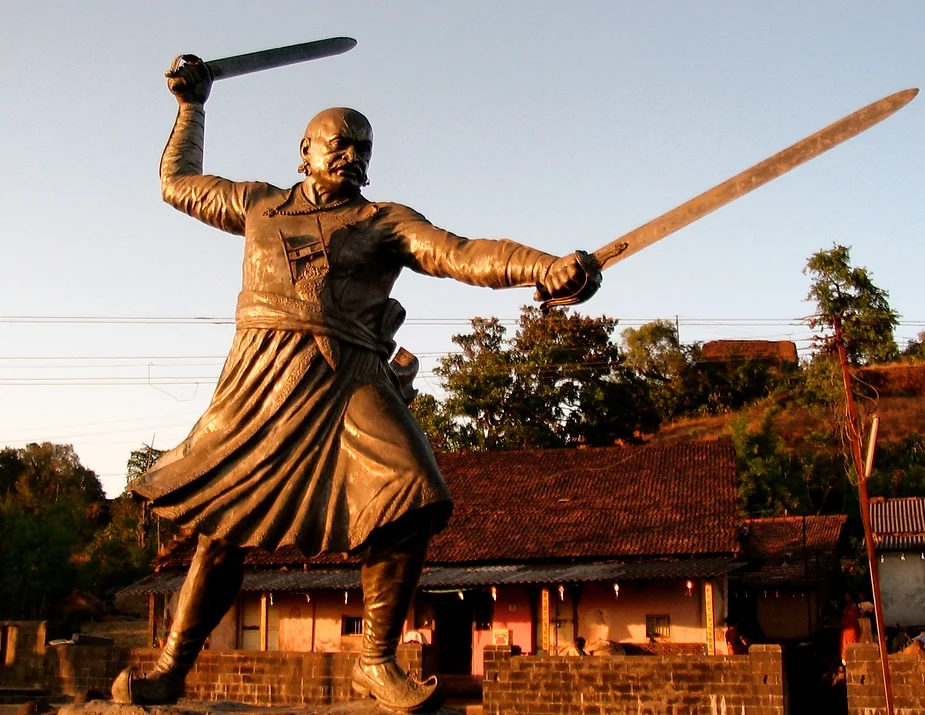
It was a full moon night of July 13th, 1660, with torrential rain, as Shivaji and the soldiers hurried on the mountainous rock-striven path, crossing flooded streams. The party hurried, knowing that they were only a few hours ahead of the enemy. Siddhi Johar realized that he had been fooled by the look-alike decoy and sent his son-in-law Siddi Masud with a vast army of close to ten-thousand soldiers chasing after Shivaji in the direction of Vishalgad. Baji Prabhu saw the flickering light of the torches of Siddi Masud’s army following them, who were gaining on them, being freshly rested while Shivaji’s men were tired from fighting while breaking the encirclement. As they approached Ghodkhind (Ghod-horse, Khind-mountainous pass) a very narrow pass through the mountains about 10 km from their destination, which was the only way to Fort Vishalgad, Baji Prabhu said to Shivaji, “Please take half of the people with you and continue towards Vishalgad, while myself and 300 others will hold back the enemy till you reach safety”. The 300 men with Shivaji were needed to attempt and break the siege of Fort Vishalgad and enter it. Shivaji could see from the number of flickering torches that the chasing army was in thousands and refused to let Baji stay behind. Baji realizing that if Shivaji was killed or captured, the dream of independence would be shattered. He uttered the famous sentence, “Even if hundred thousand die, the savior of a hundred thousand should be saved.” He begged Shivaji to go to Fort Vishalgad and continue with the dream of establishing Swarajya (self-rule) for all the people of the land. Baji requested Shivaji to fire 5 cannon shots, indicating that he had reached the safety of Vishalgad. With a heavy heart, Shivaji departed knowing the fate of these soldiers. Baji Prabhu arranged his soldiers along the extremely narrow path, which was the only way through which the enemy could follow Shivaji. With 50 people flanking the pass and multiple rows of men extending from the wider entrance leading to the narrowest portion, he positioned himself with dand pattas (gauntlet swords) in each hand. Shivaji’s soldiers were the Mavles, who were mostly agriculturists, many of them part-time farmers/soldiers, having families back in the villages. I cannot imagine what must be going through their mind as they faced the onslaught of professional soldiers from the Adil Shahi army, fully aware that they will not be returning to their families and farms. The Siddhis were Abyssinian soldiers. Many brought as slaves but given military ranks after proving their skills. The fact that they rose to such prominence in Adil Shah’s army indicated the fearsomeness of the Siddhis. With the huge mismatch in numbers, facing such an enemy gives us a glimpse of dedication to the cause of freedom. Baji Prabhu and his men held the pass for 11–12 hours. By the time the next afternoon arrived, only 40–50 of the original 300 were left. Baji Prabhu was grievously injured, but no enemy soldier could pass him and his fearsome skill at dand patta. Siddhi Masud observed Baji from the nearby hillock and summoned an Englishman accompanying his troops with a long musket gun. He ordered the Englishman to shoot Baji, as that was the only way anybody could get past him. It is said that the Englishman was looking for an area on his body to shoot so that he would know he hit his target, but Baji’s body was so covered in wounds that there was no clear area on his chest or head.
The long gun musket shot Baji in the chest, and he collapsed. As the surrounding soldiers tried to drag him to safety and cover, Baji said, “I cannot let a single enemy pass through, till I hear Shivaji has reached safety. Death has to wait till the king has reached safety.” Baji knew that Shivaji had to fight the encirclement surrounding Vishalgad, before entering the fort and reaching safety. Baji stood up and again walked to the narrow pass and continued fighting. Suddenly, the cannon fires started in the distance. As the fifth cannon shot was heard, Baji collapsed and closed his eyes, smiling. The blood of Baji and 300 heroes consecrated the soil of Ghodkhind, which from that day onwards has been renamed as Paavan Khind (Sacred Pass).
A forty-five-year-old man fighting for 11–12 hours after walking overnight indicates the strength, stamina, and devotion of Baji Prabhu to the cause of freedom and self-rule. . The sacrifice of the other 300 unknown soldiers most likely unknown to even their own descendants is profound. These ordinary soldiers surrounded and supported great heroes and individually did not get accolades or glory just like the particles of mortar holding together great rocks that form the citadel of freedom that protects us.