Category: Observations on life


  • Leading a Purposeful Life

    Leading a Purposeful Life

    On U.S. college campuses, suicide remains one of the leading causes of death among young adults which is a stark reminder of a deepening crisis of meaning and mental health. Past-year suicide attempt rates among international students have been reported in the range of roughly 1.2% to 2.2%, compared with estimates of 0.1% to 1.6% among domestic students. Moreover, an estimated 5 to 10 percent of college students each year report experiencing suicidal ideation. Some studies also indicate that within South Asian communities, certain subgroups such as Asian Indian students may report higher levels of suicidal thoughts than other South Asian ethnic groups. These sobering figures underscore not only the urgency of improving mental health support, but also the deeper need to help students cultivate connection, resilience, and a sense of purpose during one of the most formative periods of their lives.

    Having spent years listening to great teachers of Hindu philosophy and having navigated what I believe has been more than my fair share of adversity, I have tried to distill the following thoughts as guidance for my younger friends who may be feeling lost or low at this moment.

    The Gift of Human Birth

    According to Hindu philosophy, a human being arrives in this world after countless births as lower life forms, where existence was governed purely by instinct. The mere fact of being born human, an entity endowed with free will, is itself a rare gift. Through that free will, a person has the capacity to elevate themselves to the highest possible state of being, or, by their own choices, to consign themselves to unnecessary suffering.

    The Vedas describe four Purusharthas or the four goals of human life: Dharma, Artha, Kama, and Moksha. Lower animals, guided entirely by instinct, seek only Artha and Kama. Artha, in its broadest sense, encompasses security and survival. Kama refers to pleasure derived through the senses.

    Sadly, many human beings live in much the same way, spending the bulk of their lives chasing safety and sensory gratification. And yet every human being holds within them a higher potential. Only a few consciously choose to pursue Dharma, the timeless principles that sustain and uphold life, creating harmony within the individual, within society, within the world, and throughout the cosmos. Fewer still aspire to the highest goal of human existence: Moksha which is the realization of the Divine Self.

    Hindu Dharma does not reject enjoyment. It does not ask you to renounce Artha or Kama. It says: pursue them, but pursue them within the framework of Dharma, while keeping the ultimate aim of Moksha in view. Live a life rooted in Dharma so that each day, however modestly, you are moving toward Moksha.

    If life were a game of bowling, hitting a strike would represent Moksha. The bumpers along the lane would represent Dharmic principles, the guardrails that keep you on course. The polishing and drying of the ball, along with whatever pre-shot ritual a bowler performs, represent Artha and Kama. All the elaborate preparation and showmanship may impress onlookers, but it counts for nothing if you throw a gutter ball. Skilled players, of course, have internalized awareness of the gutters and rarely need the bumpers. Their discipline has become second nature.

    A purposeful life, therefore, is a life lived in Dharma.

    D.H.A.R.M.A.

    • D — Do your duty (svadharma) sincerely at whatever stage of life you find yourself.
    • H — Honor truth and self-discipline.
    • A — Act without attachment to outcomes.
    • R — Respect all beings with compassion.
    • M — Meditate and reflect regularly.
    • A — Align with righteousness in thought, word, and deed.

    Everyone’s path toward Dharma will be different, shaped by the actions of one’s past — whether of this lifetime or, as Hindu philosophy holds, of previous ones. The effects of those past actions manifest in this life as gifts and as limitations: the circumstances of your birth, the innate abilities you carry, the particular challenges you face. All of these together determine the unique contours of your Dharmic journey.

    To live a Dharmic life is to use your unique gifts and limitations to make consistent contributions toward a worthy cause you genuinely believe in, while intentionally building a life you love.

    In the beginning, the most meaningful cause may simply be yourself — and that is perfectly fine. You grow from there. You begin climbing the steps of evolution. For highly evolved spiritual beings, there are no discrete steps, only a gentle and continuous slope. For them, the boundary between self and other has dissolved entirely. Everyone, ultimately, is the Self.

    How to Actually Live a Purposeful Life

    1. Write Your Own Obituary

    The most clarifying first step I know is to write your own obituary. What do you want to be remembered for? What would you want people to say when they speak at your funeral? “He was…” “She was…” Sit with those answers. They will give you a starting point — however rough — for your sense of purpose.

    2. Understand That Purpose Evolves

    Your sense of purpose will not remain static — nor should it. In youth, it tends to center on personal growth: exploring creativity, mastering a skill, building strong and healthy relationships. As you mature, that purpose naturally expands, becoming less about self-development and more about meaningful contribution and service.

    Andrew Carnegie was, early in his life, one of the most ruthlessly profit-driven industrialists in America. Later, he underwent a profound philosophical transformation and ultimately gave away more than ninety percent of his fortune. Warren Buffett, too, built immense wealth through Berkshire Hathaway, yet has pledged to donate over ninety-nine percent of it.

    Purpose can evolve. Allow yours to.

    3. Know Yourself

    What are your genuine strengths? Your blind spots? Your triggers and recurring patterns? Which qualities support the vision of life you have begun to form? What energizes you rather than depleting you? What are your impediments — and be honest here, because you can only address deficits once you have truly acknowledged them.

    Arnold Schwarzenegger reinvented himself multiple times — leaving a small Austrian village to become a world-class bodybuilder, then patiently mastering English to pursue a Hollywood career despite repeated rejection and later entering public service as Governor of California. David Goggins transformed himself from being overweight and directionless into a Navy SEAL, ultramarathon runner, and motivational speaker. Neither man was born exceptional. Both were relentless in self-knowledge and self-correction.

    Self-knowledge fuels growth. There is simply no substitute for it.

    4. Identify What Energizes You

    Ask yourself: what problems do I feel genuinely drawn to solve? The answer will reflect your core values. Values such as integrity, compassion, curiosity, freedom, excellence, family, and justice are not abstract ideals — they are the bedrock upon which meaningful action is built. Write down your top five. Then ask: what specific activities give expression to these values?

    Eknathji Ranade, inspired by Dr. Hedgewar and Swami Vivekananda, devoted his entire life to the spiritual and national regeneration of India. His guiding values were selfless service, organizational rigor, and spiritual nationalism. He led the construction of the Vivekananda Rock Memorial and founded the Vivekananda Kendra — a nationwide organization dedicated to rural development, education, and character-building.

    Bryan Stevenson founded the Equal Justice Initiative, which provides legal representation to people who have been wrongly convicted, unjustly sentenced, or denied adequate legal defense. His core conviction is that “each of us is more than the worst thing we have ever done.” He has helped overturn wrongful convictions and challenged excessive sentencing, including life imprisonment for children.

    What aligns with your core values endures — sustained by conviction, not by circumstance.

    5. Set Meaningful, Aligned Goals

    Break your purpose down into three horizons:

    • Long-term direction (e.g., “I want to help people heal.”)
    • Medium-term goals (e.g., “Train in counseling.”)
    • Short-term habits (e.g., “Read twenty minutes daily on psychology.”)

    Thomas Edison developed the practical incandescent light bulb through methodical trial and error, testing over six thousand materials before arriving at a workable filament. He famously noted that he had not failed — he had simply discovered ten thousand approaches that did not work. Verghese Kurien transformed India’s dairy industry not through any single dramatic breakthrough, but through decades of steady, grassroots effort. By organizing small farmers in Anand, Gujarat into cooperatives and building reliable systems for milk collection, processing, and distribution, he quietly catalyzed the White Revolution, making India one of the world’s largest milk producers.

    Steady, consistent effort outweighs sudden giant leaps on the road to anything worth doing.

    6. Build Supportive Relationships

    Deliberately cultivate relationships that support the purpose you have identified. Seek mentors. Nurture friendships with people who challenge you in constructive ways. Seek out communities that share your values. The right people will amplify your efforts in ways you cannot anticipate. Stay away from chronic naysayers.

    Narendra Modi found early guidance and community within the Rashtriya Swayamsevak Sangh, where mentors shaped his discipline, his thinking, and his long-term vision. Steve Jobs co-founded Apple alongside Steve Wozniak, whose technical brilliance complemented Jobs’ design sensibility and commercial instinct. Mentors like Mike Markkula helped ground his ambition in business discipline.

    Accept people as they are, but understand that you, and only you, have the right to decide where each person belongs in your life, not where they wish to be placed. Ask yourself honestly: do the people around you enlarge you, or diminish you? And be prepared to accept that sometimes listening to the right person means acknowledging that you were wrong. That is among the most difficult things any of us can do.

    7. Cultivate Discipline and Resilience

    Unfortunate things have a way of arriving at the most inconvenient times. The best-laid plans fall apart. Any given day can simultaneously be the best of times and the worst of times. And even an ordinary life, free of tragedy and crisis, can become stagnant and dull if it is not directed toward something meaningful.

    Living with purpose requires:

    • Doing the hard thing when the easy path beckons.
    • Staying consistent when motivation has faded.
    • Recovering from setbacks without excessive self-reproach.
    • Saying no to distractions that are not aligned with your direction.

    Discipline protects purpose when motivation fades.

    I suffered a stroke two months before my planned retirement at fifty-one. The entire left side of my body was completely paralyzed. It has now been more than five years. Years of intensive work — motivating myself to exercise every single day, learning new recovery techniques, staying current with the latest research on stroke rehabilitation, all while managing the financial demands of daily life. And here is what I can tell you: I have not yet reached my maximum recovery. That moment will come only when I leave this body. I intend to keep fighting until then. Make every breath count.

    Resilience deepens purpose. Adversity, if you let it, will clarify what truly matters.

    8. Keep Evolving

    Periodically reassess your goals. A purposeful life is not a fixed blueprint — it is a living process. The destination may remain the same, but the path will need adjustment along the way.

    Leo Tolstoy achieved fame and wealth through War and Peace and Anna Karenina, yet by the late 1870s he was gripped by a profound existential crisis that left him questioning the very meaning of existence. He ultimately rejected materialism and devoted himself to a life of moral simplicity — a transformation that profoundly influenced Mahatma Gandhi. Emperor Ashoka began his reign as a conqueror of extraordinary brutality, including the devastating Kalinga War. Shattered by the suffering he had caused, he renounced violence and devoted the remainder of his reign to Buddhist principles of compassion and ethical governance.

    Growth is transformation. Do not be afraid of who you are becoming.

    9. Live in the Present

    Purpose is not only about some distant future. It is about how you show up today. Living in the present means giving your full attention to what Dharma demands of you right now — without being paralyzed by regret over the past or anxious about what lies ahead. Deep, wholehearted engagement in whatever you are doing right now transforms ordinary moments into meaningful ones. Constantly close the gap between who you are and who you aspire to be.

    Take the Controls

    My dear friends, if your life is like an airplane journey, then your childhood and early youth are the takeoff — and that phase is very nearly complete. The engines have roared. The runway is behind you. You are now rising toward cruising altitude. This is the phase where direction matters most.

    An airplane on autopilot will keep flying — but only toward whatever destination was programmed into it. If the coordinates are wrong, it will carry you confidently to the wrong place.

    Many people live exactly that way. They drift. They react. They follow the crowd. And then one day they wake up and wonder, “How on earth did I get here?”

    If you want your life to be purposeful, meaningful, and worthy of leaving a legacy, you must take the controls. Do not fly on autopilot.

    Be conscious of your direction. Be intentional with your choices. Be awake to your Dharma.

    Own today. Shape tomorrow. Become eternal.

    That is how you live a life of purpose.

  • Harmonizing Indian and American Values: Finding Common Ground

    Harmonizing Indian and American Values: Finding Common Ground

    This year I will be completing three decades of residing in this country. Very early during my stay here, I pondered the question ‘Who am I?’ This was not the Upanishadic question but geopolitical identity. This introspection about one’s identity and the clash of values between cultures is common to all immigrants, sometimes causing inter-generational strife within families. In this article, I have explored the core values that define both cultures and discuss the potential for convergence.

    American Values: The American ethos is founded upon the principles enshrined in the Declaration of Independence. While the concept of “Life, Liberty, and the pursuit of Happiness” forms the bedrock, let us delve deeper into how these values manifest in daily life.

    1. Individualism: Americans celebrate individuality, acknowledging the uniqueness and significance of each person. The freedom of expression is cherished, allowing individuals to pursue their passions, advocate for their beliefs, and engage in unconventional forms of self-expression. Some students take time off from school to travel for pleasure or service. People stand on street corners with boards declaring their preferred causes. Pro-life people can protest right across women’s health clinics. People put placards in front of their houses supporting or decrying various causes. This ethos is exemplified by notable figures such as Atticus Finch from the book, “To Kill a Mockingbird,” who stood up for justice against societal norms.

    2. Independence and Self-reliance: Self-reliance and personal freedom are highly prized in American society. From an early age, individuals are encouraged to take responsibility for their lives, pursue education, and establish independence. This emphasis on autonomy extends to various aspects, such as leaving the parental home, financing one’s education, and making independent life choices. Many do weddings with their own money. Similarly, the parents also can live their own life after the children have moved out of the house. Seniors live independently in their single-family homes or retirement homes. They can live with people their age and have activities that are fun for them. They are not dependent on their children. The families still support each other when there is a need, including getting together for important events.

    3. Equality: American values are rooted in the principle that all individuals are created equal. This notion of equality permeates society, emphasizing equal treatment, opportunities, and legal rights for all. While the reality may fall short at times, there is a continuous push to address historical injustices and ensure equal treatment for marginalized groups.

    4. Volunteerism and Charity: Americans are known for their philanthropy and willingness to help others. Charitable giving, even among those with limited means, is a testament to the spirit of compassion and generosity. Individuals from all walks of life engage in volunteer work, supporting causes and positively impacting their communities. I have seen children from extremely financially limited families donate their winter clothes towards winter coat drives at their school. A janitor in the school where we were conducting the Hindu Swayamsevak Sangh Annual subsidized book fair, donated $60 so that children in the school could buy books. He said, “Now that I am in a better financial situation, I want to help children get books, which were not accessible to me due to poverty in my childhood”.  People from the lowest salary range do automatic deductions for charity.

    5. Acceptance: American society embraces diversity and exhibits a remarkable capacity for acceptance. The adoption of children from different backgrounds, fostering care, and the ease with which individuals from varied races and cultures are integrated into families exemplify the inclusive nature of American values. Widowed and divorced people, even those with children, get remarried relatively easily with no social stigma.

    6. Well-rounded Education: Education in the United States emphasizes holistic development, promoting not only academic excellence but also the exploration of artistic, athletic, and volunteering pursuits. American values recognize the importance of a comprehensive education that nurtures diverse talents and interests.

    There are many other values like privacy, directness in speech, etc.

    Indian Values: India with its deep-rooted philosophies and spiritual traditions, holds a distinct set of values that foster interconnectedness and collective well-being. Let us explore some prominent Indian values and their practical applications.

    1. Satya (Truthfulness): Indian culture emphasizes the importance of truthfulness in our interactions with others and in our self-reflection. By aligning our thoughts, words, and actions with truth, we establish harmony within ourselves and with the world around us.

    2. Brahmacharya (Self-control): Self-control over the senses and intelligent engagement with the world form the essence of Brahmacharya. This value encourages individuals to master their senses and maintain a balanced relationship with the external world, preventing impulsive reactions and fostering inner harmony.

    3. Ahimsa (Non-violence): Ahimsa, the principle of non-violence, extends beyond refraining from physical harm. It encompasses compassion, love, and kindness towards all living beings, fostering a sense of interconnectedness and peaceful coexistence.

    4. Duty and Sacrifice: Indian culture emphasizes the fulfillment of duties as a fundamental aspect of leading a righteous life. The concept of sacrificing personal desires for the betterment of the family and society underscores the importance of collective welfare over individual interests.

    5. Spiritual Connectedness: Indian values instill a sense of spirituality in all aspects of life. Recognizing the divinity in every life form and the interconnectedness of all existence inspires reverence for nature, environmental conservation, and a holistic view of the world. The principle of milking nature not slaughtering it is ingrained in all Indians.

    There are many other well-known values like the sanctity of books, the spiritual value of food, the exalted status of teachers (Guru), and hospitality to unannounced guests, etc.

    The Americans of Indian origin who are born and raised in the USA have the unique opportunity to blend their ancestral inheritance of the universal Indian outlook with the modern American values they grow up with.  Similarly, the immigrant Indians can realize that it is easier to practice their ancestral values in this country due to the relative life of ease, compared to the struggles for daily subsistence before they came here. They should also be appreciative of American values, given that those form the basis of the opportunity they have obtained to succeed in America.

    Indian philosophies advocate that every being has divinity in it. Further, every lifeform is characterized by constant action at the gross or microcellular level. These actions can be volitional or preset by nature. As, human beings we have the ability to determine most of our actions. By assessing any volitional actions against the litmus test of the values and considering the question, “Would the divine me agree to do this?”, we can navigate potential conflicts and promote values that resonate with our inner selves. By striving for harmony between Indian and American values, we can contribute to the well-being of ourselves and those around us, fostering a society that cherishes diversity, embraces compassion, and promotes the greater good.

  • Detachment

    Detachment

    My new year’s resolution for 2020 is to internalize the principle of Detachment. Over the years, as we meander along the path of self-realization, attachment to people, material things, achievements, and identity have been a heavy ball and chain around our minds, preventing it from soaring the skies.

    We raise our children and think that we put years of sacrifice, effort, and delay our gratifications to make them what we think they should be. Then one day they find themselves. Suddenly, the parents who were the main characters of the film become supporting actors and eventually get delegated to a cameo appearance. To our chagrin, some new characters who were completely unknown a few years ago take over the main roles- boyfriends, girlfriends, husbands, wives, etc. As I prepare myself to experience these changes, I am reminded of the huge pipelines that carry water over great distances. While the water is in the pipe, the pipe protects the water from contamination. The pipe gives the water its shape. The pipe thinks that the water belongs to it. The moment the water leaves the pipe it becomes true to its own nature and fate. The pipe no longer controls the water. All that is left behind is the dampness, which in our case are memories. Two trains travel in one direction for a segment of their journey. For a time being, their speeds are the same, and the passengers in both trains feel that there is no motion. This is the time we spend together as a family. Eventually, the tracks diverge. Detachment is very difficult to practice. It was extremely difficult for me to drop my first born to college. I dread the time when my daughters will get married.

    We are also attached to our successes and more attached to our failures. It is somewhat easier to let go of our successes. We get used to them. We cling to our failures desperately. Failures are in careers, businesses, and the worse ones are in relationships. Instead of letting go, we cover them with a shroud of newer attachments. The zombies of past attachment surface at the most inopportune times in our thoughts. The attachment to financial success and fame sometimes forces people to continuously maintain a defensive shield around them, and every interpersonal interaction is looked upon as a possible exploitative situation. I once met a somewhat famous Indian comedy actor who had immigrated to UK and was working temporarily in a grocery store in London. I was told by his friend that he found this situation very liberating rather than humiliating. It is embarrassing to remember when I was considering reordering new business cards which would mention the recent honorary degree I received in my field of practice, when my original cards are still sitting unused, given that my field of medicine does not involve much in-person interaction with patients.

    Detachment does not mean abandoning your duties. Many self-proclaimed ‘detached’ aspiring Hindu renunciates (future monks) have been sent back by their Gurus to fulfill their roles and duties which they had abandoned. Running away from your duties is cowardice. Being detached while fulfilling your role in the material world is the sign of spiritual awakening. First step is to become aware of your attachment in specific situations. Then, try to think as a neutral observer and separate your preconceived notions from hard facts. Afterwards, imagine the attachment-inducing object as a butterfly fluttering its wings emerging out of the cocoon. Smile and let it fly. If this fails, try again next time. One day we will all be free.

    picture credit – Andreas Wohlfahrt

  • Memories of Rashtriya Swayamsevak Sangh (RSS) shakha during my formative years in India

    Memories of Rashtriya Swayamsevak Sangh (RSS) shakha during my formative years in India

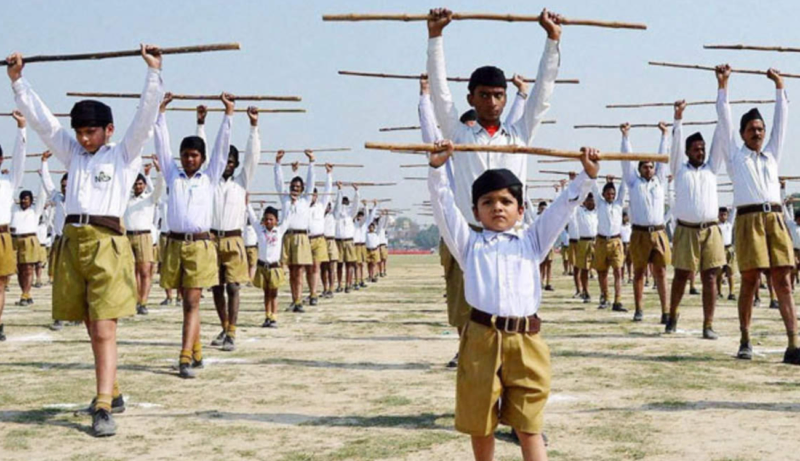
    I vividly remember the time in my childhood when at an age of 10–12 years, my friends and I used to play cricket after school, in the space around my building in the suburb of Mumbai called Mulund East. A bunch of us barefoot kids running around in the limited space with an old cricket bat, a rubber ball, and instead of wooden stumps, chalk drawn stumps on the wall. At about 5:45 PM Mr. Sudhakar Kale, one of our neighbors who we affectionately called ‘kaka’ (Kale pronounced as Kaa-Ley, kaka is uncle), used to round us up and take us to a playground of the neighborhood school for something he called RSS (short form-Sangh) shakha (daily gathering of youth and adult RSS cadets- RSS cadets are only males. Women have a parallel but separate organization also called Rashtriya Sevika Samiti Short form Samiti). The first stop, however, was in the slums along the way where in one of the shanty houses was stored the flagpole which was a 6–7 ft, half inch diameter aluminum pipe, a wrought iron tripod for the pole, and the saffron colored bifurcated silken Hindu flag in a silken bag. All the boys wanted to carry them, and so we used to argue as to who carried the items yesterday, and whose turn it was to do it today. Kaka taught us the proper protocol for conducting the gathering, with proper intonation of vocalizing the commands. After reciting some scriptures and verses describing our ancient culture and great heroes, performing yoga and sun salutations, we finally got to do the activity for which we had all come. GAMES. The games were traditional Indian games, as well as many innovative games which could all be played without any equipment. The games inculcated physical strength, team building, leadership skills, as well as principle of taking everybody together so that even the weakest person was not left behind and was everybody’s responsibility. The playing of the games cut across any barriers that may have been in the minds of kids from affluent households and the slum dwellers. All the kids hollered patriotic slogans and played with great fervor. Some days even adults joined the games. The stratification of superior and inferior based on so many factors in the outside world was demolished or at least suspended during the games. Each of the boys learnt to tell stories from the books we borrowed from kaka and sang patriotic songs. The Shakha lasted for exactly one hour and ended with the prayer to Mother India. The last slogan was Bharat Mata ki Jai — Victory to Mother India.

    As few months passed, we got familiarized to the routine and each boy got to lead conducting some of the games, leading the scripture recital, leading the ending prayer. After a year or so when the boy became familiar with the running of the shakha, a boy was selected to lead the whole shakha every day. That boy was called Mukhya shikshak (lead teacher). My memory as a Mukhya shikshak was a day when few local dignitaries were visiting our shakha and socializing in small groups in the periphery of the playing kids. As the time for ending came, I give the command for everyone to form lines. All the dignitaries immediately stopped talking and promptly joined the different lines. I was amazed that the local dignitaries who were very influential and affluent people would listen the command given by a 13-year-old boy and promptly fell in line. Their discipline and shakha upbringing were manifest and the respect they showed to my role, etched in my brain that day.

    My lifelong sense of responsibility and sense of duty was molded in those early teen age years. In the monsoon season, the attendance in open air Shakha fell, sometimes to zero, since the parents feared that we could catch cold if we got wet playing in the rain, and the wet playground was unfit to play. However, the guiding principle was that the Shakha should go on every day come rain or sunshine. I seriously took this message to heart and regardless of weather, every day I would take the flag, the flagpole and tripod to the playground, hoist the flag under the shelter of a tiny overhang of the building roof, say the prayer, bring the flag down and return it to the place of storage. This sense of discipline, and adherence to performing my duty inculcated during my formative years have helped me during my higher education as well as throughout my career as an adult. Another learning from that time was toughness towards minor discomfort. During storytelling, we were told story of hero Karna when he was a student of Sage Parashuram. The old sage had taken a nap using Karna’s thigh as a pillow. At that time an insect started biting and digging into Karna’s thigh. But he did not move his leg to not to disturb the sleep of his guru. The guru woke up when his head got soaked with the blood from Karna’s thigh. During the ending prayers we all stood in position of attention with the greatest stillness. During the prayer there were lots of mosquitoes on the playground who used to feast on our hands and legs, as we used to wear shorts and half sleeve shirts. But the protocol was not to move during the prayer. The boys used to discuss that if Karna did not move when the insect was boring a hole in his thigh, we should resist the urge to scratch the itch. After the prayer we would break into frenzy of scratching.

    I always remembered the attention and respect to the uniform. Most of the kids who came to shakha were from extremely poor families. Due to rough and tumble games and overall rough usage the uniform would often get torn. But the discipline was never to wear tattered uniform. The boys learned to sew, so that they could repair the tears by themselves without waiting for their mothers, prior to coming to shakha.

    An issue on which Hindus are often maligned is caste-based discrimination. This discrimination is illegal in India, and has decreased in major parts of the country. My view on this topic is based on what I experienced as a child. In the months before the Ganpati puja festival, the local Sanghachalak (regional president) of our area, used to invite boys of few shakhas in my town to his house, where he used to teach us how to memorize and recite a scripture called Ganpati Atharvashirsha. Every day he would make us repeat the complicated Sanskrit scripture again and again patiently correcting us till we achieved the clarity of pronunciation and intonation identical to him, who was a very orthodox brahmin with secular as well as religious education. He was a wealthy real estate developer by profession. As I have described previously most of the shakha attending boys were from the very low socioeconomic class, living in the slums and spoke a language which was crude. But after his training of two to three months all of us learnt to recite the scripture like Sanskrit scholars. During the Ganpati puja our group of 8 to 10 boys (those who persisted through the rigorous training) were invited to the houses of all the local RSS functionaries, most or all in those days in my area were Brahmins, every evening where we sat cross legged in their living room in front of the Ganpati alter and recited the scripture. After recitation the hosts used to give us a glass of milk with fruits and other holy offerings., as well as a dakshina (traditional token fee to priest) of ₹1.25. Afterwards they also touched our feet to express reverence. We used to get excited by thinking of cricket equipment we could buy from pooling our money. As I grew older, I realized the significance of the so-called high caste brahmin family heads bowing in front of the kids from so called lower castes and social economic strata, because at that moment we were performing the actions of brahmins priests. Our Karma (action) elevated us, then and there- not in the next life or even distant future. That phenomenon caused a greatest impact on my psyche more than any stories by social reformers or lectures of great orators.

    The RSS uniform pants in my youth were an unusual looking khaki short which derisively called as Khaki knicker. People used to make fun of RSS workers and their khaki knickers which on the other hand was held in great reverence by us and as an object of pride. I am sure that at an age when teenage boys are very sensitive to their appearance, a shakha attending boy who had the fortitude to wear that khaki knicker despite teasing by other boys and snickering from neighborhood girls, that boy in future can withstand any peer pressure and firmly take a principled yet unpopular stand in his life.

    On some days neighborhood boys whose parents disapproved of our RSS as well as and the boys who did not like the discipline in the shakha would sit on the parapet around the playground and make rude comments. Kale kaka told us to ignore them although I had an urge and capability to thrash them. However, when the games used to start, those boys wanted to come and join the games. We used to tell them that they could play the games only if they attend the whole shakha. Over time many relented, joined and grew up to be dedicated cadres.

    Our teacher Sudhakar Kale was my neighbor, living on the same floor of my building. Whenever somebody in the building had a leaky faucet, broken toilet flush or other minor repairs, they would either borrow his tools or request him to help and repair. He immediately helped without expecting or getting any compensation, not even a cup of tea. However, the biggest impact on me was when someone died in the building, he was the person who made arrangement for the funeral. In India we do not have formal funeral homes and the family must take care of the ritual for the deceased person’s body with the help of the seniors in the family who hopefully had knowledge of the process. However, the family members are usually rendered helpless by grief, and other relatives may be travelling from far. Kale kaka would be the first person to arrive and essentially organize this extremely sensitive ritual giving support to the grieving family. Although as a child I must have not realized it’s significance, my remembrance as an adult, indicates that it must have impacted my mind at that time. Unfortunately, this special person passed away from lung cancer at a relatively early age.

    I remember a day when I was visiting Kale kaka’s home to pick up copy of a book. We heard strains of a patriotic song coming from the neighboring building. One of the boys in that building was singing in his house a patriotic song at the top of his voice. Usually, he used to sing bawdy Bollywood songs, but attending shakha changed his repertoire to include patriotic songs. Kaka just smiled. I was beside myself laughing.

    Besides important life lessons, I also learned skills like how to cross the railway tracks picking my bicycle with one arm and stabilizing the front wheel so that I could safely cross without tripping, carrying a small note book to jot down notes, contacts and to do lists (days before cell-phones), and picking trash from our playground everyday blown over from neighborhood buildings or dumped by unscrupulous passersby without complaining.

    I sincerely believe that attending RSS shakha in those formative years has helped my personal life, family life and professional career as well as aided me to become a socially conscious member of the American society.

    Featured image photo from from American Kahani

  • The evening of life (Vanaprasth-ashram)

    The evening of life (Vanaprasth-ashram)

    Late in the afternoon of life, as the shadows start getting longer, the mind starts contemplating the approaching evening of our life. Nowadays, due to the miracles of medicine, a healthy lifestyle, and a generous helping of good luck, our evenings are many times stretched long. This late afternoon-evening of life is the stage of life which the Hinduism calls Vanaprasth-ashram, the third stage of life.

    The first stage of life is living as a student and is called Brahmacharya-ashrama. The second householder stage, Gruhasta-ashram, describes being married with a family and being a sustainer of the society. The third stage is Vanaprasth-ashram, mentioned previously, where our children have hopefully settled and we have retired/retracted from active management of our household, profession, and material ambitions. Finally, for special people who devote themselves to seeking spiritual knowledge and abandoning material pursuits, irrespective of age, there is Sanyasa-ashram.

    I am currently transitioning into the Vanaprasth-ashram stage. Vanaprasth-ashram, in ancient times, literally meant handing over the household to your children and going outside (Vana = forest/garden, Prasth = to go). Going outside could be figurative or literal. Forest-living meant joining either a commune in the forest under the guidance of a spiritual teacher or going on a pilgrimage with no plan to return. In modern days, however, a retirement community is an option. Essentially, Vanaprasth-ashram is getting out of the hair of the descendants and seeking spiritual pursuits.

    All of us want to transit into the vanaprastha-ashram on our own terms, with careful preparation and deliberate, masterful strides. We do not want to be dragged, screaming, and protesting by the merciless time. We have spent our entire childhood and young adulthood deliberately, or accidentally, preparing for adulthood through studying, learning occupational skills, gaining societal behavior skills, and playing games in order to have the best possible adult life. Similarly, in our adult life we should dedicate a portion of our time to preparing for our retirement age, which for many of us may be quite long.

    In preparing for retirement, I read innumerable articles on a successful retirement. Many of these dealt with various financial aspects, including investing, smart spending, taxes, and charitable giving. There were other articles suggesting that I take up a part-time job for a social company or pursue intellectual stimulation. Some articles suggested picking up a new hobby or restarting an old hobby that had to be abandoned previously. These aspects are very well covered in many articles and websites.

    However, none of these sources included the most foundational preparation for retirement that is described by the Hindu word Vyragya, which roughly translates to non-attachment. This means not forming new material attachments (things and people), decreasing previous attachments (detachment), and letting go of ego, feelings of superiority or inferiority, revenge, fear, paranoia, and things that are beyond human control. This internal mental reset is a gradual process. We do not need to immediately leave our domicile and get rid of our possessions. We just have to start being constantly aware of the transitory (non-permanent) nature of people and things and be ready to surrender them at the appropriate time, including our life. Non-attachment also does not mean ‘not caring.’ In contrast, successful non-attachment involves unlimited caring. Instead of caring for just your family, friends, etc., your care circle increases drastically to include the entire creation. In this non-attached state, you put your best effort without any attachment to results.

    The practice of non-attachment is a gradual upwards staircase, with each step slippery and sloping upwards. Climbing is difficult, but it is possible by practicing the ability to enjoy without attachment those very things that were previously enjoyed with attachment.

    This means evolving from an inward-facing (self-centered) life to an outward-facing (universe-centered) life and outlook. This outward-facing lifestyle is best facilitated by getting involved in service activities. Not just a sporadic volunteer hour but actual, meaningful involvement in the entire process of the service project. Developing a service-centered mindset by participating in service projects, even when you are working, makes the transition to larger participation later in life easier. Performing service without any expectation of living or even posthumous gains is the true practice of non-attachment.

    By practicing non-attachment to our best possible ability, and also being present as a home safe haven if our own or others need us, our own evening will stay brightly lit for ourselves and the people around us, who may be starting their day in the earlier hours. Being a Hindu, I also know that successful non-attachment will make my next morning (rebirth) better.

    Featured image Photo by Derek Torsani on Unsplash

  • Freedom

    Freedom

    There is an ancient fable. One day a caravan of 100 camels and drivers is traveling in the desert. The caravan loses its way and ends up outside a village at dusk. The travelers put up their tents and start tying the camels. They realize that 99 camels have their ropes and stakes, but one of the stakes and rope set is missing. The drivers are worried that if not tied down, the camel will walk away and may join other herds, get lost, or worse. The camel drivers start looking around and go to a hut on the border of the village. An old man living in the hut does not have any rope or a stake to spare. However, he suggests that the drivers should tie the camel with an imaginary rope, given that darkness has fallen, and the camel will not see the rope. The camel drivers laugh at him and think that the old man is senile. But since they cannot find any rope or stakes, they reluctantly go back to the 100th camel and act as if they are tying a rope around his neck and hammering the stake into the ground. Afterwards, they pat the camel, order him to sit down and throw some fodder in front of him. The next morning, they get up and untie all the camels who then start walking, but the 100th camel tied with the imaginary rope does not stand up. Since there was no rope to untie, the camel drivers thought that the camel would be able to just get up and walk. However, after multiple attempts and even beating the camel with a stick, the 100th camel does not get up. Finally, the camel drivers perform the entire action of untying the imaginary rope and digging out the stake from the sand. The camel then immediately gets up and starts walking.

    Each of us has the 100th camel within us. If we think and make a mental list, there are many imaginary fears and nooses which we have hung around our neck, some by our own hands, while others are created and hung by smart merchants of everything. Depending on where we were born, to whom, among which group of people, at what particular time, and who we meet on our way through life, we allow ourselves to be tied down by these imaginary chains, borders, limitations, and expectations, which prevent us from exploring our true potential and experiencing the true freedom.

    A word of caution, though! Freedom of one sometimes ends up as bondage of another. Someone’s freedom of expression from the majority can end up muzzling the expression of the minority (by thought, color, orientation, origin and all other classifications), who experience fear of the effect of their own expression. Conversely, the unfettered freedom of the minority, which when taken over a limit, can also poke into the eyes of the majority. While these disruptive processes are sometimes needed, they should not be taken lightly.

    Similarly, complete freedom may not always be a good thing and sometimes may be very dangerous. A paper kite can only soar high in the sky only if it is tied to a string. As long as the string is long and gives the kite enough freedom, it can ride the winds of opportunities. But the moment the string breaks, the moral restraint or a bond of love breaks; after an ephemeral flight of freedom, the kite ends up in tatters on a branch of a tree or in a ditch.

    The last few weeks of isolation and furlough from employment have given me free time and freedom for the mind to explore and realize that freedom is good and enjoyable, as long as you have safe and voluntary confinement to return to when needed.